Demand Generation vs Lead Generation: The Real Difference (And Why You Need Both)
Let me ask you something.
Have you ever scrolled past an ad and thought, "Who even clicks on this?"
You probably ignored it because you had no idea what the product was, why you needed it, or why you should trust that brand. The ad just showed up out of nowhere, asking you to buy something.
That company made a classic mistake. They skipped demand generation and went straight for the sale.
And that's exactly what this blog is about.
By the time you finish reading, you'll understand the difference between demand generation and lead generation not just as textbook definitions, but in a way that actually changes how you think about marketing.
Let's Clear the Confusion
Most people, including experienced marketers, use these two terms as if they mean the same thing. They don't.-
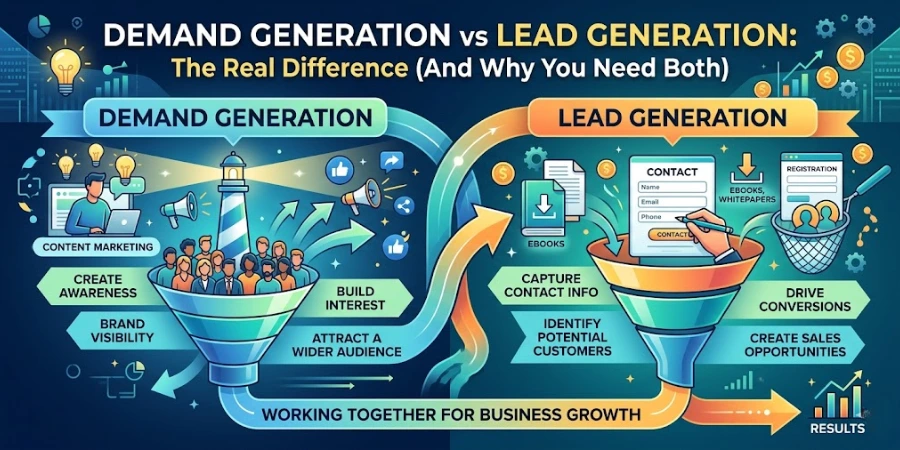
Demand Generation is about making people want something.
-
Lead Generation is about capturing the details of people who already want something.
You can't skip the first step and expect the second one to work. It's like proposing marriage on the first date. Technically possible. But almost always a disaster.
What is Demand Generation?
Demand generation is the process of building awareness, trust, and genuine interest in your product or service before you ever ask anyone to buy anything.Think about the last time you made a significant purchase. A course, a phone, a subscription service. Did you just randomly click "Buy Now" on something you'd never heard of?
No. You probably:
-
Watched a few YouTube videos about it
-
Read some reviews or blog posts
-
Followed someone on Instagram who talked about it
-
Heard a friend mention it
-
Googled it out of curiosity one random evening
Demand generation is the long game. It's patient. It educates first and sells later. It focuses on creating the kind of content and experience that makes someone think, "Okay, I get it now. I actually need this."
What Does Demand Generation Look Like in Practice?
Imagine you run a digital marketing institute in India. Here's what demand generation looks like for you:-
You post Instagram reels about how a 12th-grade student learned digital marketing and now earns ₹50,000 a month
-
You write blogs answering questions like "Is digital marketing a good career in India?"
-
You record YouTube videos explaining what SEO is, how Google Ads work, or what a social media manager actually does every day
-
You go live on Instagram to talk about the job market for digital marketers
-
You share student success stories, industry news, useful tips — all for free
You. Because you showed up consistently before they were even ready to buy.
That's the power of demand generation.
What is Lead Generation? (Not What Most People Think)
Lead generation is the process of collecting contact information, like name, email, phone number, and WhatsApp from people who have shown interest in what you offer.But here's the keyword: shown interest.
These aren't random people. These are people who already know who you are, understand what you do, and are curious enough to raise their hand and say, "Tell me more."
Lead generation is the moment someone:
-
Fill out a form for your free demo class
-
Download your free ebook on digital marketing careers
-
Registers for your webinar
-
Sends a WhatsApp message asking about your course fees
-
Clicks on your ad and lands on your contact page
What Does Lead Generation Look Like in Practice?
Going back to our digital marketing institute example:-
You run a Meta ad: "Join Our Free 1-Hour Demo Class Learn How to Earn with Digital Marketing"
-
You create a simple landing page with a form: Name, Email, Phone Number
-
You offer a free PDF: "Top 10 Digital Marketing Skills Employers Want in 2026"
-
You set up a WhatsApp link so interested students can contact you directly
-
You run Google Ads targeting people searching "best digital marketing course near me"

The Core Difference (Made Simple)
Here's the simplest way to understand the difference:Demand Generation = Making people want it
Lead Generation = Capturing the people who want it
| Demand Generation | Lead Generation | |
| Goal | Create awareness and interest | Collect contact information |
| Funnel Stage | Top of the funnel | Middle and bottom of the funnel |
| Approach | Educate and build trust | Convert and capture |
| Timeline | Long-term strategy | Short-term results |
| Examples | Blogs, videos, podcasts, reels | Forms, ads, landing pages, lead magnets |
| Metrics | Traffic, engagement, shares | Conversion rate, cost per lead, ROI |
Why Businesses Fail When They Skip Demand Generation
Here's a scenario that happens every single day:A small business owner decides to grow fast. They hire someone to run Facebook ads. They spent ₹20,000 in the first month. They get maybe 3 to 4 leads. The leads are cold, confused, or unresponsive. The owner calls it a failure and gives up on digital marketing entirely.
Sound familiar?
The problem wasn't the ads. The problem was that nobody had ever heard of that business before the ad appeared. There was no trust, no recognition, no warmth, just a stranger on the internet saying, "Buy my stuff."
People don't buy from strangers. They buy from people (and brands) they trust.
Without demand generation:
-
Your ads feel intrusive, not inviting
-
Your cost per lead is unnecessarily high
-
Your conversion rate stays painfully low
-
You keep spending money without understanding why it's not working
Why Lead Generation Alone Isn't Enough Either
Some businesses go the other direction. They focus purely on content. They post great blogs, make incredible videos, build a huge social following, but never ask anyone to take action. They never have a clear call-to-action, a landing page, or a system to capture leads.The result? Lots of fans, very few customers.
Demand without a capture system is like pouring water into a bucket with no bottom. All that effort, all that content, all that trust just goes to waste.
You need both pieces working together.

How Demand Generation and Lead Generation Work Together
Think of it as a journey, not a single event.Stage 1 Stranger: Someone has never heard of you. They're scrolling Instagram, watching YouTube, and googling questions.
Stage 2 Aware: They come across your content. A reel, a blog, a video. They find it helpful. They follow you, bookmark the article, and save the post.
Stage 3 Interested: They keep seeing your content. They binge your videos. They start to trust you. Now they're thinking about their problem and thinking about you as part of the solution.
Stage 4 Lead: They click your ad, fill out your form, download your ebook, or message you on WhatsApp. They want to know more.
Stage 5 Customer: You follow up, nurture the relationship, answer their questions, and they enrol, purchase, or sign up.
Demand Generation Strategies That Actually Work in 2026
1. Short-Form Video Content
Instagram reels, YouTube Shorts, and similar formats are among the most powerful demand generation tools right now. They're free to post, reach massive audiences, and build personal trust faster than almost anything else. If you can educate or entertain in 60 seconds, you're building demand every single day.2. Long-Form SEO Blogs
When someone types a question into Google, "how to become a digital marketer" or "what is performance marketing", and lands on your blog, that's demand generation happening organically. Good SEO content keeps working for you for months or years, bringing in warm traffic without paid spend.3. YouTube Tutorials
YouTube is the second-largest search engine in the world. Tutorial-style videos that genuinely teach something position you as an expert and naturally create interest in your paid offerings.4. Free Webinars and Live Sessions
Going live and teaching something valuable for free is one of the fastest ways to build trust at scale. People get to see you, hear you, and judge for themselves whether you know your stuff. That kind of real-time interaction creates demand like nothing else.5. Community Building
Building a Telegram group, WhatsApp community, or Discord server around your niche creates a tribe of engaged people who already like and trust you. When you announce a product or launch, they're already warm.Lead Generation Strategies That Convert in 2026
1. Paid Ads with Strong Targeting
Meta Ads and Google Ads are still the fastest way to generate leads if you're targeting the right people with the right message. The keyword there is right. Generic ads to cold audiences rarely work. Ads to warm audiences who've already engaged with your content? Much higher return.2. High-Converting Landing Pages
A landing page is a single-focus web page designed to do one thing: get a visitor to fill out a form. No distractions, no extra links, just a clear value proposition and a simple form. Every serious lead generation campaign needs one.3. Lead Magnets
A lead magnet is something valuable you give away for free in exchange for contact details. Think:-
A free ebook or guide
-
A free mini-course
-
A free checklist or template
-
A free demo or consultation
4. Retargeting Ads
Retargeting lets you show ads specifically to people who have already visited your website, watched your videos, or engaged with your social media. These people are far more likely to convert because they already know who you are. Retargeting ads typically cost less and convert better than cold traffic ads.5. Email Marketing and Follow-Ups
Most leads don't convert on the first contact. An email that educates, builds trust, and gently guides a lead toward a decision over 5, 7, or 10 emails is one of the highest-ROI activities in digital marketing.
Metrics You Should Actually Be Tracking
For Demand Generation:-
Website traffic (especially organic)
-
Time spent on the page
-
Video views and watch time
-
Social media engagement (saves, shares, comments)
-
Branded search volume (people Googling your name)
-
Number of leads generated
-
Cost per lead (CPL)
-
Lead-to-customer conversion rate
-
Return on ad spend (ROAS)
-
Lead quality score
A Common Mistake You Should Avoid Right Now
Many marketers and business owners treat these two as choices. As if you have to pick one.The smartest brands run both simultaneously. While their long-term content builds brand awareness and organic trust, their paid campaigns capture leads from people who are already warm. Both engines run at the same time, feeding each other.
Start with whatever you can manage, even one blog post a week, even one reel every few days and add paid lead generation once you have a foundation. Then watch how much better your ads perform when people already recognise your name.
Final Thoughts
Demand generation and lead generation are not rivals. They're two halves of the same strategy.Demand generation builds the audience. Lead generation monetises it.
If you're struggling with high ad costs and low conversions, invest more in demand generation. Build trust first. Educate your audience. Show up consistently before you ask for anything.
If you're creating great content but not growing your business, invest in lead generation. Add clear CTAs, build landing pages, run retargeting ads, collect emails, and follow up.
Do both, do them well, and do them consistently, that's how sustainable business growth actually works in 2026 and beyond.
If you want to gain in-depth knowledge, we also offer a Digital Marketing Course in Chandigarh, where you learn in-demand skills with practical training.