
Portfolio Mistakes That Stop Freelancers From Getting Clients (And How to Fix Them)
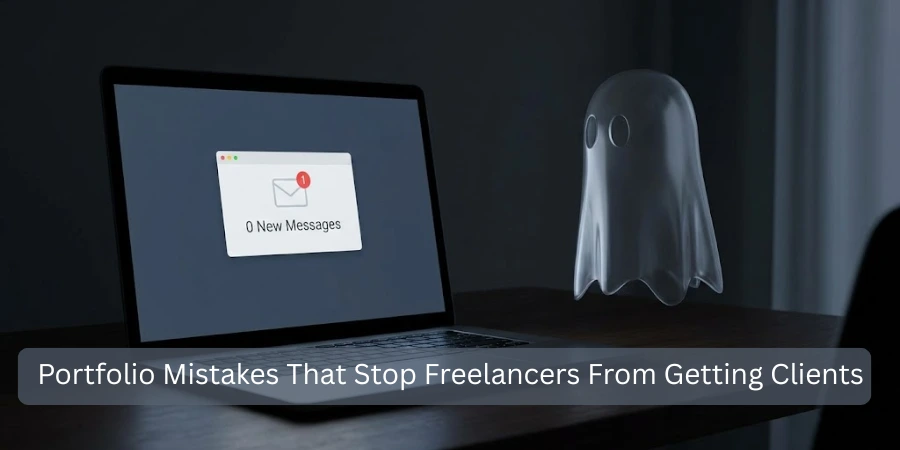
You have the skills. You completed the course. You even got a certificate.
But clients? Silence.
No messages. No inquiries. Just you refreshing your inbox, hoping something shows up.
Here's the hard truth: the problem is probably not your skill.
It's your portfolio.
Most freelancers think a portfolio just means "a place to put my work." But it's much more than that. Your portfolio is your online salesman working 24 hours a day, talking to clients even when you're asleep. If it's not convincing, clients leave. Without telling you why.
The good news? Every single mistake in a portfolio can be fixed. And once you fix them, clients start responding differently.
Let's go through all of the mistakes, the fixes, and exactly what a good portfolio looks like.
Why Your Portfolio Matters More Than Your Skills
Think about the last time you hired someone, maybe a plumber, a tailor, or a photographer. What did you do before saying yes?You looked at their past work. You checked reviews. You tried to figure out if they were trustworthy.
Your clients do the same thing.
No matter how talented you are, a client who doesn't know you will always go through your portfolio before deciding. It's the first impression, the trust signal, and the decision-making all in one place.
A strong portfolio does four things:
-
Shows proof — "I've done this before"
-
Builds trust — "This person knows what they're doing"
-
Saves time — Clients decide faster when your work speaks clearly
-
Gets you better clients — A good presentation attracts good-paying people

The 10 Portfolio Mistakes That Stop Freelancers From Getting Clients
Mistake 1: You're Trying to Do Everything
The problem: Your portfolio says you do graphic design, content writing, video editing, web development, and social media management.Clients see this and think: "This person doesn't really specialise in anything."
When someone is looking for a logo designer, they want a logo designer, not someone who also edits videos on the side.
The fix: Pick one service and one audience. Be specific.
Instead of: "I do digital marketing" Say: "I help small clothing brands get more customers through Instagram ads"
That second one speaks directly to a specific client. They immediately feel like you understand their world.
A clear niche doesn't shrink your market; it actually makes you more attractive to the right people.
Mistake 2: You're Showing Work Without Showing Results
The problem: You upload a beautiful Instagram post you designed. Or a website you built. Or an article you wrote.But there's no context. The client looks at it and thinks, "Okay, it looks nice. But did it actually do anything?"
Screenshots without results are decorations, not proof.
The fix: Add numbers wherever you can.
-
"Designed social media posts that helped grow this brand's Instagram from 500 to 8,000 followers in 4 months"
-
"Wrote product descriptions that increased conversions by 30%"
-
"Ran Google ads with a 4x return on spend"
Results turn your work from pretty pictures into actual proof.
Mistake 3: You Have No Real Projects to Show
The problem: You're new. You haven't had clients yet. So your portfolio is just certificates and course completion screenshots.Here's the thing: clients don't hire certificates. They hire people who can do the work.
The fix: Create your own projects right now. Today.
-
Graphic designer? Pick 5 random brands and redesign their social media posts.
-
Content writer? Write 3 blogs on topics in your niche and publish them.
-
Web developer? Build a website for an imaginary business or a local shop near you (for free, as practice).
-
Digital marketer? Run a small ₹500 test campaign and document the results.
Mistake 4: Your Portfolio Looks Messy
The problem: Everything is thrown together. Different fonts, random colours, no clear flow. The client doesn't know where to look first.A messy portfolio makes clients feel uncomfortable, even if the work inside is good. First impressions happen in seconds. If something looks disorganised, people assume the person is disorganised.
The fix: Keep it clean and simple.
-
Use one or two fonts throughout
-
Stick to 2-3 colours maximum
-
Put your best work at the top
-
Leave some space, not every pixel needs to be filled
-
Make it easy to read on a phone
Mistake 5: Clients Don't Know Who You Are
The problem: Your portfolio has work samples but nothing about you. No photo. No name. No story. Just floating work with no human behind it.People hire people, not anonymous collections of work.
The fix: Add a short, honest introduction. Three or four sentences are enough.
Tell them:
-
Who you are
-
What you do
-
Who you help
-
Why do you do it
That's it. Simple. Human. Real.
Mistake 6: Clients Don't Know What to Do Next
The problem: Client visits your portfolio. They like what they see. They scroll to the bottom and then... nothing. No button. No email. No next step.So they close the tab.
This happens more than you think.
The fix: Put a clear Call-To-Action (CTA) in at least three places: top, middle, and bottom of your portfolio.
Examples:
-
"Liked what you saw? Let's talk → [Book a free 15-minute call]"
-
"Ready to work together? Email me at yourname@gmail.com"
-
"Message me on Instagram: @yourhandle"
Mistake 7: No Testimonials or Social Proof
The problem: Anyone can say they're good at something. But when someone else says it, that's trust.No reviews, no testimonials, no proof that anyone has worked with you and been happy.
The fix: Collect testimonials actively. After every project, even a free one, ask for a short review.
"Hey, I'm glad you liked the work! Would you mind writing 2-3 lines about your experience working with me? I'd love to add it to my portfolio."
Most people say yes.
No clients yet? Ask a mentor, a course instructor, or someone you've helped informally. Even a LinkedIn recommendation counts.
Screenshot those messages. Add them to your portfolio. One real testimonial is worth more than ten certificates.
Mistake 8: You're Relying Only on Free Portfolio Sites
The problem: Behance, Canva, or a Google Drive folder. These work when you're starting out. But they scream "beginner" to experienced clients.It also gives you zero control. The platform can change, go down, or look cluttered.
The fix: Create your own space.
You don't need to spend a lot of money. A basic WordPress or Wix website costs less than ₹3,000 a year.
Having your own domain, like yourname.com, tells clients you're serious about your work. It's a small investment that changes how people see you immediately.
If you're not ready for a website yet, at least create a structured PDF portfolio or a clean Notion page. Something that you fully control.
Mistake 9: You're Writing Like a Technical Report
The problem: Your portfolio says things like: "Proficient in SEO meta-optimization, SERP visibility enhancement, and keyword density calibration."The client has no idea what that means. And confused clients don't hire.
The fix: Write in plain language. Focus on what the client gets, not on the technical words you know.
Instead of: "I implement on-page SEO strategies to improve organic search rankings"
Write: "I help your website show up on Google so more people find you without spending on ads"
Same skill. Completely different effect.
Write like you're explaining your work to a friend. Simple wins every time.
Mistake 10: Your Portfolio Is Stuck in the Past
The problem: Your portfolio still has that project from 2022 as the hero piece. Or the tools you listed are ones you haven't used in a year.An outdated portfolio tells clients you're not active. And inactive freelancers feel like a risk.
The fix: Set a reminder to update your portfolio every 3 months.
-
Remove your oldest or weakest work
-
Add your most recent and best project
-
Update your services if they've changed
-
Refresh your introduction if it feels old
How to Build a Portfolio That Actually Gets You Clients
Now that you know what not to do, here's what a good portfolio looks like in order.-
Strong Opening (Above the fold) Your name, what you do, who you help, and a clear CTA button. Someone should understand your value in 5 seconds.
-
Services Section List 1 to 3 specific services. Not ten. Be clear about what each service includes and who it's for.
-
Work Samples with Results: Show 3 to 6 of your best projects. For each one: what was the goal, what did you do, and what was the result?
-
Case Studies (If Possible) Pick one project and go deep. Walk the client through the problem, your approach, and the outcome. This builds enormous trust.
-
Testimonials: Even two or three genuine reviews change everything. Place them near your CTA.
-
About You: A short paragraph. Real, human, honest. Include a photo, yes, a real one.
-
Contact / CTA Easy-to-find email, booking link, or WhatsApp number. No hunting required.

Bonus Tips to Get More Clients as a Freelancer
A great portfolio is the foundation. But you also need to put it in front of the right people.Solve problems, don't just sell services. Clients aren't looking for "a graphic designer." They're looking for someone who can make their brand look more professional. Lead with the problem you solve.
Build a presence on LinkedIn or Instagram. You don't need thousands of followers. You need the right 200 people to see your work. Post regularly. Share what you know. Show your process.
Use content to attract clients. Share tips in your niche. Write about common mistakes. Show before-and-after work. Content builds trust with people who haven't even spoken to you yet.
Start on freelance platforms if you have no clients. Upwork and Fiverr are competitive, but they have real clients with real budgets. Start there, get reviews, and then use those reviews to attract direct clients.
Learn basic communication skills. A freelancer who responds clearly, sets expectations properly, and follows up professionally will almost always beat a more skilled freelancer who communicates poorly.
Offer a free audit or consultation. Before asking for money, give something. A free 15-minute call or a quick audit of someone's social media page costs you almost nothing but builds trust fast.
Stay consistent. Most freelancers quit too early. They send 10 outreach messages, get no replies, and give up. Freelancing success takes months, not weeks. Keep showing up.
Common Myths Freelancers Believe (That Are Holding Them Back)
"Making a portfolio is enough." A portfolio is step one. Without outreach, content, or visibility, no one will see it."Clients will find me on their own." They won't. Especially in the beginning. You have to go find them. Cold emails, LinkedIn messages, Fiverr gigs put yourself out there.
"Certificates will get me work." Certificates show that you completed a course. Clients want to see that you can do the work. Projects and results matter far more.
The Real Strategy: Skill + Portfolio + Outreach
Here's the simple formula:Skill → Portfolio → Outreach → Clients → Repeat
None of these steps works without the others.
You can be incredibly skilled, but if your portfolio is poor and you're not reaching out to anyone, nothing happens.
You can have a perfect portfolio, but if you have no skills to back it up, clients will leave after one project.
And if you have both, but you never reach out, you're still waiting.
All three need to work together.
Final Thoughts
A lot of freelancers spend months improving their skills, but never spend a single weekend fixing their portfolio.That's the gap.
Your portfolio is not just a collection of old work. It's your sales machine. It talks to clients when you're offline. It builds trust before you even have a conversation. It's often the single thing that separates a freelancer who gets clients regularly from one who's still waiting.
Go back to your portfolio today. Look at it with fresh eyes, or better, ask someone who doesn't know you to look at it. What do they understand? What confuses them? What's missing?
Fix one mistake this week. Then fix another.
And if you want to build your portfolio like a professional, with proper guidance, real projects, and client-ready skills, you can join our online digital marketing course at Digital Study School. If you are a student and want to gain proper knowledge in this high-demand industry, you can join our Digital Marketing Course after 12th.
Small improvements, done consistently, change everything.