Introduction
STEM stands for (Science, Technology, Engineering, and mathematics). In the rapidly evolving world of education, technology continues to reshape how we teach and learn. Among the most groundbreaking advancements is Augmented Reality (AR), a tool that brings interactive, immersive, and engaging educational experiences into classrooms and virtual learning environments alike. Particularly in STEM education, AR has revolutionized how students grasp complex topics by transforming abstract theories into tangible, real-world experiences.
This article explores the deepening impact of AR on STEM education and why platforms like Digital Study School are well-positioned to lead this transformation. We’ll also discuss the practical advantages of incorporating AR into online courses like the Online Digital Marketing Course and its counterpart offered on campus in Chandigarh.
What is Augmented Reality in Education?
Using gadgets like smartphones, tablets, AR glasses, or headsets, augmented reality imposes digital content—such as pictures, videos, simulations, and information—onto the physical world. AR acts as a link between theoretical understanding and experiential learning in educational contexts.
AR makes learning more interactive and contextual, which improves the real world, in contrast to Virtual Reality (VR), which immerses users in a fully virtual environment. AR makes learning more approachable and fun, whether it's through a virtual chemistry experiment or a rotating 3D model of the solar system in a science class.
Why STEM Education Needs a Revamp
STEM subjects are essential for the workforce of the future. They are the foundation for careers in tech, engineering, research, and innovation. However, STEM topics are often perceived as difficult, dull, or too abstract. Students struggle with concepts that are theoretical and not easily visualized—think quantum mechanics, calculus, or genetic engineering.
Traditional classroom methods, including textbooks and lectures, fail to cater to the needs of diverse learners. This is where AR steps in to fill the gap by adding a visual, practical, and interactive dimension to STEM education.
The Advantages of Augmented Reality in STEM Education
1. Improved Conceptual Understanding
AR provides 3D visualizations that make it easier to understand abstract STEM topics. For example:
- •
In Biology, students can explore the human circulatory system in 3D, following the flow of blood through arteries and veins.
- •
In Physics, learners can see real-time simulations of magnetic fields or Newtonian mechanics.
- •
In Mathematics, geometric figures and complex graphs can be visualized dynamically, improving comprehension.
2. Enhanced Student Engagement
AR captures students’ attention and sustains their interest by making learning fun. Rather than passively reading from a textbook, students interact with content in a way that resembles gaming or real-world exploration. This engagement improves retention and makes learning a more enjoyable experience.
3. Accessibility and Inclusion
AR helps level the playing field for all learners. It benefits students with learning disabilities by offering multisensory instruction—visual, auditory, and kinesthetic. It also allows remote learners, such as those enrolled in online platforms like Digital Study School, to enjoy interactive STEM experiences from the comfort of their home.
4. Safe Simulation of Risky Experiments
In subjects like chemistry or engineering, AR enables students to simulate hazardous experiments without real-world risks. This is especially useful for schools or online learning platforms that may not have access to expensive or dangerous laboratory equipment.
5. Real-World Application
The gap between education and practical application is closed by AR. For example, coding students can interact with UI/UX elements in a 3D environment, while engineering students can use AR to visualize blueprints and structures.
Use Cases of AR in STEM Classrooms
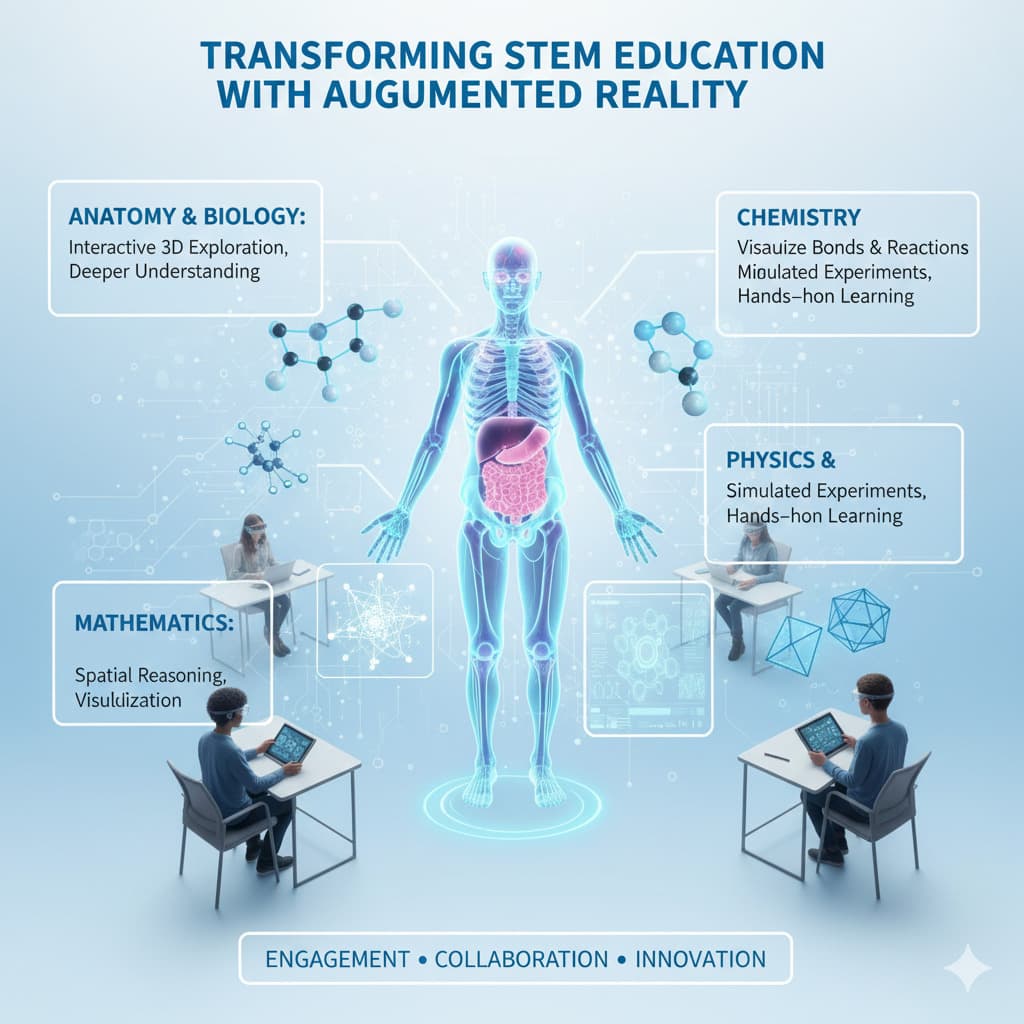
Biology: Exploring Anatomy
Instead of just reading about the human body, students can use AR apps to explore a full-scale virtual human anatomy. By clicking on each organ, they receive detailed information, animations, and real-time functions, making the learning process far more interactive.
Chemistry: Visualizing Molecules
Understanding molecular structure can be difficult through 2D images. AR allows students to see molecules in 3D, rotate them, and even simulate chemical reactions.
Physics: Experimenting With Forces
From gravity to electromagnetism, physics experiments can be performed virtually, giving students a clear visual understanding of the forces and interactions at play.
Math: Manipulating Shapes and Graphs
Students can manipulate geometric shapes and plot 3D graphs using AR tools, helping them comprehend abstract mathematical concepts with ease.
AR in Online Education: The Role of Digital Study School
While AR is often associated with physical classrooms, online learning platforms are increasingly integrating it to enhance remote education. Digital Study School is one such platform that recognizes the power of innovation in education.
Why Choose Digital Study School?
- •
Interactive Learning Modules The Online Digital Marketing Course includes dynamic content that simulates real-world marketing scenarios. While not AR in the traditional STEM sense, it uses similar concepts of interactivity and visualization to help learners understand digital tools, customer journeys, and analytics.
- •
Blended Learning Opportunities With a physical campus in Chandigarh, Digital Study School provides hands-on learning along with its online modules. This makes it easier to incorporate immersive tech like AR into both formats.
- •
Innovation-Driven Curriculum The platform is committed to innovation in teaching, which includes gamification, simulation, and AR-enhanced experiences. The learning process is more comprehensive since students engage with the material in addition to consuming it.
- •
Accessible Education for All Digital Study School promotes open learning, much like the philosophy behind Open Educational Resources (OER), which encourages inclusive, accessible, and cost-effective education.
The Future of AR in STEM and Beyond
As AR devices become more affordable and mobile technology continues to evolve, we can expect a wider adoption of AR in educational settings. Here’s what the future could hold:
1. Wider Curriculum Integration
Beyond STEM, AR will likely be used in history (e.g., exploring ancient civilizations), literature (e.g., visual storytelling), and arts (e.g., creating virtual sculptures).
2. Collaborative AR Learning
Multiple students can engage with a single AR module simultaneously, promoting teamwork and collaborative problem-solving—key skills in STEM careers.
3. Data-Driven Feedback
AR tools can track student interactions and provide educators with data on learning patterns. This data can be used to personalize education and improve learning outcomes.
4. AI and AR Integration
Combining AR with Artificial Intelligence can create intelligent tutors and dynamic content that adapts in real time to the learner’s performance.
Challenges to AR Implementation
While AR offers numerous benefits, it’s not without challenges:
- •
Cost of Equipment: Not all schools can afford AR-compatible devices.
- •
Teacher Training: Instructors need to be trained to effectively integrate AR into their curriculum.
- •
Digital Divide: Some students may lack access to stable internet or devices, especially in remote areas.
However, platforms like Digital Study School are actively working to make high-quality, interactive education more affordable and accessible.
How Digital Study School is Addressing These Challenges
Digital Study School addresses the barriers to immersive learning through
- •
Affordable Online Courses The online digital marketing course is competitively priced and accessible from anywhere.
- •
Location-Based Support For learners in Chandigarh and surrounding regions, the on-ground digital marketing course provides a blend of tech-enabled and classroom learning.
- •
Resource-Rich Blog and Materials The Digital Study School Blog features articles, updates, and free resources that keep students and educators informed about trends like AR in education.
Final Thoughts
Augmented Reality is not just a fancy add-on; it’s a powerful educational tool that enhances STEM learning by making abstract concepts visible, interactive, and memorable. From high school classrooms to professional training environments, AR is transforming how knowledge is shared and absorbed.
Digital Study School is embracing this change by integrating innovative, interactive methods into its curriculum. Whether you're taking an online digital marketing course or attending classes in Chandigarh, you're gaining access to future-forward education that equips you with real-world skills.
As AR becomes more mainstream, it will play a key role in shaping the next generation of scientists, engineers, analysts, and creators. The institutions that adopt it early—like Digital Study School—will lead the way in transforming learning from passive to powerful.
Ready to experience the future of education? Explore the range of immersive, career-focused programs at Digital Study School, and join a community of learners who are building skills that matter in the digital age.