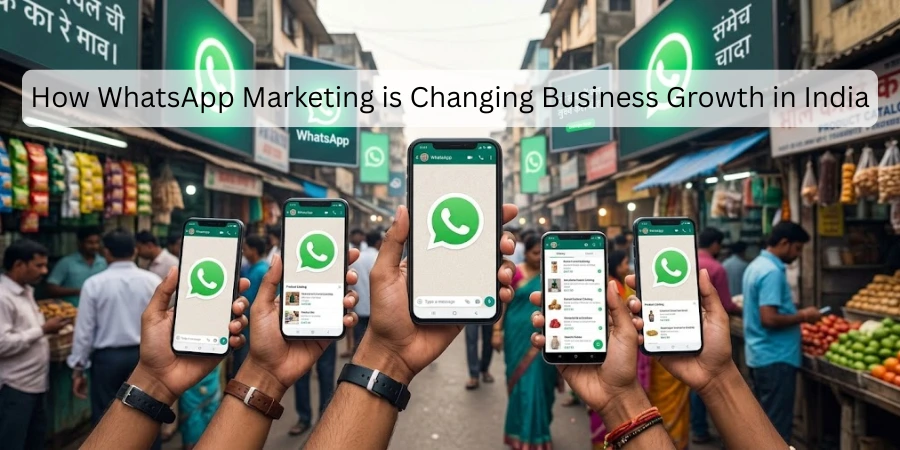
How WhatsApp Marketing is Changing Business Growth in India
A customer sees your ad on Instagram, taps through, fills a form on your website, and then nothing happens for two days. By the time someone from the sales team calls back, the customer has already spoken to two competitors or simply moved on. This is one of the most common and quietly expensive problems in Indian business marketing: enquiries arrive faster than businesses can respond to them.
WhatsApp marketing exists to close that gap. Instead of a form sitting in a spreadsheet, a customer's message lands on a screen someone is already checking throughout the day. But a WhatsApp message is not automatically a lead, and a conversation is not automatically a sale. What happens after the first message how a business qualifies interest, follows up, and moves someone from curiosity to purchase is what actually decides whether WhatsApp marketing works.
This guide breaks down how WhatsApp marketing functions for Indian businesses: the funnel, the tools, real examples, costs, KPIs, and the mistakes that quietly waste enquiries.
Quick Answer: What Is WhatsApp Marketing?
WhatsApp marketing is the use of WhatsApp's business tools WhatsApp Business, the WhatsApp Business Platform, catalogues, and approved business messaging to attract, qualify, convert and retain customers through direct conversation. It includes lead generation (often via Click-to-WhatsApp Ads), sales conversations, customer support and retention, not just promotional broadcasts, and it works best when businesses respect consent and platform policies.In this guide:
-
What Is WhatsApp Marketing?
-
Why WhatsApp Marketing Matters for Businesses in India
-
How WhatsApp Marketing Works
-
WhatsApp Marketing Funnel for Businesses
-
WhatsApp Business App vs WhatsApp Business Platform
-
10 WhatsApp Marketing Strategies That Work for Businesses
-
Click-to-WhatsApp Ads for Lead Generation
-
WhatsApp Marketing Examples for Indian Businesses
-
WhatsApp Marketing Strategies for Small Businesses
-
WhatsApp Marketing for Different Business Types
-
WhatsApp Marketing vs Email vs SMS
-
WhatsApp Marketing Costs in India
-
WhatsApp Marketing KPIs to Track
-
How to Create a WhatsApp Marketing Campaign
-
WhatsApp Marketing Message Examples
-
WhatsApp Marketing and Automation
-
WhatsApp Marketing Rules, Consent and Privacy
-
Common WhatsApp Marketing Mistakes
-
Is WhatsApp Marketing Worth It in 2026?
-
WhatsApp Marketing Checklist
-
Frequently Asked Questions
What Is WhatsApp Marketing?
WhatsApp marketing is often reduced to "sending promotional messages," but that's only a small part of it. In practice, WhatsApp does several different jobs inside a business, and it helps to separate them:-
Customer support — answering questions about an order, service or complaint
-
Sales conversations — helping someone choose a product, plan or service one-to-one
-
Lead generation — capturing and qualifying enquiries from ads, social media or a website
-
Promotional messaging — sending offers or updates to people who've opted in
-
Retention — staying in touch after a purchase so customers return or refer others
Why WhatsApp Marketing Matters for Businesses in India
India has a strong culture of chat-based communication, and most people already use WhatsApp for everyday interactions, from tracking a delivery to asking a tailor about an order. A few practical reasons this matters for businesses:-
Customers can ask questions before deciding, instead of abandoning a one-directional form
-
Businesses can respond conversationally, in the customer's own language
-
Appointment-based businesses salons, clinics, tutors can confirm bookings and send reminders in a channel people actually check
-
E-commerce brands can answer sizing, product or delivery questions without losing the customer mid-purchase
-
Sales teams can qualify budget, requirements, or timeline before spending time on a call
-
Service businesses can follow up on quotes without repeated calls customers may not pick up
How WhatsApp Marketing Works
At its core, WhatsApp marketing follows a simple sequence:Traffic → WhatsApp entry point → Conversation → Qualification → Recommendation → Follow-up → Conversion → Retention
-
Traffic is anyone who becomes aware of the business through an ad, a post, a Google search or a referral
-
The entry point turns that awareness into a message, a button, a link, a QR code or an ad click
-
The conversation is where the relationship actually begins
-
Qualification means understanding what the person wants and whether you can serve them
-
Recommendation matches them to the right product, service or plan
-
Follow-up keeps things moving when a decision isn't immediate
-
Conversion is the purchase, booking, enquiry or sign-up
-
Retention is what happens after support, updates and future purchases
WhatsApp Marketing Funnel for Businesses
Stage 1: Attract — Awareness comes from Instagram, Facebook, Google, SEO, a website, QR codes, or offline promotions. Match the entry point to the traffic source: a QR code at a salon counter, a website button for organic visitors, a direct ad link for paid campaigns.Stage 2: Start Conversation — A clear WhatsApp CTA, "Chat with us on WhatsApp" rather than a generic "Contact us" sets expectations. A pre-filled wa.me link removes friction from the first message.
Stage 3: Qualify — Before recommending anything, ask a few relevant questions: budget, location, timeline or requirements. This is the step most businesses skip in a rush to sell.
Stage 4: Recommend — Match the customer's answers to a specific product, service or property, rather than sending a generic price list.
Stage 5: Follow Up — Most customers don't decide on the first conversation. A structured, permission-based check-in after a few days often matters more than the first message.
Stage 6: Convert — This looks different by business: a purchase, booking, appointment, demo or signed enquiry. What matters is a clear, trackable point where conversation becomes outcome.
Stage 7: Retain — After conversion, WhatsApp stays useful for support, updates and relevant offers. Retention is usually cheaper than new acquisition, but only if the business doesn't disappear after the sale.
WhatsApp Business App vs WhatsApp Business Platform
WhatsApp Business and the WhatsApp Business Platform (formerly referred to as the WhatsApp Business API) are often confused, but they serve different needs:| Factor | WhatsApp Business App | WhatsApp Business Platform |
| Intended user | Small businesses, solo operators | Growing businesses, teams, brands |
| Setup | Free app, install directly | Needs a solution provider or Meta-approved integration |
| Conversations | One phone/person, or a few via linked devices | Multiple agents via a shared inbox or CRM |
| Automation | Basic quick replies, greeting/away messages | Advanced chatbots and API-based workflows |
| Team usage | Limited | Built for multi-agent, multi-department use |
| Integrations | Minimal | CRM, helpdesk, e-commerce, marketing tools |
| Scalability | Low-to-moderate message volume | Built for high, structured volume |
| Best use case | Local shops, individual consultants | E-commerce brands, education providers, real estate teams |
10 WhatsApp Marketing Strategies That Work for Businesses
-
Generate WhatsApp leads from your website. Add a wa.me link with a pre-filled message so visitors can message you instead of filling a form. Example: a tuition centre's course page opens WhatsApp with "I'd like to know more about the Class 10 batch" already typed.
-
Use Click-to-WhatsApp Ads: Run Facebook/Instagram ads that open a chat instead of a landing page, best for higher-consideration purchases. Example: a real estate ad opens a chat asking budget and location before sharing properties.
-
Create a useful WhatsApp catalogue. Keep a WhatsApp Business catalogue updated with clear pricing and images, and reference specific items during conversations. Example: a skincare brand shares a catalogue link when asked about products for oily skin.
-
Qualify leads through conversation. Ask 2–4 relevant questions before recommending anything. Example: a consultant asks about company size and current challenge before suggesting a package.
-
Use WhatsApp for appointment bookings. Share slots and confirm bookings directly in chat. Example: a salon confirms a haircut appointment and sends a reminder the evening before.
-
Follow up with enquiries: Set a follow-up window (2–3 days) and keep the message relevant, not repetitive. Example: an agent follows up after a site visit with more options in the same budget.
-
Provide customer support: Handle order status and complaints in chat, escalating complex issues to a human quickly. Example: a D2C brand resolves a delayed-delivery complaint by sharing a tracking update.
-
Use WhatsApp for recommendations. Reference what the customer already told you in the recommendation itself. Example: "Since you mentioned a 2 BHK under ₹80 lakh in the western suburbs, here are three options."
-
Encourage repeat purchases: Message past customers with a relevant reorder prompt or offer, only if they've opted in. Example: a salon reaches out around the time a client's last treatment would need a follow-up visit.
-
Connect WhatsApp with the broader funnel. Track which channel brought each conversation so you know what's actually converting. Example: comparing WhatsApp leads from Instagram ads versus Google search.
Click-to-WhatsApp Ads for Lead Generation
Click-to-WhatsApp Ads work like this:Facebook or Instagram ad → WhatsApp conversation → qualification → follow-up → conversion.
Instead of sending traffic to a landing page, the ad opens a chat directly.
This format tends to make sense for:
-
Real estate, where buyers usually have questions before a site visit
-
Education, where prospects want fee and format details before enrolling
-
Local services, where customers want a quick quote or availability check
-
D2C brands, especially products that need some explanation
-
Consultants, where trust matters before a paid engagement
WhatsApp Marketing Examples for Indian Businesses
Real Estate: Ad → WhatsApp → Budget → Location → Property recommendation → Site visit. A buyer clicks an ad, shares budget and location, gets 2–3 matching options, and books a visit without filling a form.Digital Marketing Institute: Instagram/Google → WhatsApp → Course enquiry → Qualification → Counselling → Demo → Enrollment. A prospective student is guided toward the right programme based on their goals, attends a demo, and enrols.
E-commerce Brand: Instagram → WhatsApp → Product question → Recommendation → Purchase. A customer confirms a product suits their needs, gets a catalogue link, and completes the purchase, sometimes preferring COD.
Salon: Google/Instagram → WhatsApp → Service selection → Appointment → Reminder. A customer asks about a treatment, books a slot, and gets a reminder before the visit.
Restaurant: Social media → WhatsApp → Menu → Order/reservation → Confirmation. A customer messages for the day's menu, places an order or books a table, and receives confirmation.
Local Service Business: Google → WhatsApp → Requirement → Quote → Booking. A customer searching for an electrician or a packers-and-movers company shares their requirement, gets a quote, and confirms.
WhatsApp Marketing Strategies for Small Businesses
A small business doesn't need expensive software to start. A practical setup includes:-
A complete WhatsApp Business profile: name, category, address, hours, description
-
A basic catalogue with main products/services and current pricing
-
Quick replies for common questions (hours, location, delivery, pricing)
-
A website CTA or QR code at a physical location
-
Connecting Instagram so post and reel enquiries land in WhatsApp
-
A simple way to track leads, even a spreadsheet noting source, date and status
-
Customer labels (built into WhatsApp Business) to separate new enquiries, follow-ups and customers
-
A defined follow-up rule, even something as simple as "follow up after 2 days"
-
A simple content approach: occasional useful updates rather than frequent promotions
WhatsApp Marketing for Different Business Types
| Business Type | Best Use | Example Campaign | Main KPI |
| Real Estate | Qualifying budget and location before a site visit | Click-to-WhatsApp ad for a specific project | Site visits booked per 100 conversations |
| Education & Training | Answering course/fee questions before counselling | Ad promoting a free demo class via WhatsApp | Demo attendance rate |
| E-commerce | Product questions, sizing, order support | Catalogue shared via Instagram-to-WhatsApp DMs | Conversation-to-purchase rate |
| Restaurants | Menu queries, orders, reservations | QR code on tables/packaging for reorders | Repeat order rate |
| Salons & Beauty | Appointment booking and reminders | Post with a WhatsApp booking link | Booking rate from enquiries |
| Local Services | Requirement gathering and quotes | Google Business Profile WhatsApp button | Quote-to-booking conversion |
| Professional Services | Consultation scheduling and trust-building | Website CTA for a short consultation | Consultation booking rate |
WhatsApp Marketing vs Email vs SMS
| Channel | Best For | Strength | Limitation |
| Conversational, high-consideration enquiries | Two-way dialogue, supports media and catalogues | Needs active management; can feel intrusive if overused | |
| Detailed information, newsletters, formal communication | Good for long-form content and documentation | Often lower engagement; easy to miss | |
| SMS | Urgent, short, transactional updates | High deliverability, works without an app | Plain text only; feels impersonal for sales |
WhatsApp Marketing Costs in India
There's no single number for "how much WhatsApp marketing costs"; it depends on scale and approach. Costs generally fall into a few categories:-
Advertising spend for Click-to-WhatsApp Ads or other paid traffic
-
Software/platform fees for CRM tools or Business Platform providers
-
Automation tools for chatbots and workflow builders
-
CRM/integration costs to connect chats with a sales pipeline
-
Staff time for managing conversations
-
Creative production for ad creatives and catalogue images
-
Support time for post-purchase queries
-
Message-related platform charges, which can apply once volume moves beyond the free app
WhatsApp Marketing KPIs to Track
WhatsApp marketing is easy to measure vaguely and hard to measure precisely; "messages sent" alone doesn't tell you much. Messages sent ≠ conversations ≠ qualified leads ≠ customers, and each stage deserves its own number:-
Conversations started: how many people actually messaged you
-
Qualified conversations: how many matched your target customer
-
Response rate: how many enquiries got a timely reply
-
Cost per conversation for paid traffic
-
Cost per qualified lead more meaningful than cost per message
-
Appointment rate for booking-based businesses
-
Conversion rate: conversations that became a sale or booking
-
Revenue attributed to WhatsApp, where trackable
-
Repeat purchase rate for retention tracking
How to Create a WhatsApp Marketing Campaign
-
Define objective: lead, sale, booking, support or retention
-
Define audience: be specific by location, budget, need or business type
-
Create the offer/message specific enough to attract the right person
-
Choose the entry point: website, Instagram, Facebook, Google or QR code, based on where your audience already is
-
Build the conversation flow plan: qualifying questions in advance
-
Train and respond; make sure whoever answers understands the offer and when to escalate
-
Track results: record source and outcome for each conversation, even in a spreadsheet
-
Improve review: what's working and fix the weakest part of the funnel first
WhatsApp Marketing Message Examples
First enquiry: "Hi! Thanks for your interest in our 2 BHK apartments in Andheri. Could you share your budget range and preferred possession timeline?"Lead qualification: "Got it. Are you looking to join immediately or planning for the next batch? That'll help me suggest the right schedule."
Appointment confirmation: "Your haircut and beard styling appointment is confirmed for Saturday, 4 PM. We'll send a reminder the evening before."
Product recommendation: "Since you mentioned oily skin, our gel moisturiser and clay mask combo tends to work well together. Want the catalogue link?"
Follow-up: "Following up on the property options from last week happy to arrange a site visit this weekend, or share more options if your requirement has changed."
Post-purchase support: "Your order is out for delivery and should arrive by tomorrow evening. Let us know if you need anything else."
WhatsApp Marketing and Automation
Automation works well for:-
Instant acknowledgement of a new message
-
FAQs (hours, location, basic pricing)
-
Routing leads to the right person or team
-
Appointment reminders
-
Order and delivery updates
-
Initial qualification questions
-
Syncing conversations with a CRM
WhatsApp Marketing Rules, Consent and Privacy
Sending marketing messages on WhatsApp isn't a free-for-all, and getting this wrong can damage customer trust and your ability to use the platform. A few principles worth keeping in mind:-
Consent matters. Customers should reasonably expect to hear from you through an enquiry or purchase, or by explicitly opting in, rather than being added to a list without context.
-
Platform policies apply. WhatsApp and Meta maintain Business and Commerce Policies governing promotional and template messages, and these are updated periodically.
-
Opt-outs should be respected promptly whenever a customer asks to stop.
-
Privacy expectations go beyond legal minimums. Even where something is technically permitted, over-messaging or careless data handling erodes trust.
Common WhatsApp Marketing Mistakes
-
Messaging without appropriate permission damages trust and can limit your ability to message that customer again
-
Sending too many promotions turns a useful channel into one customers mute
-
Using generic copy rarely performs as well as a message tailored to the enquiry
-
Responding too slowly: WhatsApp's advantage largely disappears if replies take hours
-
Treating every chat as a qualified lead inflates pipeline numbers without reflecting real intent
-
Skipping lead qualification wastes time recommending the wrong thing to the wrong person
-
No follow-up system: most conversions don't happen on the first message
-
No tracking makes it impossible to know what's actually working
-
Using WhatsApp only for promotions misses its value for support and retention
-
Automating everything removes the judgment that often closes a sale or resolves a complaint
-
Ignoring complaints: a public or word-of-mouth complaint often costs more than the original sale
-
Not connecting WhatsApp to the wider funnel makes it hard to credit the channel that actually drove a result
Is WhatsApp Marketing Worth It in 2026?
WhatsApp marketing is genuinely useful when a business model benefits from conversation, questions, follow-up or relationship-based selling; lead generation for high-consideration purchases; local businesses built on trust and repeat visits; real estate, education, professional services, e-commerce support, and retention-focused businesses.It's less naturally suited to businesses where customers decide and buy instantly without needing a conversation, or where message volume would overwhelm a small team without the right processes and tools in place.
WhatsApp isn't "the future of marketing" any more than any single channel is. It rewards businesses with a clear qualification process, a reasonable follow-up system and genuine responsiveness, and it underperforms for businesses that treat it as just another place to broadcast offers.
WhatsApp Marketing Checklist
-
Business profile complete
-
Clear value proposition
-
Website WhatsApp CTA
-
Instagram/Facebook connection
-
Lead source tracking
-
Response process
-
Qualification questions
-
Follow-up system
-
Customer support process
-
Consent/communication process
-
KPI tracking
-
Conversion tracking
-
Regular optimisation
Frequently Asked Questions
What is WhatsApp marketing?
WhatsApp marketing is the use of WhatsApp's business tools WhatsApp Business, the Business Platform, catalogues and Click-to-WhatsApp Ads to attract, qualify, convert and retain customers through direct conversation. It covers lead generation, sales, support and retention, not just promotional messages, and works best when businesses respect consent and platform policies.How can I use WhatsApp for business marketing?
Start with a WhatsApp entry point a website button, QR code or Instagram link so interested customers can message you easily. From there, qualify enquiries with a few relevant questions, recommend the right product or service, and follow up consistently rather than waiting for customers to decide on their own.Is WhatsApp marketing effective in India?
It can be, since Indian consumers are broadly comfortable with chat-based communication for both personal and business interactions. Effectiveness depends less on the platform itself and more on how well a business qualifies leads, responds quickly, and follows up the same factors that drive success on any channel.How do I generate leads through WhatsApp?
Leads typically come through a WhatsApp entry point connected to existing traffic, a website CTA, a Click-to-WhatsApp Ad, a QR code, or an Instagram bio link. The entry point captures interest; a clear qualification process determines which conversations turn into genuine leads worth following up on.What is Click-to-WhatsApp advertising?
Click-to-WhatsApp Ads are Facebook or Instagram ads that open a WhatsApp conversation when clicked, instead of a landing page. They work well where customers have questions before deciding on real estate, education, consulting and considered D2C purchases, provided the follow-up process is solid.Is WhatsApp Business free?
Yes, the WhatsApp Business app is free and includes a business profile, catalogue and basic automation like quick replies and greeting messages. Costs typically appear when a business moves to the Business Platform for team-based or automated messaging at scale, or runs paid Click-to-WhatsApp Ads.What is the difference between WhatsApp Business and WhatsApp Business Platform?
WhatsApp Business is a free app suited to small businesses managing conversations from one or a few devices. The Business Platform is built for larger-scale, multi-agent use with CRM integrations, chatbots and structured workflows, and typically requires a solution provider to set up.How much does WhatsApp marketing cost?
There's no fixed cost it depends on advertising spend, software or platform fees, automation tools, staff time and creative production. It helps to separate the cost of using WhatsApp itself from the cost of acquiring a customer through it, since the two can move independently.
Can small businesses use WhatsApp marketing?
Yes, a completely free business profile, a basic catalogue, a website or QR code entry point, and a simple follow-up habit are enough to start. Small businesses don't need the Business Platform or paid tools immediately; those matter more once conversation volume outgrows manual handling.
How can I avoid spamming customers on WhatsApp?
Only message people who've reasonably opted in through an enquiry or purchase, keep promotional messages infrequent and relevant, and respect opt-out requests promptly. Using WhatsApp mainly for conversation, support and follow-up rather than repeated broadcasts keeps the channel useful instead of something customers mute.Reviewed by the Digital Study School team, with a focus on practical digital marketing, performance marketing and online business education.
Conclusion
WhatsApp marketing works best when it's treated as one stage in a longer customer journey: Discovery → Conversation → Qualification → Conversion → Retention rather than a standalone tactic. The platform itself doesn't create results; a business's ability to hold relevant conversations, follow up consistently, respect consent, and measure what's actually working does.For Indian businesses, from real estate teams to salons to D2C brands, this usually means starting small: a complete business profile, a clear entry point, a short qualification process, and a follow-up habit that doesn't rely on memory alone. The businesses that get the most out of WhatsApp aren't the ones sending the most messages; they're the ones having the most useful conversations.
If you are interested and want to learn in depth, our Digital Marketing Course in Mohali offer practical training in social media marketing, SEO, paid ads, automation, and email marketing, all with 30+ AI tools.