
Performance Marketing in India 2026: Skills, Jobs, Salary & Career Guide
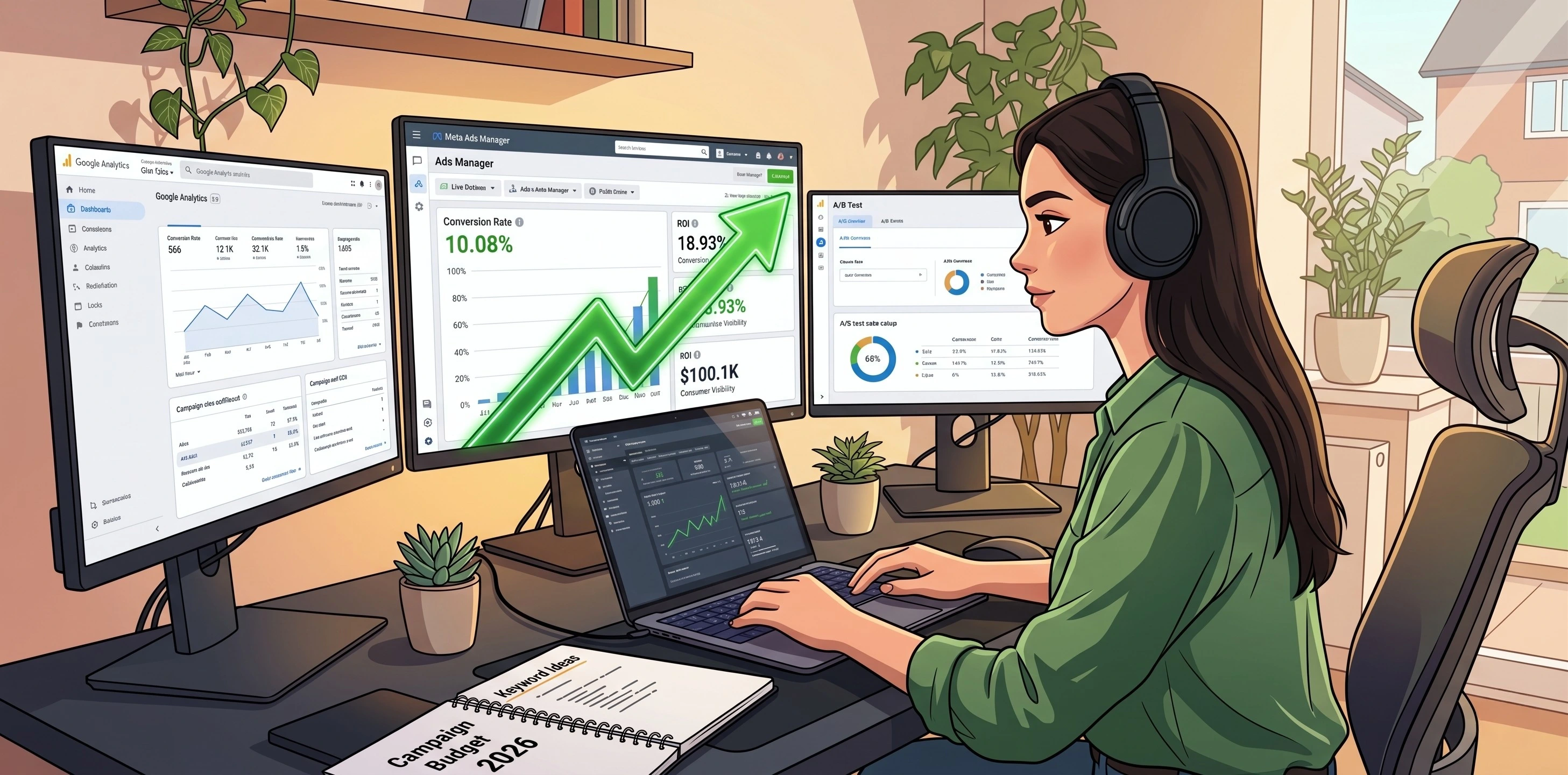
Every rupee a business spends on advertising today has to justify itself. A founder in Jaipur running a D2C skincare brand does not care how many people "engaged" with an Instagram post. He cares whether that post led to a sale, at what cost, and whether he can spend more tomorrow and still make a profit. This shift, from attention to accountability, is what performance marketing is built around. For Indian students, freshers, and career switchers, it matters in 2026 because it is one of the few marketing skills where your work is judged by numbers you can show, not opinions about how "creative" your campaign looked. That makes it easier to prove your ability early, even without years of experience, which is exactly why this field has become such a practical entry point into a marketing career.
What Is Performance Marketing?
Performance marketing is a form of digital marketing where campaigns are planned, run, and judged against measurable business outcomes: leads, sales, app installs, qualified enquiries, or revenue. Instead of asking "did people see this ad," a performance marketer asks "did this ad produce a result the business can count."
It is often confused with the idea that you "only pay when someone converts." That is one pricing model, but performance marketing is broader than that. It includes campaigns billed on clicks (CPC), impressions (CPM), or leads (CPL), as long as the marketer is tracking those costs against actual business outcomes and adjusting strategy accordingly. The defining feature is not the billing method. It is the discipline of tying spend to results and improving continuously based on data.
How Performance Marketing Actually Works
Performance marketing is a connected system, not a single ad you switch on. Every part depends on the one before it.
Audience: Who exactly are you trying to reach, and what do they already believe or want?
Offer: Why should this specific audience care right now? A generic offer rarely converts as well as a specific one.
Creative: What headline, visual, or video actually stops the scroll and communicates the offer in seconds?
Ad: Which platform and ad format puts that creative in front of the right audience at the right moment?
Landing Page: Where does the click go, and does that page match what the ad promised?
Conversion: What single action do you want the visitor to take: buy, call, fill a form, download?
Tracking: How do you know, with certainty, that the conversion actually happened and which ad caused it?
Measurement: Which numbers tell you whether this campaign is working, and working profitably?
Optimisation: Based on that data, what should change: the audience, the creative, the bid, the landing page?
Scaling: How do you increase budget and reach without the cost per result quietly climbing out of control?
Consider a small example. A local furniture business in Pune wants more showroom visits. The audience is homeowners within 15 km who recently searched for furniture online. The offer is a festive discount on a specific sofa range. The creative is a short video of the sofa in a real living room. The ad runs on Meta and Google. The landing page shows the same sofa and offer mentioned in the ad, not the entire catalogue. The conversion goal is a form fill for a showroom appointment. Tracking confirms which ad led to which form fill. Measurement shows the cost per appointment. If that cost is too high, the marketer tests a new audience or creative before increasing budget. This loop, not any single ad, is what performance marketing actually is.
Performance Marketing vs Digital Marketing
Digital marketing is the umbrella term for every marketing activity that happens online: SEO, content marketing, social media, email marketing, paid advertising, and analytics all sit under it. Performance marketing is one approach within that umbrella, distinguished by its obsession with measurable acquisition.
SEO and content marketing build long-term visibility and trust, but results are gradual and harder to attribute to a single rupee spent. Email marketing nurtures existing contacts. Performance marketing, by contrast, is usually paid, immediate, and tightly measured. A performance marketer will often use tools from across digital marketing, including SEO insight for keyword intent or content for ad creative, but the reporting always comes back to the same question: what did this spend actually produce?
In short, digital marketing asks "how do we build a presence online." Performance marketing asks "how do we generate a specific, countable business result, and can we prove it."
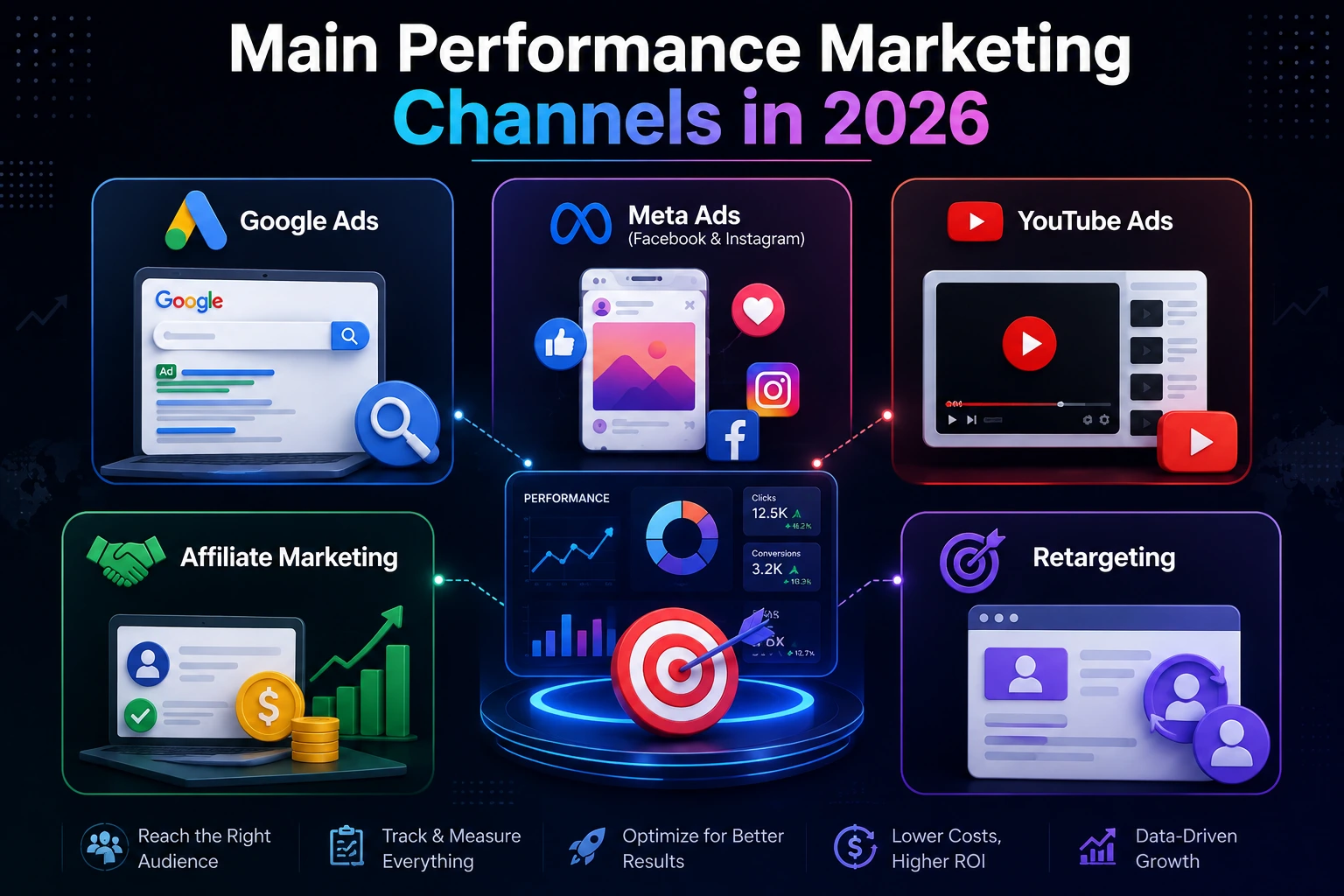
Main Performance Marketing Channels in 2026
Google Ads: Captures people who are actively searching with clear intent, such as "best CA course after 12th" or "buy running shoes online." It works well when demand already exists, and you need to capture it. Beginners should understand keyword match types, search intent, and Quality Score before touching bids.
Meta Ads (Facebook and Instagram): Reaches people based on interests and behaviour rather than active search, so it is useful for creating demand, not just capturing it. Creative quality matters more here than on search, because you are interrupting someone's feed, not answering their query.
YouTube Ads: Video-based reach that works well for storytelling, brand consideration, and retargeting warm audiences with a longer message than a static ad allows. Beginners should focus on the first five seconds of the video, since most viewers decide whether to skip within that window.
Affiliate Marketing: A performance-based partnership where publishers or influencers earn a commission only when they generate a sale or lead. It shifts risk toward the affiliate and can be cost-efficient, but it needs careful tracking to avoid paying for fraudulent or low-quality conversions.
Retargeting: Re-engages people who already visited your website, added to cart, or watched part of a video. It typically has a lower cost per conversion than cold audiences because the audience already knows the brand. Every serious performance marketer treats retargeting as a core layer, not an afterthought.
Performance Marketing Metrics You Need to Know
Numbers only mean something in relation to each other. Here is how the core metrics connect, from a click to actual profit.
| Metric | What It Measures | Why It Matters |
|---|---|---|
| CTR (Click-Through Rate) | Percentage of people who click after seeing your ad | Signals whether the ad grabs attention |
| CPC (Cost Per Click) | Average cost for one click | Shows how expensive traffic is |
| CPM (Cost Per Mille) | Cost per 1,000 impressions | Useful for awareness-stage campaigns |
| CPL (Cost Per Lead) | Cost to generate one lead or enquiry | Connects ad spend to sales pipeline |
| CPA (Cost Per Acquisition) | Cost to acquire one paying customer | The real cost of a sale, not just a click |
| CAC (Customer Acquisition Cost) | Total cost to acquire a customer, including all marketing spend | Business-level view, broader than CPA alone |
| Conversion Rate | Percentage of visitors who complete the desired action | Reveals whether the landing page and offer work |
| ROAS (Return on Ad Spend) | Revenue generated per rupee spent on ads | Common headline metric, but incomplete alone |
| ROI (Return on Investment) | Profit relative to total cost, including product and operations | The metric that actually reflects profitability |
| LTV (Lifetime Value) | Total revenue a customer generates over time | Determines how much you can afford to spend to acquire them |
Here is why cheap clicks do not automatically mean profitable marketing. Suppose a campaign gets clicks at ₹5 each, which sounds excellent. But if only 1 in 500 clicks converts into a sale, the cost per sale is ₹2,500. If the product's profit margin is ₹1,000, that campaign is losing money on every sale, no matter how impressive the CTR or CPC looked in the dashboard.
This is why experienced marketers follow the full chain: traffic leads to leads, leads lead to customers, customers generate revenue, and revenue minus all costs equals profit. A campaign can look excellent at the traffic stage and still be unprofitable by the time it reaches the profit stage. ROAS alone will not warn you about this. Only tracking the full funnel will.
Performance Marketing Skills Employers Want in 2026
Paid Advertising (Google Ads and Meta Ads): This is the operational core. You need to understand campaign structures, targeting options, bidding strategies, and how each platform's algorithm actually learns from data.
Analytics: Running an ad is easy; knowing whether it worked is not. Employers want people who can look at a dashboard and explain what happened, not just report the numbers.
Tracking (GA4, Google Tag Manager, conversion tracking): Without accurate tracking, every other metric is guesswork. This is one of the most underrated skills because it is invisible when done right and catastrophic when done wrong.
Creative Strategy: Understanding what hook, angle, or visual actually stops someone from scrolling past, and being able to test multiple creative directions systematically rather than relying on one guess.
Landing Pages and CRO: Traffic is wasted if the landing page does not match the ad's promise or make the next step obvious. Conversion rate optimisation is what turns visitors into results.
Business Understanding: Knowing what CAC, margin, and LTV actually mean for the business you are marketing for. A marketer who understands the business's economics makes far better decisions than one who only understands the ad platform.
AI Skills: Using AI tools for audience research, ad copy ideation, creative variations, data summarisation, and reporting. This does not replace strategic thinking, but it removes hours of manual work every week.
How AI Is Changing Performance Marketing in 2026
AI has moved from an experimental add-on to a working part of most campaigns. Automated bidding systems on Google and Meta now adjust bids in real time based on signals a human could never process manually. AI tools generate multiple ad copy and creative variations quickly, which speeds up testing. Audience insight tools surface patterns in customer data that would take an analyst days to find manually. Reporting and dashboard summarisation, once a weekly chore, can now be automated to a large extent.
What AI Cannot Replace
AI is genuinely useful for execution and analysis, but it does not decide what a business should offer, to whom, or why. Strategic thinking, understanding a specific customer's real objections, choosing the right offer for a specific market, and judging whether a creative direction actually fits the brand still require a human who understands the business. AI can suggest ten headline variations, but it cannot tell you which one will feel authentic to an Indian tier-2 audience versus a metro audience. Interpreting why a campaign underperformed, and deciding what strategic change to make next, remains a human decision. The realistic picture for 2026 is not AI replacing marketers, but marketers who use AI well outperforming those who do not.
Performance Marketing Jobs in India
Most of these roles overlap significantly. Titles vary more than the actual work.
- Performance Marketing Executive: Entry-level role executing campaigns, pulling reports, and assisting with optimisation under a senior marketer's guidance.
- Paid Media Specialist / Google Ads Specialist / Meta Ads Specialist: Focused on one or two platforms, handling campaign setup, bid management, and creative testing on that platform specifically.
- Performance Marketing Manager: Owns campaign strategy and budget across channels, reports on business outcomes, and manages junior executives.
- Growth Marketing Specialist / Paid Acquisition Specialist: Similar to the above but often with a stronger focus on experimentation, funnels, and testing new acquisition channels.
- Performance or Growth Lead: Senior role owning acquisition strategy across the business, working closely with product, sales, and leadership on revenue targets.
Performance Marketing Salary in India in 2026
Salary figures for this field vary meaningfully across sources such as AmbitionBox, Glassdoor, and Naukri, because they pool different samples, mix fixed pay with total CTC differently, and cover loosely defined job titles. Treat the ranges below as indicative benchmarks, not fixed numbers. Actual pay depends on your experience, city, whether you work at an agency or in-house, the size of the budget you have managed, your platform expertise, and most importantly, whether you can show documented results.
| Career Stage | Typical Experience | Indicative Annual Salary (CTC) |
|---|---|---|
| Executive / Fresher | 0–1 years | ₹3–5.5 LPA |
| Senior Executive / Specialist | 1–3 years | ₹5–9 LPA |
| Performance Marketing Manager | 4–6 years | ₹10–16 LPA (up to ₹22–25 LPA at product companies and funded D2C brands) |
| Growth / Performance Lead | 7+ years | ₹20 LPA and above, with senior roles at consumer tech and fintech companies going well beyond this |
A few honest caveats. Freshers who can show a live campaign portfolio tend to land at the higher end of the entry range, while generalists without demonstrated results often stay at the lower end regardless of years worked. Metro cities like Bengaluru, Mumbai, and Delhi-NCR typically pay 15 to 30 per cent above these ranges. Product companies, D2C brands, and fintech firms generally pay more than service agencies for the same experience level, largely because performance marketing has a more direct line to revenue in those businesses.
Agency vs In-House Performance Marketing Career
Agency: You work across multiple clients and industries at once, which accelerates learning because you see different problems, budgets, and platforms in a short time. The trade-off is juggling multiple accounts, tight deadlines, and client pressure, which can be intense for someone still building fundamentals.
In-House: You work deeply on one business, which builds a stronger connection to actual revenue and long-term strategy. You understand the product, the customer, and the numbers in far more depth. The trade-off is narrower exposure, since you may only work with one or two platforms and one industry for years.
For most beginners, an agency environment offers faster, broader learning in the first one to two years, simply because of the sheer variety of campaigns and problems you will encounter. Many marketers move in-house once they have built platform fluency and want deeper ownership of results.
How to Become a Performance Marketer in 2026
Step 1: Learn digital marketing fundamentals. Understand how SEO, content, social, and paid advertising fit together before specialising.
Step 2: Learn Google Ads. Understand campaign types, keyword match types, Quality Score, and how search intent maps to ad copy.
Step 3: Learn Meta Ads. Understand audience targeting, campaign objectives, and how creative testing works on Facebook and Instagram.
Step 4: Learn analytics and tracking. Get comfortable with GA4 and Google Tag Manager so you can verify what is actually happening after a click.
Step 5: Understand landing pages and CRO. Learn what makes a page convert: message match, clarity, and a single clear call to action.
Step 6: Run a small practical campaign. Theory only gets you so far. This is where many beginners get stuck, because platforms feel intimidating without real money and real data involved. A structured way to break through this is to learn Google Ads by running a ₹500 campaign, which lets you experience the full loop, from setup to result, on a budget small enough that mistakes are cheap lessons rather than costly ones.
Step 7: Analyse the campaign. Look at what happened: which keywords or audiences performed, what the cost per result was, and why.
Step 8: Build a portfolio. Document the campaign, your decisions, and your results, even if the budget was small.
Step 9: Apply for internships or jobs. Use your portfolio as proof of practical ability, not just certificates.
Step 10: Specialise and continue learning. Deepen expertise in one or two platforms while staying current, since ad platforms and tracking methods change frequently.
What Should a Beginner Performance Marketing Portfolio Include?
You do not need years of professional experience to build a credible portfolio. What matters is showing you can think through a campaign end to end. Include a Google Ads campaign structure with your keyword research and reasoning, sample ad copy for a real or hypothetical business, a Meta Ads campaign concept with audience research, a landing page audit pointing out what you would change and why, a simple conversion tracking plan, and a report from any small-budget campaign you have actually run, including what you would optimise next.
Before running or reviewing any campaign for your portfolio, it helps to work from a structured process rather than guessing what to check. A high-converting performance marketing campaign checklist gives you exactly that: a clear list of what needs to be right, from targeting to tracking, before you call a campaign ready. Using one on your portfolio project also signals to employers that you think in systems, not just individual ads.
Is Performance Marketing a Good Career in 2026?
Yes, with realistic expectations. The advantages are genuine: your work produces measurable outcomes you can point to in interviews, businesses across every industry need customer acquisition, and opportunities exist at agencies, in-house teams, and as an independent freelancer. Multiple industries, from e-commerce to fintech to education, all run performance campaigns.
The challenges are equally real. Ad platforms change their algorithms and features frequently, which means a strategy that worked last year may need rethinking. Automation and AI are handling more execution work, which raises the bar on strategic thinking rather than lowering the value of the role. Competition for entry-level roles is significant, since the barrier to learning the basics is low. Privacy changes and evolving tracking rules make measurement harder than it used to be. And the pressure to deliver visible results, quickly, is constant. This is not a field where you learn once and stop. It rewards people who keep learning.
7 Performance Marketing Mistakes Beginners Make
- Focusing only on clicks: Clicks are cheap to get and mean nothing without conversions attached.
- Ignoring conversion tracking: Without it, you are optimising blind, no matter how good your instincts are.
- Optimising for cheap traffic instead of quality: Low CPC often hides a high cost per actual sale.
- Ignoring landing pages: A great ad sending traffic to a poor page wastes most of the budget.
- Changing campaigns too quickly: Ad platforms need time and data to learn; constant changes reset that learning.
- Copying competitors without understanding the audience: What works for one brand's audience may fail for yours.
- Measuring ROAS without understanding profitability: A high ROAS can still mean a loss once real costs are counted.
Performance Marketing Career Roadmap
The typical progression runs from Beginner to Executive to Specialist to Manager to Growth or Performance Lead. At the beginner stage, the focus is learning platform mechanics and running small, controlled campaigns. As an executive, you build speed and accuracy in execution and reporting. As a specialist, you go deeper into one or two platforms and start owning creative and targeting decisions independently. As a manager, the focus shifts to strategy, budget ownership, and mentoring juniors across channels. At the lead level, the work becomes about connecting acquisition strategy to overall business growth, working closely with product and leadership. Each stage demands broader business understanding, not just more platform knowledge.
Frequently Asked Questions
1. What is performance marketing in simple words?
It is digital marketing where you only judge success by measurable outcomes like leads, sales, or app installs, not by views or likes.
2. Is performance marketing a good career in India in 2026?
Yes, for people willing to keep learning. Demand is strong across e-commerce, fintech, and D2C, but the field also changes fast and rewards continuous upskilling.
3. What skills are needed for performance marketing?
Google Ads and Meta Ads knowledge, analytics and tracking, creative testing, landing page understanding, basic business metrics like CAC and LTV, and increasingly, comfort using AI tools.
4. What is the salary of a performance marketer in India?
It ranges widely by experience and company, roughly ₹3–5.5 LPA for freshers up to ₹20 LPA and above at senior levels, though figures vary by source and city.
5. How can a fresher get a performance marketing job?
Build a portfolio with real or small-budget campaigns, learn Google Ads and Meta Ads hands-on, and apply with proof of practical ability rather than certificates alone.
6. Is Google Ads necessary for performance marketing?
It is one of the two most important platforms alongside Meta Ads. Most performance marketing roles expect at least working knowledge of it.
7. What is the difference between performance marketing and digital marketing?
Digital marketing is the broader field covering SEO, content, email, and social media. Performance marketing is a results-focused approach within it, centred on measurable acquisition.
8. Can AI replace performance marketers?
No, though it changes the job. AI handles bidding, reporting, and creative variations well, but strategy, offer positioning, and interpreting why a campaign worked still need a human.
Conclusion
Performance marketing is often mistaken for a technical skill: learn the ad platforms, and you are done. In reality, the marketers who build lasting careers understand the whole system: audience, offer, creative, advertising, landing pages, tracking, analytics, and how all of it connects to actual business results. Platforms and tools will keep changing between now and whenever you read this. That underlying way of thinking will not.
If you want to gain in-depth knowledge, we also offer a Digital Marketing Course in Chandigarh, where you learn in-demand skills with practical training.
If you are starting out, do not wait to feel fully ready before running your first campaign. A small, well-tracked campaign teaches you more in a week than months of reading alone. Study the fundamentals, get hands-on early, document what you learn, and let your results speak for your ability. That combination, more than any certificate, is what actually builds a career in this field.
Focus on getting real-world results. That's the only skill that pays well in this field.