
Long-Form Content vs Short-Form Content: What Drives Traffic and Conversions in 2026
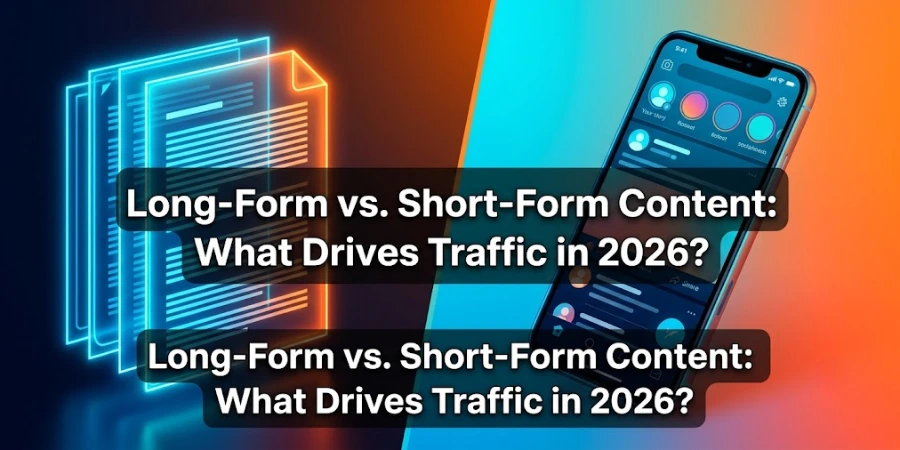
If you write content for a website, you have probably asked this question: Should I write a long, detailed article, or a short, quick one?
In 2026, this question matters more than ever. AI tools can write content in seconds. Google now shows AI Overviews at the top of search results. People scroll fast on their phones. So the old rules of content marketing are changing.
In this blog, we will break down long-form vs short-form content in simple words. You will learn what each type is good for, what the real data says about traffic and conversions, and how to choose the right mix for your website in 2026.
What Is Long-Form Content?
Long-form content is any piece of writing that is detailed and goes deep into a topic. Most experts consider anything above 1,500 to 2,000 words as long-form. This includes:-
In-depth blog posts and guides
-
Case studies
-
Whitepapers and ebooks
-
Long, detailed video scripts
What Is Short-Form Content?
Short-form content is quick and to the point. It is usually under 1,000 words, and sometimes just a few lines. Examples include:-
Social media posts
-
Short news updates
-
Quick tips or listicles
-
Short videos and reels
What the 2026 Data Actually Shows
Let's look at real numbers instead of guessing. Several studies published in 2026 point in the same direction.Long-form content wins on traffic and backlinks. Long-form content of 3,000 or more words receives 77.2% more backlinks than short-form content under 1,000 words. One SEO agency also found that blog posts over 3,000 words generate 4.5 times the traffic that posts between 500 and 1,000 words do, along with 3.5 times more backlinks.
Ranking pages tend to be longer. Research shared by one marketing site found that pages with 2,000 or more words rank on average two positions higher in Google search results, and Google's top 10 ranking pages average between roughly 1,447 and 2,500 words.
Short content struggles more than people think. According to one B2B SEO report, short content between 300 and 900 words attracts 21% less traffic and 75% fewer backlinks than average-length articles of 900 to 1,200 words.
Long-form content also boosts leads. A large marketing survey found that companies publishing articles with over 2,500 words report a 3.2 times higher lead conversion rate compared to companies that only publish short-form content around 800 to 900 words.
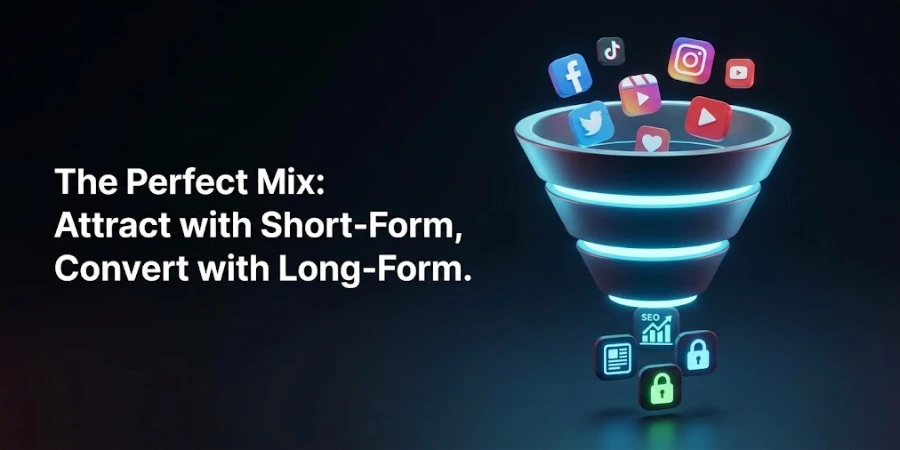
But short-form still has its place. Short content is not useless. It is powerful for reach and awareness. Short-form content drives is important for awareness, social engagement, and top-of-funnel reach, while long-form content wins on SEO, authority, and conversion. The most effective lead generation funnels run short-to-long: attract readers with short-form content, then convert them with long-form content.
So the honest answer is not "long-form always wins." It is: long-form wins for search rankings and trust, short-form wins for reach and speed. The smartest brands use both.
Why Long-Form Content Still Wins for SEO in 2026
Here are the real reasons long-form content keeps performing well, even with AI changing search:1. It Covers More Ground
A 2,000-word article can naturally include many related keywords and subtopics. This helps it rank multiple times for related search terms, instead of just one.2. It Builds More Trust
Longer, well-researched content shows readers and Google that you understand the topic deeply. This is part of what Google calls E-E-A-T: Experience, Expertise, Authoritativeness, and Trustworthiness.3. It Earns More Backlinks
Other websites are far more likely to link to a detailed guide than to a short 300-word post. Backlinks are still one of the strongest ranking signals in 2026.4. It Gets Cited by AI Search Tools
AI Overviews and AI chat tools need well-structured, detailed content to pull answers from. A short, thin post doesn't have enough substance to be picked as a source. A well-organised long article with clear headings and direct answers has a much better chance of being picked by AI.5. It Keeps People on the Page Longer
Detailed content increases the time a visitor spends reading. Longer time on page tells search engines that people find the content genuinely useful.Why Short-Form Content Still Matters
Long-form is not the only answer. Short-form content plays a different, equally important role.1. It Spreads Faster
Short posts and videos are easy to consume and easy to share. This makes them great for growing your audience on social media.2. It Fits Modern Attention Spans
Many people are scrolling quickly on their phones. A short, clear answer often works better than a long article when someone just needs a quick fact.3. It Works for Simple Searches
If someone searches something very simple and specific, a short, direct answer can rank perfectly well. Not every search needs a 2,000-word guide.4. It Builds Awareness for Your Long-Form Content
Short posts can act like small doors that lead people to your bigger, more detailed content. A short LinkedIn post or reel can drive curious readers to your full blog post.So, What Should You Actually Do in 2026?
Here is a simple, practical approach you can follow.Use long-form content for:
-
Main topic guides you want to rank for
-
Comparison posts ("X vs Y")
-
Case studies and detailed how-to articles
-
Any topic where competitors already have long, detailed articles
-
Social media updates
-
Quick news or announcements
-
Teasers that link back to your long-form articles
-
Simple, low-competition search queries
How to Write Long-Form Content That Actually Ranks
Writing 2,000 words is not enough by itself. The structure matters just as much as the length. Here is what works well right now:-
Start with a clear answer. Don't make readers wait. Answer the main question early in the article.
-
Use clear headings (H2, H3). This helps readers scan and helps AI tools understand your structure.
-
Break up long paragraphs. Keep paragraphs short, even in a long article. Big blocks of text feel tiring to read.
-
Add real examples and data. Readers and search engines both reward content backed by facts, not just opinions.
-
Include an FAQ section. This matches how people actually search, and it helps you appear in AI answers.
-
Avoid filler. Depth means more useful information, not more repeated sentences. A study noted that Google's ranking systems and AI-powered search reward content that matches search intent, earns engagement, and shows real authority, not content that is simply long for the sake of being long.
Common Mistakes to Avoid
-
Writing long just to hit a word count. Writing an article with repeated points hurts more than it helps.
-
Ignoring short-form completely. If you only publish long articles, you miss out on fast audience growth.
-
Publishing once and forgetting it. Long-form content should be updated regularly to stay accurate and competitive.
-
Skipping structure. A 3,000-word wall of text with no headings will lose readers fast, no matter how good the information is.
Final Thoughts
The long-form vs short-form debate is not really about picking a winner. It's about using each format for what it does best.If your goal is to rank on Google, build trust, and convert readers into leads or customers, long-form content is still your strongest tool in 2026. If your goal is to grow your audience quickly and stay visible on social platforms, short-form content is exactly what you need.
The brands that win in 2026 are not choosing one over the other. They are using short-form content to attract attention, and long-form content to earn trust and conversions. That combination is what actually drives real, lasting results.
If you are interested and want to learn in depth, our Digital Marketing Course in Mohali offer practical training in social media marketing, SEO, paid ads, automation, and email marketing, all with 30+ AI tools.
FAQs
Is long-form content dead because of AI?No. AI tools like AI Overviews actually rely on well-structured, detailed content to generate their answers. Thin content has a harder time getting picked.
How long should a blog post be to rank well in 2026?
There's no fixed number, but most top-ranking pages fall between 1,500 and 2,500 words. The right length depends on how much detail your topic genuinely needs.
Can short-form content still rank on Google?
Yes, especially for simple, specific, or low-competition searches. It's less likely to rank for competitive, broad topics.
What's the best content mix for a small business?
A common approach is one long-form article for every four to six short-form pieces, adjusted based on what actually drives your traffic and leads.