
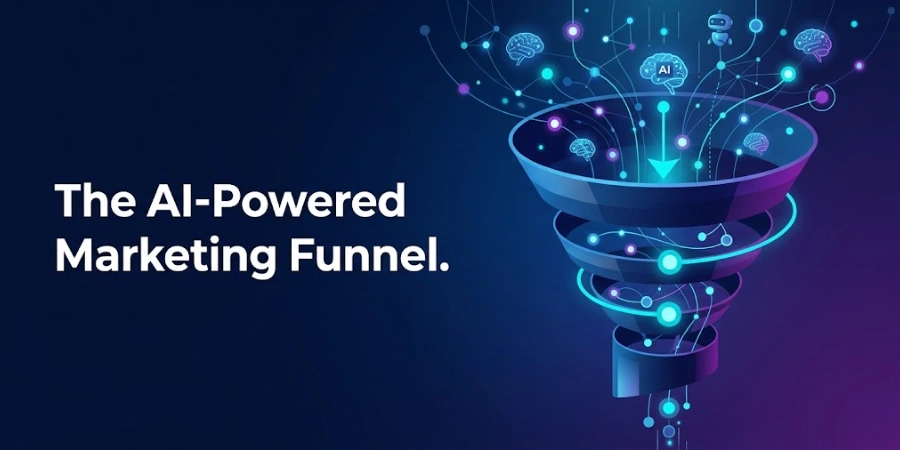
The AI-Powered Marketing Funnel: How Businesses Are Turning Strangers Into Customers Faster
Not long ago, running a marketing campaign meant a lot of guesswork. You'd put together an ad, pick an audience based on your best judgment, set a budget, and hope the right people saw it. Sometimes it worked. Mostly it didn't. And figuring out why is the task itself.
That's changing rapidly. Businesses today are using artificial intelligence to take the guesswork out of marketing, and the results are way better. Ads that reach exactly the right people. Emails that arrive at exactly the right moment. Website chatbots that answer customer questions at two in the morning. All of it working together, automatically, while you sleep.
The framework that holds all of this together is called a marketing funnel. And when you combine it with AI, it becomes one of the most powerful customer growth systems available to any business, big or small.
If you've never heard either of these terms before, don't worry. By the end of this guide, you'll understand exactly how it works and how businesses are using it right now.
What Is a Marketing Funnel, and Why Is It Shaped Like One?
A marketing funnel is simply a way of visualising the journey a person takes from first hearing about your business to eventually becoming a paying customer.It's called a funnel because of what happens to the numbers at each stage. At the very top, you have a large number of people who become aware of your brand, maybe they saw your ad, stumbled across your content, or heard about you from someone. As they move through the journey, some people drop off at each stage. By the time you reach the bottom, you're left with a smaller but much more committed group, the people who actually buy.

The four main stages are:
Awareness: the person discovers your brand for the first time. They don't know much about you yet, and they definitely aren't ready to buy.
Interest: They're curious. They start engaging with your content, watching your videos, reading your blogs, or browsing your website.
Decision: They're seriously considering buying, but are comparing their options. This is where trust becomes everything.
Action: they make the purchase. The journey through the funnel is complete.
Every business, whether they know it or not, has some version of this funnel. The difference between businesses that grow consistently and those that struggle is how they manage each stage and, increasingly, how intelligently they use AI to do it.
Where AI Changes Everything
The traditional version of this funnel relied heavily on human effort and educated guesses. You'd write emails manually, create one version of an ad for everyone, and follow up with leads when you remembered to. It worked, but it was slow, inconsistent, and expensive.AI doesn't replace this process; it supercharges it. Instead of one message going to everyone, AI delivers the right message to the right person at the right time. Instead of waiting for a human to follow up with a lead, AI does it automatically within minutes. Instead of guessing which audience to target, AI analyses data and finds the people most likely to buy.
Let's walk through each stage of the funnel and look at exactly what AI is doing differently.
Stage One: Awareness (Reaching the Right People)
This is the top of the funnel, where most marketing budgets get spent. The goal here is simple: get your brand in front of people who don't know you exist yet. The challenge is doing it without wasting money on showing ads to people who will never be interested.This is where AI earns its keep immediately. Platforms like Google and Meta use AI to analyse behavioural data, such as what people search for, what content they engage with, what they buy, and what pages they visit and use that to predict who is most likely to respond to your ad.
Stage Two: Interest (Keeping People Engaged)
Getting someone's attention is only the first step. The harder part is holding it long enough to build genuine interest and trust. This is where AI-driven personalisation makes a dramatic difference.Think about how Netflix recommends shows. It doesn't show everyone the same suggestions; it studies what you've watched, how long you watched it, what you skipped, and what you rewatched, then uses that to predict what you'll want to see next. The experience feels personal because it is personal.
AI does the same thing in marketing. If someone watches a video about social media marketing on your website, AI can automatically follow up with a related blog post, a relevant case study, or an email that digs deeper into that exact topic. Every interaction teaches the system more about what that person is interested in, and the content they see becomes increasingly relevant to them specifically.
Stage Three: Decision (Helping Customers Choose You)
This is the most delicate stage of the funnel. Your potential customer is genuinely interested. They're comparing you with competitors, reading reviews, weighing the price, and looking for a reason to commit or a reason to walk away.AI helps at this stage in a few meaningful ways. Chatbots have become incredibly effective at handling the questions that come up at this point in the journey. Pricing questions, product comparisons, delivery timelines, and refund policies a well-trained AI chatbot can answer all of these instantly, at any hour, without a customer having to wait for a human response. That immediacy matters more than most businesses realise. A customer who has to wait until the next morning for an answer often decides before that answer arrives.
Stage Four: Action (Turning Interest Into Sales)
The bottom of the funnel is where revenue is generated, and it's also where AI handles one of the most valuable functions in e-commerce and online business: recovering customers who almost bought but didn't.Abandoned cart emails are the most familiar example of this. Someone adds a product to their cart, gets distracted, and leaves without completing the purchase. AI sends them a personalised reminder and brings a meaningful percentage of those people back to complete their order. The timing, the messaging, and the offer are all optimised automatically based on what's worked before.

What This Looks Like in Practice
Imagine you run a fitness coaching business. Someone searches "how to lose weight at home" and comes across your YouTube video. That's awareness. AI identifies them as a potential lead and serves them a targeted ad for your online programme on Instagram the next day. They click through and browse your website. That's interesting. AI triggers an automated email sequence with testimonials, a free workout guide, and details about your programme. A chatbot answers their questions about what's included and how the payment plan works. That's the decision stage. Three days later, AI sends them a limited-time offer. They sign up. That's action.The entire journey happened with less manual effort on your part, guided at every step by AI making smart decisions about what to say, when to say it, and to whom.
A Note on Getting the Balance Right
AI is a tool, not a replacement for genuine human connection. The businesses that use it most effectively are the ones that automate the repetitive, data-driven tasks while keeping the human voice alive in their content, their community, and their customer relationships.People can tell when they're being processed rather than genuinely communicated with. Use AI to handle the heavy lifting, but make sure the message it's delivering is one that actually sounds like you.
The Bottom Line
The marketing funnel has always existed. AI has simply made it more effective, more targeted at the top, more personalised in the middle, and more efficient at the bottom. For businesses willing to understand how it works and invest in setting it up properly, the results speak for themselves.You don't need a large team or a massive budget to start. You need a clear understanding of your customer's journey, the right tools in place at each stage, and the willingness to let data guide your decisions rather than guesswork.
The businesses growing fastest right now are the ones that figured this out early. The good news is that it's still early enough for you to be one of them.
If you want to gain in-depth knowledge, we also offer a Digital Marketing Course in Chandigarh, where you learn in-demand skills with practical training.