
Why Your SEO Rankings Are Up, but Website Traffic Is Down in 2026
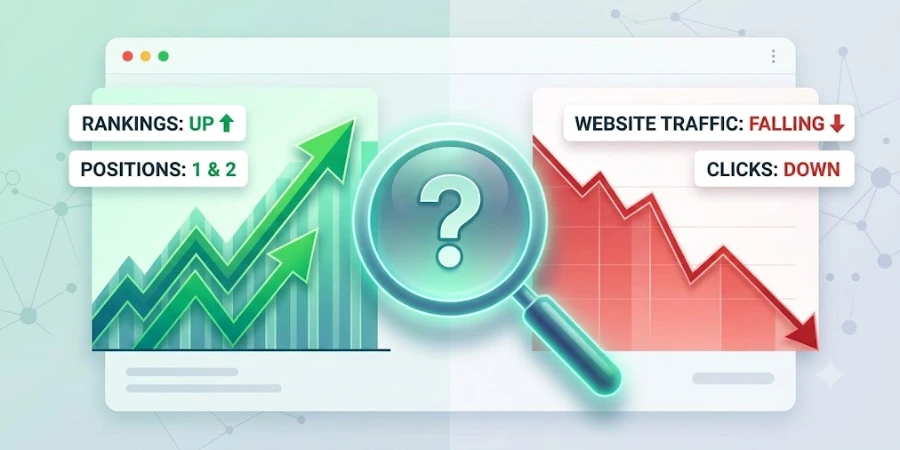
You checked your rankings, and they look great. Your keywords moved up. Some are even sitting at position one or two. But when you look at your actual website traffic, it is worse; it is falling.
If this is happening to you, you are not alone, and you are not doing anything wrong. This is one of the biggest and most confusing shifts in SEO right now, and there is a clear reason behind it. In this post, we will explain exactly why this is happening in 2026, and what you can do about it.
The Old Rule of SEO Doesn't Fully Work Anymore
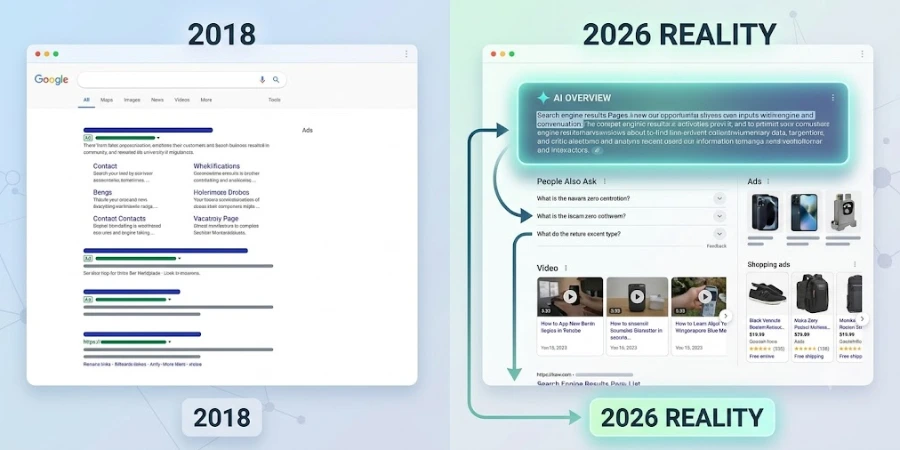
For years, SEO worked in a simple, predictable way: rank higher, get more clicks, get more traffic. That rule made sense when Google's results page was mostly just a list of blue links.That is not true anymore. Search results pages today are crowded with AI summaries, quick answer boxes, "People Also Ask" questions, videos, and ads, all before a person even reaches your website's listing. So even if you rank at the very top, your listing is no longer the first thing people see.
This is the real reason rankings and traffic have started moving in different directions.
The Biggest Reason: AI Overviews Are Answering Questions Before People Click
The single biggest cause of this gap is Google's AI Overviews the AI-generated summary that appears at the top of many search results.Here is what is happening, based on recent industry research:
-
Search sessions that end without any click have climbed sharply over the last two years, and now make up roughly six out of every ten Google searches.
-
When an AI Overview appears above the results, people click through to a normal website result far less often than when there is no AI summary at all.
-
On Google's newer AI Mode experience, the vast majority of searches end with no click to any outside website at all, because the AI answer replaces the usual results completely.
-
Ranking at position one used to almost guarantee strong traffic. Today, even a position one ranking can bring in a fraction of the clicks it used to, because the AI Overview is answering the question first.
It Hits Some Topics Much Harder Than Others
This problem is not equal across every type of content. Some topics are affected far more than others.-
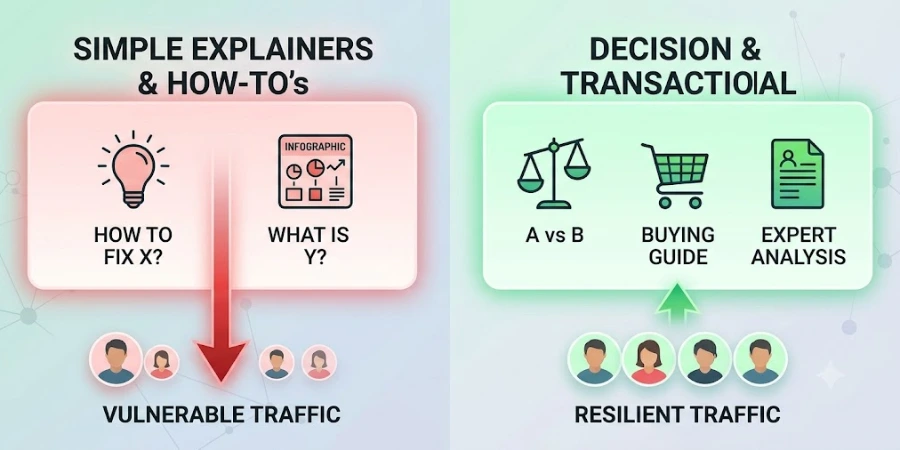
"How to" and general explainer questions are hit the hardest, because AI can summarise a clear answer very easily.
-
Health and technology topics tend to trigger AI summaries more often than other categories.
-
Buying-focused searches, like "buy," "price of," or "best X for Y," are affected much less, because people usually still want to visit a real website before spending money.
Why Your Rankings Can Look "Good" While Traffic Falls
This is the confusing part for a lot of website owners. Here is what is actually going on behind the scenes.Google Search Console shows you two separate numbers: impressions (how often your page appeared in search) and clicks (how many people actually visited your site). Rankings are based on position, not on whether someone clicked.
So it is completely possible for your page to:
-
Keep the same or even a better ranking position
-
Show up in search just as often, or more often (deeper impressions)
-
But still lose clicks, because a chunk of those searchers get their answer from an AI Overview and never scroll down to click anything
Old Model vs New Reality
| Old SEO Model (Pre-AI Search) | 2026 Reality | |
| Ranking #1 | Usually meant strong traffic | Can still mean lower traffic if an AI answer appears first |
| Impressions | Roughly matched real interest | Can stay high even while clicks drop |
| Best content type | Any well-optimised page | Comparison, buying, and expert-opinion content perform better |
| Success metric | Rankings and traffic together | Rankings, traffic, and AI visibility, tracked separately |
Other Reasons Traffic Can Drop Even With Good Rankings
AI Overviews are the biggest factor, but they are not the only one. A few other common reasons include:Branded vs non-branded traffic mixing: If people already searching for your brand name make up a large share of your traffic, your overall numbers can look stable even as your non-branded "new visitor" traffic is quietly shrinking. It helps to look at these two types of traffic separately instead of one combined number.
More competition on the results page itself: Even without AI, today's search results often include shopping sections, video carousels, local map results, and extra ad slots. All of these push regular organic listings further down the page, even if your position technically stays the same.
Seasonal changes or shifting search interest: Sometimes a topic simply gets searched less than it used to, especially if the season, trend, or public interest has moved on. This can look like a traffic problem when it is actually a demand problem.
Keyword cannibalisation: If you have multiple pages competing for the same keyword, one page may rank while pulling small amounts of traffic away from another page on your own site, without your total traffic actually growing.
What You Should Actually Do About It
The good news is that this shift does not mean SEO is dead. It means the goal has expanded. Here is a simple path forward:1. Check your Search Console data properly. Look specifically at pages where impressions are steady or rising, but clicks are falling. This is the clearest sign that AI Overviews or other search features are affecting that page.
2. Separate branded and non-branded traffic. This helps you understand whether your real "new audience" discovery traffic is actually shrinking, instead of judging everything by one combined number.
3. Try to get cited inside AI Overviews, not just ranked. Pages that are mentioned or quoted in an AI Overview tend to earn noticeably more clicks than pages ranked below it. To improve your chances, add clear, direct answers near the top of your content, use original data or examples, and organise information with simple headers.
4. Shift some content toward comparisons and decisions. Basic explainer content gets absorbed by AI summaries most easily. Content that compares options, shares real experience, or helps someone make a buying decision tends to hold on to more of its traffic.
5. Add real structure to your pages. Clear headers, short direct answers, FAQs, and simple tables make it easier for both readers and AI systems to understand your content and give it credit.
6. Don't panic and delete content. Studies show AI-written or AI-assisted content is not being penalised by Google. The traffic drop is not usually a content quality problem. It is a change in how answers reach people before they ever click.
Final Thoughts
If your rankings are climbing but your traffic is falling, it does not mean your SEO strategy failed. It means search itself has changed. AI Overviews and other search features are now answering many questions directly on the results page, so a good ranking no longer guarantees a click the way it used to.The websites that will do well going forward are the ones that stop measuring success by rankings alone, and start paying attention to real clicks, AI citations, and content that gives people a genuine reason to visit the actual website, not just read a summary of it.
Frequently Asked Questions
Why are my rankings going up but my traffic going down?This usually happens because AI Overviews and other search features are answering user questions directly on the results page, so fewer people click through, even when your ranking position improves.
Is this only happening because of AI Overviews?
AI Overviews are the biggest cause in 2026, but crowded search pages, seasonal demand changes, and competing pages on your own site can also play a role.
Does this mean SEO is no longer worth doing?
No. SEO is still valuable, but the goal has expanded to include being cited inside AI-generated answers, not just ranking well in traditional results.
How can I tell if AI Overviews are affecting my traffic?
Check Google Search Console. If your impressions are steady or growing but your clicks are falling for the same pages, that is a strong sign AI Overviews or similar features are involved.
What type of content is least affected by this traffic drop?
Content built around comparisons, buying decisions, and real experience tends to hold on to more traffic than simple explainer or "how to" content.