
Affiliate Marketing: A Complete Guide from Beginner to Advanced

Affiliate Marketing in India: How to Start & Earn
Someone scrolls through Instagram or YouTube, sees a creator recommending a laptop, a skincare product, or a course, and wonders how that creator earns money when a stranger buys through their link. That's affiliate marketing. It's one of the most accessible ways to build an online income stream in India, but it isn't simply "posting links and waiting." A working affiliate business needs a relevant niche, the right products, an audience that trusts you, content that actually helps people, traffic with buying intent, and a way to track what's converting. This guide covers how affiliate marketing works, how to start in India, which platforms and programs to consider, how SEO and social media generate traffic, what you can realistically earn, and the mistakes that stall most beginners.Quick Answer: What Is Affiliate Marketing?
Affiliate marketing is a performance-based model where a business pays an affiliate a commission for driving a specific outcome, usually a sale or lead through a tracked referral link.The basic flow: Merchant → Affiliate → Audience → Click → Conversion → Commission.
The affiliate doesn't own the product or handle customer service; they're paid for the qualifying action their content generates.
In this guide: how it works, whether it's legit, a step-by-step start in India, picking a niche and platform, SEO and YouTube/Instagram traffic, realistic earnings, tracking, disclosure, mistakes, and a beginner checklist.
How Does Affiliate Marketing Work?
Every affiliate relationship involves the same core parts, connected through a tracking system.1. Merchant — The business selling the product (an e-commerce brand, SaaS company, hosting provider, ed-tech platform).
2. Affiliate Program — The system the merchant uses to recruit affiliates, set commission rules, and issue payouts — run directly by the brand or through an affiliate network.
3. Affiliate — The publisher (you) who promotes the merchant's product to your audience.
4. Affiliate Link — A unique tracked URL assigned to you so any resulting action is attributed correctly.
5. Customer — The person who clicks your link and takes an action on the merchant's site.
6. Conversion — The qualifying event: a sale, signup, app install, or lead form.
7. Commission — What you earn once that conversion is verified.
How tracking actually works: it isn't only about cookies. Programs use a mix of unique referral links, cookies, attribution windows, and app- or platform-level tracking, depending on the merchant. The mechanism and window vary by program, so always check current terms.
Is Affiliate Marketing Legit?
Yes, affiliate marketing is a legitimate, widely used marketing channel, and reputable programs pay according to their published terms. But legitimacy at the model level doesn't guarantee results at the individual level: there is no guaranteed income; results depend heavily on your niche, content, and traffic.The difference between legitimate affiliate marketing and get-rich-quick claims matters. Real affiliate marketing means understanding a niche, building useful content, earning trust, and being paid fairly for sales you influence. Scams typically promise fast or "passive" income for minimal effort, ask you to pay upfront for "affiliate access," or push recruitment over real sales. Before promoting any program, verify the merchant is real and read the terms.
How to Start Affiliate Marketing in India
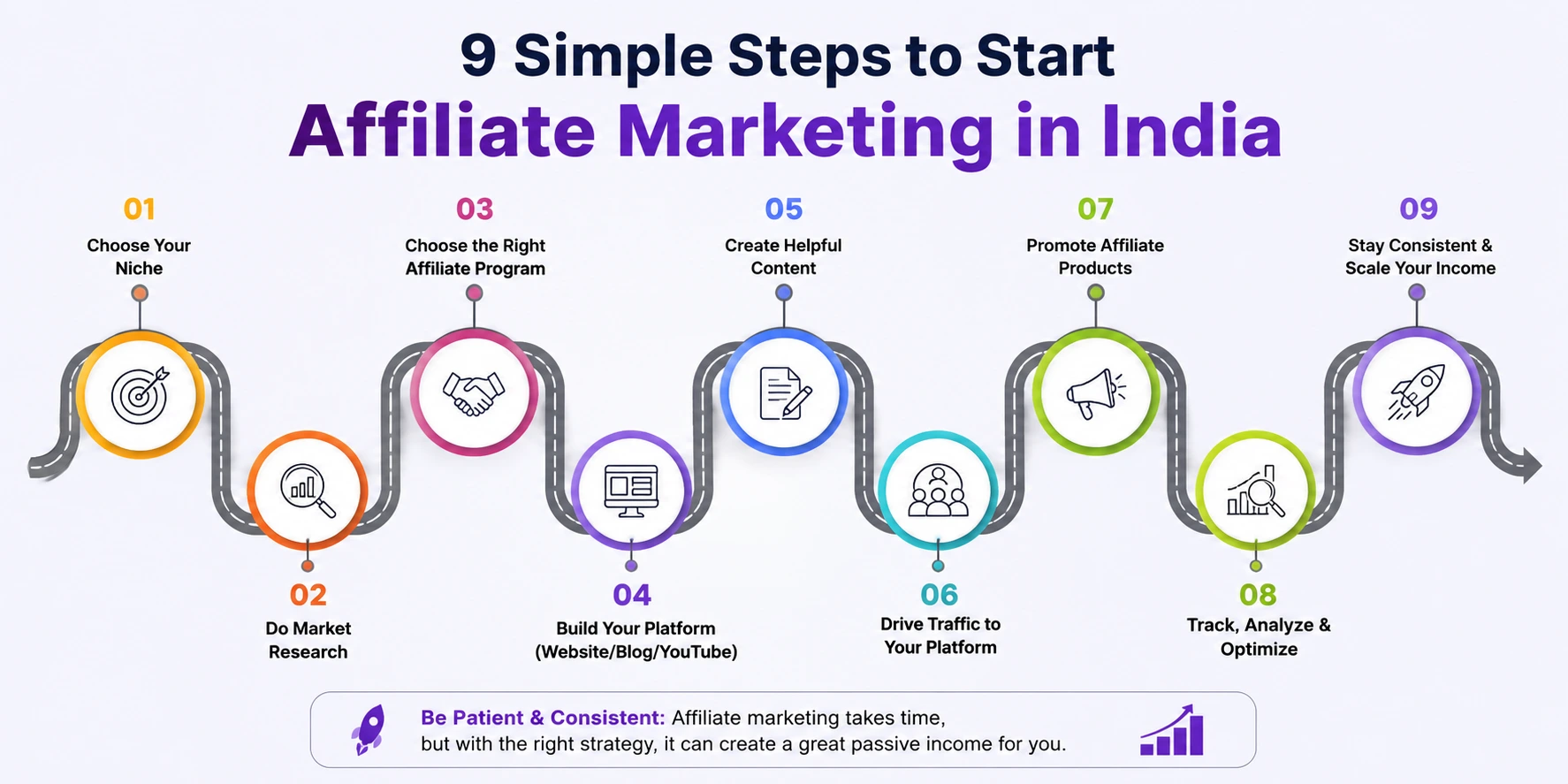
Step 1: Choose a niche
The specific topic or audience you'll focus on. Indian beginners commonly start with smartphones, laptops, beauty, fashion, education, software/SaaS, hosting, digital marketing, home products, fitness, or travel. A narrower niche ("laptops for college students") is usually easier to rank in than a broad one ("technology"). Avoid regulated categories like investment or trading products unless you understand the compliance requirements.Step 2: Understand your audience
What problem are they solving? What's their budget? Are they close to buying, or just researching? Their intent shapes your content.Step 3: Choose your platform
A website, YouTube channel, Instagram profile, email list, or a mix covered below.Step 4: Find relevant affiliate programs
Direct brand programs, e-commerce programs, and affiliate networks that match your niche.Step 5: Create useful content
Reviews, comparisons, buying guides, and tutorials that genuinely help someone decide.Step 6: Add affiliate links naturally
Place links where they help the reader decide, not everywhere on the page.Step 7: Disclose affiliate relationships
Tell your audience clearly when a link is an affiliate link.Step 8: Track performance
Know which pages, links, and products are actually converting.Step 9: Improve what works
Double down on what's producing results; fix or remove what isn't.Best Affiliate Marketing Platforms & Programs in India
There's no single "best" affiliate program; the right one depends on your niche, audience, and content format. Broad categories to explore include:-
E-commerce affiliate programs (broad product catalogues)
-
Software/SaaS affiliate programs
-
Hosting and website-building affiliate programs
-
Education/course affiliate programs
-
Travel affiliate programs
-
Direct brand affiliate programs
-
Affiliate networks (connecting many merchants with affiliates)
How to Choose the Right Affiliate Niche
Evaluate a niche across these factors before committing:-
Audience demand — are people actively searching for this?
-
Product availability — enough relevant products to recommend?
-
Commercial intent — do searchers here tend to buy?
-
Content opportunities — room for reviews, comparisons, guides?
-
Competition — realistic for a new site or channel to gain traction?
-
Personal knowledge — can you recommend these credibly?
-
Commission potential — is the payout reasonable?
-
Long-term relevance — will this niche still matter in a few years?
Best Platforms for Affiliate Marketing
| Platform | Best For | Strength | Challenge |
| Website/Blog | In-depth reviews, comparisons, SEO traffic | Long-term, compounding organic traffic | Takes time to rank |
| YouTube | Product demos, tutorials, reviews | High trust, strong search + suggested traffic | Production time, consistency |
| Reels, quick recommendations, visual products | Fast audience feedback, discovery | Algorithm-dependent, link restrictions | |
| Nurturing an existing audience | Owned channel, high engagement | Needs an audience first | |
| Visual, evergreen product ideas | Long content lifespan | Smaller in India vs. global markets |
Affiliate Marketing SEO: How to Get Free Google Traffic
SEO is one of the most durable traffic sources for affiliate content because it keeps working long after publishing. Start with keyword research built around search intent: informational, commercial investigation, and transactional. Commercial-intent content (comparisons, "best" lists, reviews) tends to convert better than purely informational content, since the reader is already close to a buying decision.A typical keyword journey looks like:
affiliate marketing → how affiliate marketing works → how to start affiliate marketing in India → best affiliate programs in India → best [product] for [audience] → [product] review
Other core levers: long-tail keywords, internal linking (so authority flows across your site), topical authority (covering a niche thoroughly rather than one-off posts), helpful, original content over thin summaries, and updating old content as products, prices, and programs change.
Affiliate Content Ideas That Can Generate Sales
| Content Type | Search Intent | Affiliate Opportunity |
| Product reviews | Evaluating a specific product | High reader is close to deciding |
| Comparisons | Choosing between options | High direct decision support |
| Best-of lists | Browsing top options | High multiple link opportunities |
| Alternatives | Looking for a substitute | Medium-high |
| Buying guides | Understanding what to look for | Medium |
| Tutorials | Learning how to use something | Medium |
| Problem-solving content | Solving a specific issue | Medium |
Affiliate Marketing Through YouTube
YouTube works well for reviews, tutorials, comparisons, unboxings, and buying guides, since video lets viewers see the product before deciding. Put affiliate links in the description, mention them verbally, and disclose the relationship clearly. Trust is the real currency; viewers who feel misled rarely return, and no format guarantees sales.Affiliate Marketing Through Instagram
Reels, short educational posts, demonstrations, and Stories all work for affiliate promotion, but Instagram is a discovery and trust-building channel more than a search channel content needs to work in the moment rather than being found months later. Use profile links or approved link tools where allowed, and disclose affiliate content clearly in every post.Affiliate Marketing Without Investment
You can start with free tools: YouTube, Instagram, organic search (once you build a site), and free content-creation tools. But "without investment" doesn't mean "without effort." The hidden costs are real your time, internet access, content production, editing tools, and eventually domain/hosting if you build a website. Learning SEO or video editing also takes time before it pays off.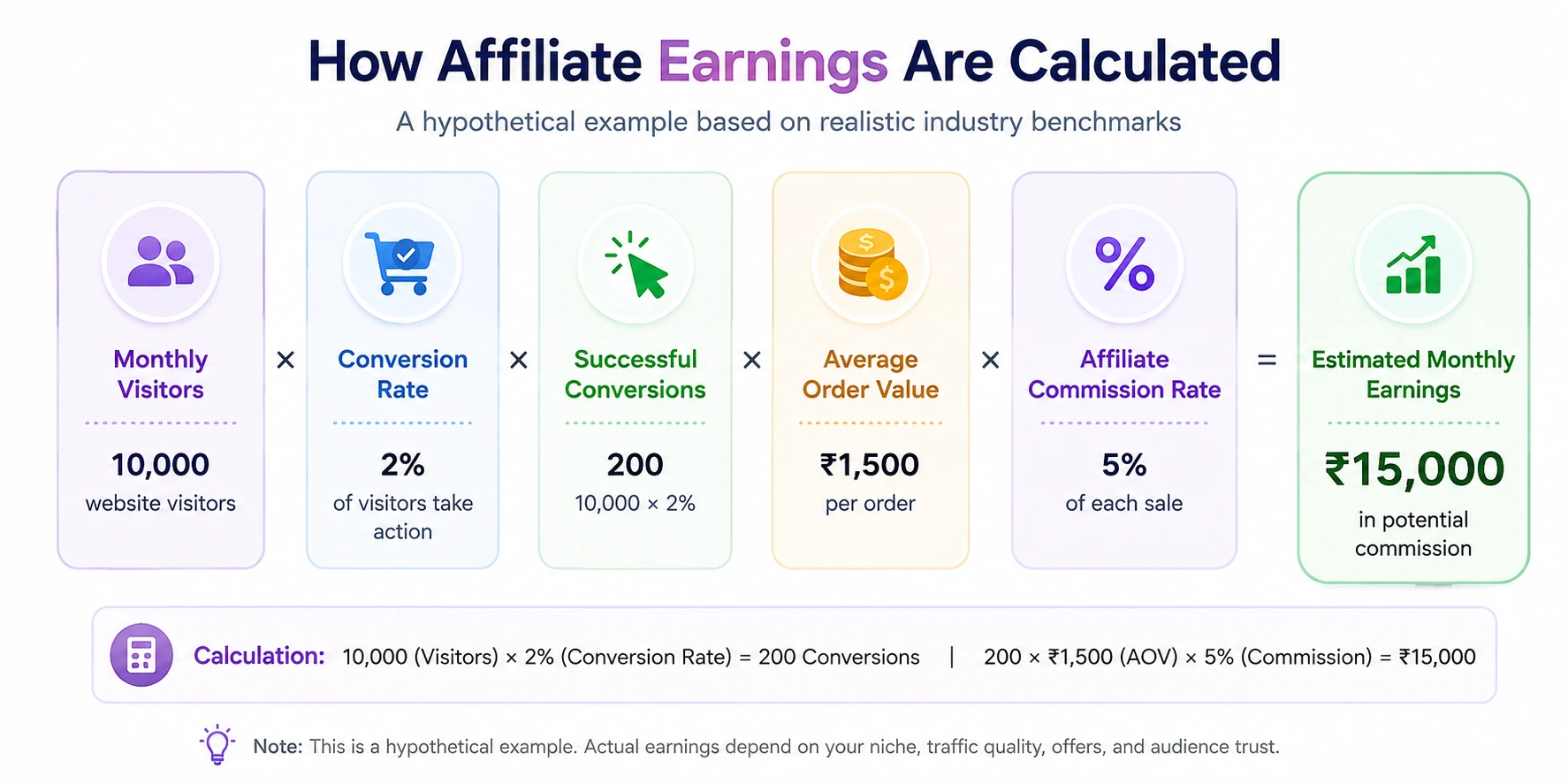
How Much Can You Earn From Affiliate Marketing in India?
There's no fixed income figure; earnings depend on traffic volume, audience quality, conversion rate, commission structure, product price, content quality, niche, and seasonality. A simplified way to think about it:Affiliate earnings ≈ qualifying conversions × average commission
Illustrative example (hypothetical, not an income promise):
-
10,000 relevant monthly visitors
-
× 5% affiliate click rate = 500 clicks
-
× 3% conversion rate = 15 conversions
-
× ₹800 average commission = ₹12,000
Affiliate Marketing Example for a Beginner
Consider a hypothetical Indian beginner who builds a small content site around affordable technology for students: best budget laptops, laptop comparisons, accessories, buying guides, and a few software recommendations. As the site earns search visibility, readers researching a purchase land on these pages, click links when a product genuinely fits their need, and some buy, generating commissions. This is a simplified, illustrative scenario, not a real Digital Study School student or client result.Affiliate Marketing for Students in India
Affiliate marketing appeals to students because it needs little upfront investment and can run alongside studies. Realistic expectations matter: early months usually involve learning and content-building with little or no income. Suitable starting points include a niche site or YouTube channel around topics students already understand: study tools, budget tech, online courses using free or low-cost platforms. It takes consistent time, honest recommendations, and proper disclosure, not shortcuts.Affiliate Marketing Tools for Beginners
-
Keyword research tools — find what people are searching for
-
Website analytics — see where traffic comes from
-
Search performance tools — track rankings and clicks
-
Link management tools — organise affiliate links
-
Content creation tools — writing, design, video editing
-
Spreadsheets — track programs, links, and payouts
-
Conversion tracking tools — see what actually drives sales
Affiliate Marketing Tracking and KPIs
Key metrics: clicks, click-through rate (CTR), conversion rate, earnings per click (EPC), commission per sale, total revenue, traffic source, and your top-performing pages and products.Three distinctions matter: traffic ≠ clicks, clicks ≠ conversions, and conversions ≠ guaranteed profit (your time and any promotional costs still count). Tracking these separately shows exactly where your funnel is leaking.
Affiliate Marketing Disclosure and Compliance
Always disclose affiliate relationships clearly, near the link itself, not buried in a footer. Follow the platform's rules and each program's promotional terms. Don't make false product claims, manipulate reviews, or hide that a link is an affiliate link. Advertising and consumer-protection expectations around influencer disclosures in India continue to evolve, so stay current with official guidance. This isn't legal advice for specifics; consult current regulatory guidance or a professional.Common Affiliate Marketing Mistakes Beginners Make
-
Niche chosen only for commission: pick topics you can genuinely evaluate.
-
Promoting products you don't understand: use or research it first.
-
Thin content: answer the reader's question fully.
-
Copying competitors: add your own analysis.
-
Keyword stuffing: write for the reader, not the algorithm.
-
No search-intent match: check what searchers actually want.
-
Ignoring SEO basics: learn on-page fundamentals early.
-
One traffic source: build at least two channels.
-
Spamming links: link only where it helps the decision.
-
Hiding disclosures: disclose clearly, every time.
-
Ignoring tracking: check performance regularly.
-
Expecting instant income plan for a multi-month runway.
-
Not updating old content; revisit top pages periodically.
-
Products picked only for payout- prioritise fit instead.
Is Affiliate Marketing Passive Income?
Partially, and only after real upfront work. Published content can keep generating traffic and commissions without a new post every day, but a successful affiliate business still needs ongoing maintenance: updating content, adapting to SEO or algorithm changes, fixing broken links, tracking product and commission changes, and growing the audience. Treat it as a business that gets more efficient over time, not a one-time setup that runs itself.How to Scale Affiliate Marketing
Once the basics work: publish more useful content, target stronger commercial-intent keywords, build content clusters, strengthen internal linking, grow an email list, combine YouTube with a website, optimise pages for conversion, and update top-performing content rather than only chasing new posts. Traffic growth alone isn't enough; conversion and trust need to scale with it.Is Affiliate Marketing Worth It in 2026?
It still works when the audience has genuine buying intent, content is honestly useful, recommendations are trustworthy, traffic is relevant, and the publisher keeps improving. Competition has grown well beyond simply placing links online; what differentiates publishers now is real expertise, audience trust, original content, hands-on demonstrations where possible, and transparent recommendations.Frequently Asked Questions
1. What is affiliate marketing?
A performance-based model where an affiliate earns a commission for driving an outcome, usually a sale or lead through a tracked link. The affiliate doesn't own or ship the product; they're paid for verified results.2. How does affiliate marketing work?
A merchant runs a program, an affiliate promotes the product with a unique tracked link, and when a referred visitor completes a qualifying action, the affiliate earns a commission per the program's terms.3. How can I start affiliate marketing in India?
Choose a niche, understand your audience, pick a platform, join relevant affiliate programs, create useful content, add disclosed links, and track performance so you can improve.4. Is affiliate marketing legal in India?
Yes, it's a legitimate model. What matters is following platform rules, program terms, and disclosure expectations, and avoiding misleading claims. For specifics, refer to current official guidance.5. Can students do affiliate marketing?
Yes. It needs little upfront capital and can run alongside studies, but it needs consistent time, honest content, and patience; early results are usually slow.6. Can I start affiliate marketing without investment?
Yes, using free platforms like YouTube, Instagram, or organic search. But "without investment" still means investing time and effort.7. How much can I earn from affiliate marketing?
There's no fixed figure. It depends on traffic, conversion rate, commission structure, and product price; roughly, qualifying conversions multiplied by average commission.8. Which affiliate programs are available in India?
Categories include e-commerce, SaaS/hosting, education, travel, direct brand programs, and affiliate networks. Terms change, so verify current details with each program.9. Do I need a website for affiliate marketing?
No, YouTube or Instagram alone can work, but a website adds a durable, search-driven traffic source independent of any one platform's algorithm.10. How do I promote affiliate links?
Place them where they genuinely help the reader decide inside reviews, comparisons, and buying guides, always with a clear disclosure.Conclusion
Building a real affiliate marketing business in India follows a fairly consistent path: choose a niche → understand your audience → select suitable affiliate programs → create genuinely useful content → build relevant traffic → earn qualifying conversions → track results → improve. There's no shortcut around that sequence, and no guaranteed income at the end of it, but the model is legitimate and consistent; honest execution is what separates publishers who eventually earn from those who quit early. If you want to build the underlying skills SEO, content strategy, tracking, and traffic generation that's exactly what Digital Study School's practical digital marketing courses are built to teach.It might take time, but the results are real. If you want to learn in depth, then enrolling in an online digital marketing course is a huge advantage. If you want to learn offline, we also offer a Digital Marketing Course in Chandigarh, where you learn in-demand skills with practical training.
Start small. Stay consistent. Think long-term.