
AI Search vs Google Search: How SEO Has Changed in 2026
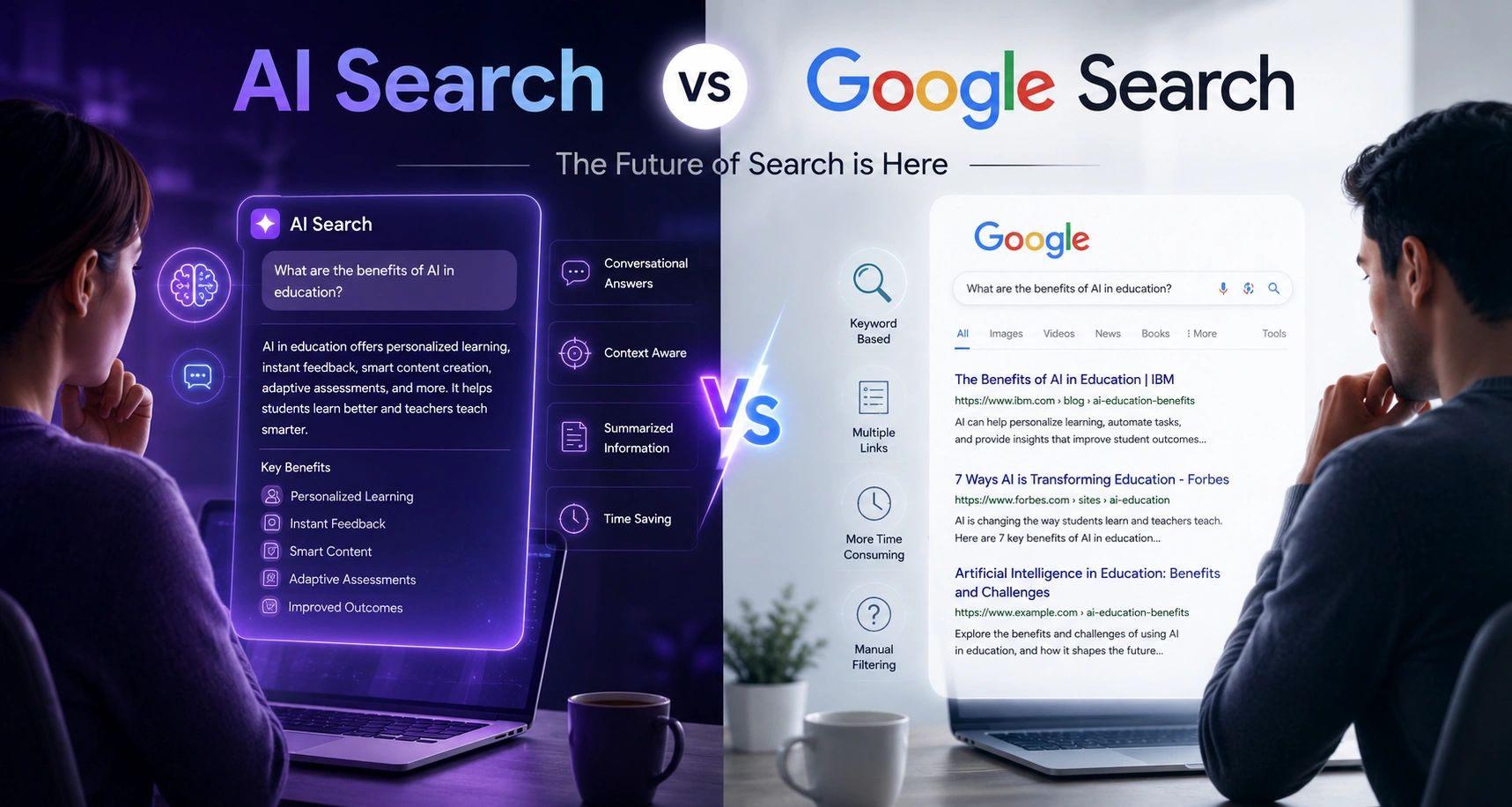
A student in Mohali looking for a digital marketing course a few years ago would type "digital marketing course in Mohali" into Google, scroll through ten blue links, open four tabs, and compare fees by hand. Today, that same student might type a longer question into an AI assistant instead: "I'm a beginner in Mohali and want a practical digital marketing course that can help me build job-ready skills. What should I look for?" The assistant doesn't just hand back a list of links. It explains what to check, weighs a few options, and sometimes names specific institutes and courses along the way.
That shift feels dramatic, and a lot of SEO commentary in 2026 treats it as proof that Google is being replaced by AI. It isn't. What's actually happening is narrower: search discovery has expanded beyond a single results page into several overlapping surfaces: Google's organic results, Google's AI Overviews and AI Mode, and independent tools such as ChatGPT, Gemini, and Perplexity. Most still lean on the same underlying signals: a website that's easy to crawl, content that actually answers the question asked, and a brand that both people and machines have reason to trust. This article looks at what has genuinely changed about how people search, what hasn't, and what businesses and marketers should do about it.
Google Search vs AI Search: What's Actually Different?
Traditional Google Search still works in a straight line: query → results page → click → website → action. Along the way, a searcher might see organic results, local map listings, shopping results, or a knowledge panel, but the reading and comparing is theirs to do.AI-powered search Google's AI Overviews and AI Mode, ChatGPT, Gemini, Perplexity follows a different path: a person asks a question, often with real context attached, and gets a synthesised answer built from multiple sources, sometimes with citations, sometimes with a follow-up question of its own. One AI exchange can replace what used to take three or four separate searches, because the system does some of the comparing itself.
It's tempting to simplify this as "Google gives links, AI gives answers," but that's not accurate anymore. Google's own Search Central documentation is explicit that AI Overviews and AI Mode are part of Google Search itself, not a rival product competing with it. Google's guidance also notes that these features often surface a wider and more diverse set of supporting links than a classic results page, since their systems identify more relevant pages while generating a response. The real change isn't links versus answers. It's that information now gets discovered, evaluated, and acted on differently, often across a conversational back-and-forth, before someone commits to a decision.
Is Traditional SEO Still Important in 2026?
Yes. This is worth saying plainly, because a lot of 2026 content implies otherwise.Websites still need to be discoverable, crawlable, indexable, fast, and genuinely useful because AI Overviews and AI Mode run on Google's existing Search index and ranking systems, not a separate one. Google has stated directly that there are no additional technical requirements or special markup needed to appear in these AI features: a page simply has to meet the same technical SEO fundamentals and be eligible to show a normal snippet in Search. Search intent, helpful content, internal linking, and topical authority aren't legacy tactics being phased out; they're the foundation AI features are built on.
The important distinction: AI search changes how visibility gets presented sometimes a summary with links, sometimes a classic results list but it hasn't removed the need for a website that deserves to be found in the first place.
How Search Intent Has Changed in the AI Era
Compare a keyword query "digital marketing course Mohali" with a conversational one: "I'm a student in Mohali who wants practical digital marketing training. What should I look for, and how do I avoid courses that are mostly theory?"The second carries far more context: a location, a skill level, a specific worry, and an implied comparison. This is common now across categories: longer questions, several constraints packed into one query, explicit comparisons, and follow-ups that build on an earlier answer instead of starting fresh.
This doesn't mean long-tail keywords have replaced short ones, or that keyword research is obsolete. It means understanding the information need behind a search, not just matching a phrase. A page built only to rank for "digital marketing course Mohali" will struggle to satisfy or be cited for the longer version of that same need. A page built to genuinely answer both does both jobs at once.
From Keywords to Topics, Entities, and Context
The practical shift looks like this: keyword → topic → entity → intent → context → relationship. A keyword alone tells you almost nothing about what someone needs; a fully covered topic, connected to related concepts, tells you a lot.Take "digital marketing course" as a topic. Around it sit concepts a learner actually cares about: SEO, Google Ads, social media marketing, analytics, AI tools, and critically whether the types of content taught actually build a usable portfolio. A page that only repeats an exact keyword phrase, without connecting to any surrounding context, gives a reader and an AI system very little to work with. A site that covers a topic in depth, with clearly linked pages on each related idea, signals real expertise to both.
Keywords haven't died. They're a useful signal for what people search. But alone, they're only one part of understanding what a search is really about.
What Makes Content More Useful for AI Search?
Content that performs well in AI-powered search shares a few traits, none of them exotic.Clear — it answers the implied question directly and early, in plain language, rather than building up to the point for several paragraphs.
Contextual — it explains who this applies to, when it's true, and when it isn't. A generic answer that ignores exceptions is less trustworthy than one that names them.
Verifiable — important claims are backed by a credible source, a genuinely expert author, or a specific, checkable example, not just asserted.
Structured — clear headings, short paragraphs, and lists or tables where they genuinely help, instead of dense text with the answer buried in the middle.
Original — first-hand experience, a specific example, or an insight that isn't already sitting on ten other pages in slightly different words.
This matters more than most SEO checklists admit. If ten sites already explain the same idea the same way, rewriting it an eleventh time, even cleanly, gives a reader, or an AI system choosing what to cite, little reason to prefer it. The content that gets used is the content that adds something the others didn't already say.
Does AI Search Mean You Should Stop Chasing Google Rankings?
No. Organic visibility still matters, rankings still drive a large share of discovery, and Google remains one of the biggest entry points to the internet for people with a specific, ready-to-act need. Strong SEO fundamentals also directly support visibility inside AI-powered experiences, since those experiences draw from the same index.What's genuinely new is a broader concept worth adopting: search visibility is bigger than ranking position. It now spans organic rankings, appearances inside AI-generated answers, brand mentions across the web, local-pack results, product visibility in shopping surfaces, and referral traffic from AI tools. Not all of these are equally easy to measure; citation tracking inside AI answers is still an immature discipline next to decades-old rank tracking, but treating rank position as the only scoreboard is no longer a complete picture of whether a business can actually be found.
How to Build an SEO Strategy for Both Google and AI Search
1. Fix technical SEO. Crawlability in robots.txt, clean indexation, mobile usability, reasonable speed, a working sitemap, and correct canonicals. Google is explicit that this is the foundation AI features rely on.2. Understand search intent. Build pages around the real reason someone is searching, not just the phrase typed.
3. Build topical depth. Instead of isolated articles, create connected clusters using the same logic behind a solid content marketing strategy so readers and search systems see the fuller picture.
4. Improve content clarity. Put the direct answer near the top; use headings that match what people actually ask.
5. Demonstrate real expertise. Name the author, show first-hand experience, use a specific worked example over a generic overview.
6. Strengthen brand authority. Relevant backlinks, digital PR, genuine reviews, and consistent business information all feed into how trustworthy a brand looks to people and algorithms.
7. Measure business outcomes. Track traffic, clicks, conversions, and brand searches, and add AI-referral traffic where reliable tools exist.
How Local SEO Is Changing in the AI Search Era
A useful test case: "Which digital marketing institute in Mohali is suitable for someone who wants practical training?" A local business a Chandigarh salon, a Mumbai boutique, a Bengaluru repair shop needs to make a few things unmistakably clear to readers and search systems alike: who you are, what you offer, where you operate, and why you're relevant.That means an accurate, complete Business Profile, consistent name-address-phone details across the web, genuine reviews, and website content describing services in specific terms rather than generic marketing language. None of this is about repeating city names in every paragraph that kind of stuffing doesn't help and reads badly. The goal is enough real information for people and search systems to place a business accurately.
What AI Search Means for E-commerce SEO
Take an online store selling iPhone covers. The traditional search is short: "iPhone 17 Pro Max covers." The AI-style version carries a real decision inside it: "What type of iPhone 17 Pro Max cover is best if I want something slim but still properly protective?"Answering that well means giving readers and AI systems more than a listing: accurate specifications, genuine reviews, comparison content between cover types, a short buying guide, organised category pages, and structured data matching what's visible on the page the same fundamentals covered in a solid e-commerce marketing approach. None of this replaces standard product SEO; it builds on it. AI search raises the value of genuinely useful product information over thin listings that just repeat a name and price.
What SEO Tactics Should Marketers Stop Relying On?
- Keyword stuffing → adds no value → write for the question, use keywords naturally.
- Mass-produced generic content → indistinguishable from ten other pages → invest in fewer pieces with real insight.
- Chasing every trending keyword → disconnected pages, no lasting authority → build clusters around subjects you can genuinely speak to.
- Buying low-quality backlinks → real risk, little benefit → earn links through digital PR and content worth referencing.
- Measuring success only by rank → misses how people actually find you → track traffic, conversions, and citations together.
- Publishing without a clear audience → satisfies no one → write for a specific reader with a specific need.
What SEO Professionals Should Start Doing in 2026
Build genuine topical authority instead of scattered pages. Publish original information rather than repackaged summaries. Answer complex, multi-part questions instead of narrow phrases. Strengthen demonstrable expertise through named authors and real experience, including comfort with AI tools that speed up research and drafting without replacing judgment. Improve how clearly your brand is represented across the web. Build content clusters that connect related pages. Design for more than one kind of search journey. Measure outcomes beyond rankings. Keep important pages updated. Build authority the slow way, through consistency, rather than chasing shortcuts.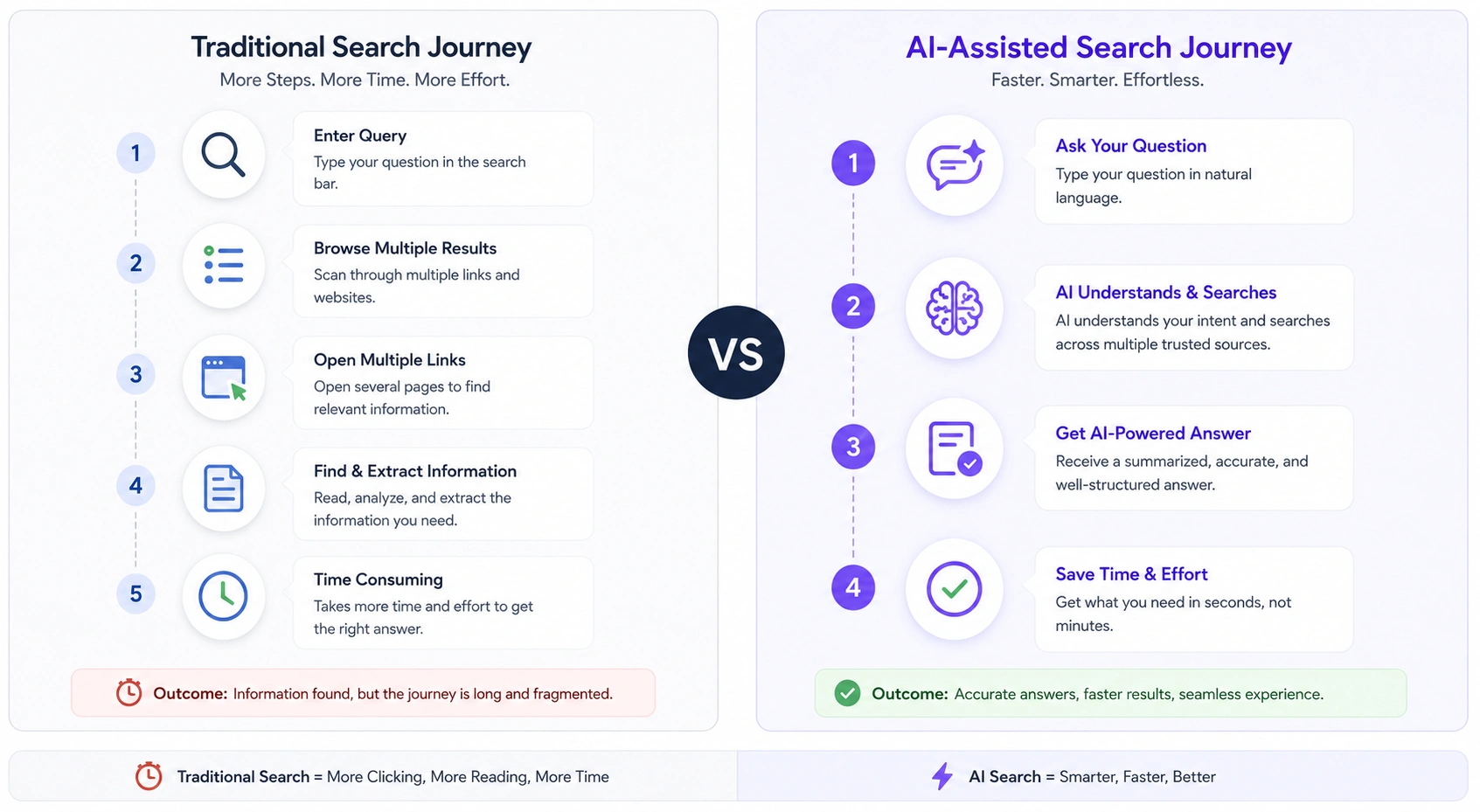
SEO vs AI Search Visibility: What Should You Prioritise?
| Area | Traditional SEO | AI Search Visibility |
| Main objective | Organic search visibility | Visibility within AI-generated answers |
| Content | Search-intent focused | Clear, contextual, and useful |
| Authority | Expertise, reputation, relevant links | Expertise, credibility, useful sources |
| Measurement | Rankings, clicks, traffic | Mentions, citations, referral signals where measurable |
| Technical foundation | Essential | Still essential |
| User experience | Important | Important |
The Future of SEO Is Search Visibility, Not Just Rankings
People increasingly discover businesses through more than one channel in the same week: a Google search, an AI assistant's answer, a Maps listing, a short video, a recommendation pulled from a chat with an AI tool. SEO's job is no longer answered by one question: "what position does my page rank at?" It's answered by a bigger one: can this brand be discovered, understood, trusted, and chosen, across however many places people now go looking? That's harder to measure cleanly, but it's the more honest question and the one that will still matter after today's AI products are replaced by newer ones.Frequently Asked Questions
Is SEO still worth doing in 2026?
Yes. AI Overviews, AI Mode, and other AI-powered search experiences run on the same underlying index and quality signals as classic Google Search, so fundamentals crawlability, useful content, and authority still determine whether a site is found at all.Is AI search replacing Google?
No. Google has built AI Overviews and AI Mode directly into Search rather than launching a separate competing product. Discovery now spans more surfaces, several of which Google itself owns and runs on its own index.Does traditional SEO help with AI search?
Yes. Google states there are no special technical requirements or extra markup needed to appear in AI Overviews or AI Mode beyond standard Search technical requirements and snippet eligibility. Solid, foundational SEO is what makes a page eligible in the first place.How can I optimise my website for AI search?
Focus on clear, direct answers near the top of relevant pages, genuine topical depth linking related content, verifiable sourcing, clean technical SEO, and structured data matching your visible text. There's no separate technical standard; the same good practices that help classic SEO help here too.What is the difference between SEO, AEO, and GEO?
SEO is the broad discipline of making a site discoverable and rankable. AEO (answer engine optimisation) and GEO (generative engine optimisation) are industry terms for optimising specifically toward being cited inside AI-generated answers, best understood as an extension of SEO, not a separate discipline with different rules.Will AI search reduce organic traffic?
It can, on queries where an AI summary satisfies the searcher without a click, a pattern documented industry-wide. Google has also indicated that clicks from pages appearing alongside AI Overviews tend to reflect higher engagement once someone clicks through. The realistic read is a shift in traffic patterns on some queries, not a wholesale collapse.Can AI-generated content rank on Google?
Google evaluates content on quality and usefulness regardless of how it was produced, and content made primarily to manipulate rankings falls under its spam policies either way. Thin AI content struggles for the same reason thin human content always does: it adds nothing a searcher couldn't find elsewhere.What should businesses focus on most in 2026?
One genuinely good website, built around real search intent, real expertise, and real usefulness, rather than two separate strategies for "Google SEO" and "AI SEO." The overlap between what earns rankings and what earns AI citations is far larger than the differences.Conclusion
SEO isn't disappearing because AI search exists. What's changing is the definition of being found: rankings still matter, but they now sit alongside citations, mentions, and referral traffic from AI tools as parts of a bigger picture of search visibility.The fundamentals haven't moved: a fast, crawlable website, content that genuinely answers the question asked, demonstrable expertise, and a brand people have a real reason to trust. For businesses and marketers navigating 2026, the takeaway is simple: stop treating "Google SEO" and "AI SEO" as two separate jobs. Build one strong, honest, useful website, and both forms of visibility tend to follow from the same work.
If you are interested and want to learn in depth, our Digital Marketing Course in Mohali offer practical training in social media marketing, SEO, paid ads, automation, and email marketing, all with 30+ AI tools.