
AI Workflow for Content Marketing: From Keyword Research to Publishing
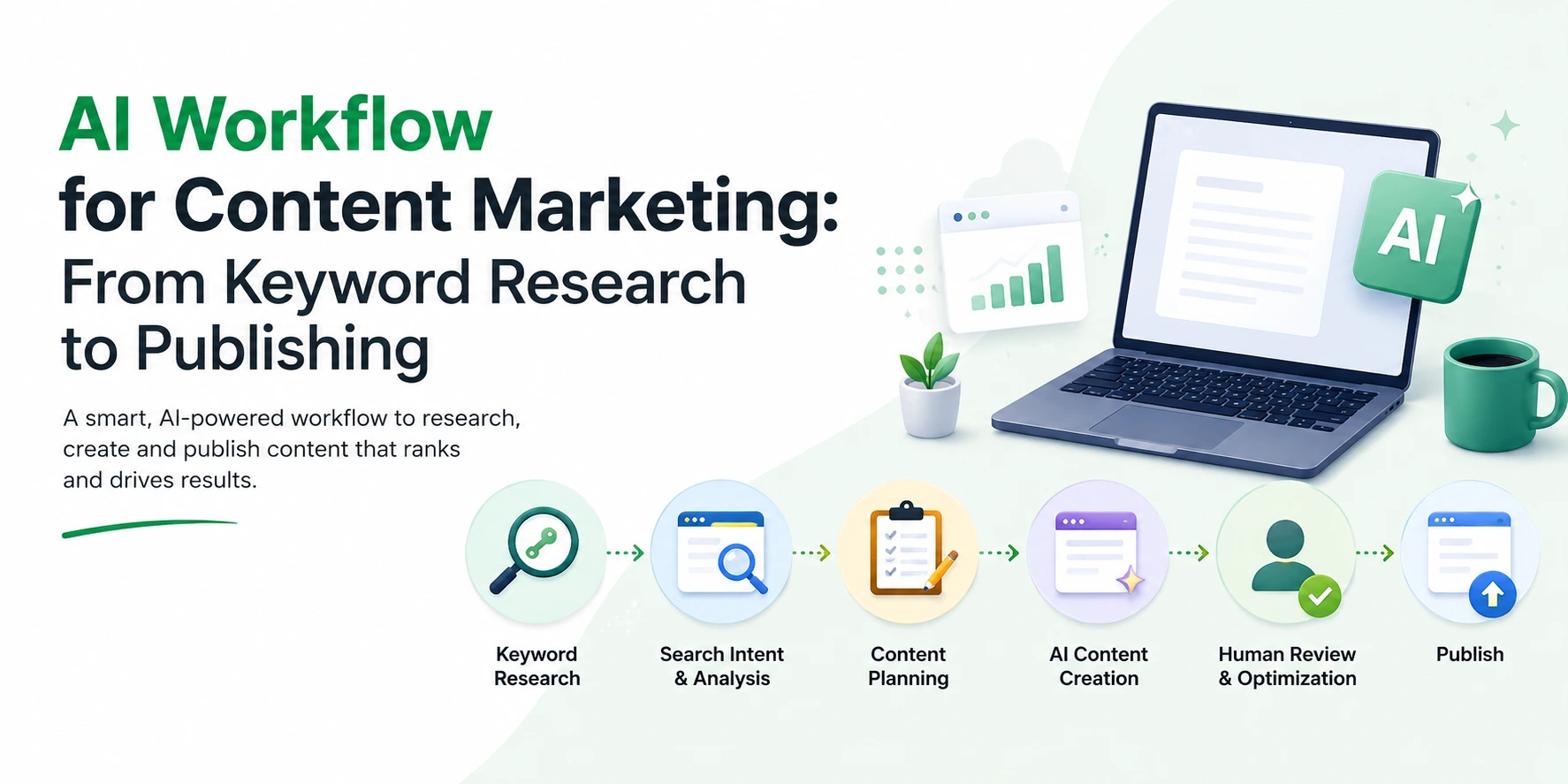
Ask an AI tool to write a blog post, and you will get a blog post. Ask it to power a content marketing workflow, and you get something more useful: a repeatable system that turns keyword research into published content that actually satisfies search intent and earns trust over time. Many marketers stop at the first step, typing a topic into a chatbot, copying the output and publishing it, then wondering why the content does not perform. An AI workflow for content marketing is not a shortcut around strategy. It combines keyword research, search intent, original research, AI-assisted drafting, human expertise, fact-checking, SEO optimisation and measurement into one connected process. This article breaks down how each stage works, where AI genuinely helps, and where a human still has to take over.
What Is an AI Workflow for Content Marketing?
An AI workflow for content marketing is a structured, repeatable process where AI tools support specific stages of content production while a human marketer directs strategy, verifies facts and adds original expertise. It is different from simply "using AI to write."A traditional workflow looks like this: research, write, edit, publish. It is linear and depends heavily on the writer's own knowledge and available time.
An AI-assisted workflow expands that into more distinct stages: keyword research, intent analysis, research, content brief, AI-assisted draft, human expertise, fact-checking, SEO optimisation, human editing, publishing, promotion, measurement and updating.
The extra stages exist because AI can produce text quickly, but text alone is not content marketing. Without a workflow, AI use becomes inconsistent, strong on some days and generic or inaccurate on others. A workflow keeps quality consistent regardless of who runs it or which tool is used.
Why Use AI in a Content Marketing Workflow?
Used well, AI genuinely speeds up parts of content marketing: faster initial research, quicker ideation and topic clustering, first-pass outlines, content repurposing, basic SEO analysis, editing suggestions and refreshing older articles. For a small business, freelancer or lean in-house team handling content across several clients, that saved time matters.AI also has clear limitations. It can state incorrect facts with total confidence. It tends toward generic, safe language unless given specific direction. Its knowledge can be outdated or wrong on niche or fast-moving topics, and left unchecked, it repeats the same ideas across articles and struggles to include real, first-hand experience.
The practical takeaway: AI accelerates specific tasks inside content marketing. It does not replace the strategic decisions, subject knowledge and judgement that make content genuinely useful.
AI Content Marketing Workflow at a Glance
Before going stage by stage, here is the full process in one view.| Stage | Purpose | How AI Helps | Human Responsibility |
| Keyword research | Find topics people search for | Generates seed and long-tail ideas | Validates with real search data |
| Search intent | Match content to what searchers want | Classifies likely intent | Confirms the right format |
| SERP analysis | Understand current expectations | Summarises ranking pages | Spots real content gaps |
| Content planning | Defines the angle and structure | Drafts a brief from research | Sets strategy and audience |
| Research | Gather accurate information | Speeds up source summaries | Verifies against primary sources |
| Writing | Produces the draft | Generates structured text | Adds expertise and direction |
| Fact checking | Confirm accuracy | Flags unclear claims if prompted | Verifies every specific fact |
| SEO optimisation | Improves relevance and usability | Suggests headings and keywords | Reviews for natural, useful copy |
| Editing | Improve quality | Assists with clarity edits | Runs the full editorial review |
| Publishing | Get the page live correctly | Helps draft metadata | Checks technical SEO details |
| Analytics | Measures real performance | Summarises reports | Interprets and decides next steps |
| Updating | Keep content accurate over time | Speeds up rewriting sections | Decides what needs to change |
Step 1: Use AI to Support Keyword Research
AI is useful for generating seed keyword ideas, long-tail variations, related topics and keyword clusters. This speeds up early brainstorming considerably.What AI should not do is replace actual search data. Search volume, keyword difficulty and real ranking behaviour come from live SEO tools, not a language model's training data. Use AI to widen the list of possibilities, then validate each opportunity with a proper keyword research tool before committing time to a topic.
Step 2: Analyse Search Intent
Every keyword carries an intent: informational (the searcher wants to learn something), commercial investigation (comparing options before deciding), transactional (ready to buy or sign up) or navigational (looking for a specific brand or page).AI can help classify intent quickly by reviewing a keyword and suggesting the likely category, which is useful when sorting large keyword lists.
For example, "what is content marketing" is informational, "best AI writing tools for bloggers" is commercial investigation, and a search for a specific brand name is navigational. This classification also helps decide which topics deserve organic content and which are better suited to paid channels like Google Ads.
Creating a listicle for a transactional keyword, or a sales page for a purely informational one, usually hurts performance even when the keyword itself is relevant.
Step 3: Analyse the Search Results Before Writing
Before drafting anything, look at what currently ranks: the content format, the headings competitors use, the questions in "People Also Ask," any featured snippet, and what seems thin or missing.This is not about copying competitor structure. It is about understanding what searchers expect to find, then identifying where existing content is shallow or missing practical detail. That gap should shape your content angle.
Step 4: Build an AI-Assisted Content Brief
A strong brief keeps both the AI tool and the writer focused. It should include: primary keyword, secondary keywords, search intent, target audience, content angle, proposed H1, H2 and H3 structure, questions to answer, planned internal links, credible external sources, E-E-A-T requirements and image ideas.Hypothetical example: a brief for "AI tools for small business marketing" might set the audience as Indian small business owners with limited budgets, and the angle as practical and cost-conscious rather than enterprise-focused.
AI can help draft this brief from your research, but the strategic decisions, audience, angle and depth should come from the marketer.
Step 5: Research Before Asking AI to Write
Research should happen before drafting, not during it: research, then evidence, then outline, then draft, not straight from prompt to finished article.Good sources include official documentation, established industry publications, original studies where available, and first-hand business knowledge. AI-generated summaries should always be checked against a primary source, since models can misstate details or state a plausible-sounding claim that is simply incorrect.
Step 6: Use AI to Create the First Draft
Vague prompts produce vague content. Asking an AI tool to "write a 2,500 word SEO blog about AI content marketing" with no other input generates generic, forgettable text.A better approach is to give the AI tool the audience, search intent, full outline, verified facts, real examples, brand voice notes and formatting requirements, then draft one section at a time rather than the entire article at once. Staged, section-by-section prompting gives the marketer more control and produces a draft closer to publishable quality from the start.
Step 7: Add Human Expertise and Original Value
This is where content marketing actually gets differentiated. AI can generate fluent language, but it cannot provide your real experience. Human expertise adds what an AI model cannot know about your specific situation, including first-hand observations, practical recommendations, business context, informed opinions, lessons learned from mistakes, and original ways of solving a problem.AI can accelerate content production, but human expertise creates the differentiation. In practice, this means reviewing the AI draft and asking: What do I know about this topic that the AI could not know? What would I tell a client, student or customer in this exact situation?
Adding two or three genuinely specific, experience-based insights can improve a draft far more than simply adding more AI-generated text.
For marketers, this also means understanding the fundamentals behind the content you are creating. SEO, content strategy, social media, paid advertising and analytics help you decide what to create, who it should reach and how it should support a business goal. If you want to develop these practical digital marketing skills alongside AI, learn more about the Digital Marketing Course in Mohali at Digital Study School.
Step 8: Fact-Check AI-Generated Content
Confident language is not the same as accurate language. AI models can state incorrect statistics, wrong dates or invented features with the same tone of certainty as correct information.Before publishing, verify:
-
Statistics and figures
-
Dates and timelines
-
Product or tool information
-
Platform features and capabilities
-
Pricing
-
Any claim about search engine algorithms
-
Quotes attributed to a person or source
-
Regulations or compliance requirements
-
Research findings referenced in the draft
Step 9: Optimise AI-Assisted Content for SEO
Once the facts and expertise are in place, review the content for on-page SEO: a clear title and H1, a logical H2 and H3 structure, natural keyword placement, related terms, relevant internal links, credible external sources, descriptive image alt text, an accurate meta description, a clean URL and schema markup where it applies. This matters just as much for commercial content, such as an affiliate marketing product roundup, as for a purely informational guide.The goal is relevance and usability, not keyword density. Content stuffed with exact match phrases reads poorly and rarely performs better than content that simply covers the topic thoroughly and naturally.
Step 10: Optimise Content for AI Search
Search behaviour now includes AI-powered experiences such as Google's AI Overviews, and standalone tools like ChatGPT, Gemini and Perplexity. These systems tend to favour clear definitions, direct answers near the top of a section, well-structured headings, verifiable information and genuine topical depth.Writing clearly for these systems largely overlaps with writing clearly for search engines and readers. No workflow can guarantee a specific citation or appearance in an AI-generated answer. The realistic goal is content that is easy to understand, verify and reference.
Step 11: Human Editing and Quality Control
A structured, multi-pass edit catches issues a single read-through misses:-
Accuracy: confirm every fact, figure and claim
-
Search intent: confirm the format and depth match what the searcher wants
-
Usefulness: confirm each section adds real value, not filler
-
Originality: confirm the content includes genuine expertise, not just rephrased AI output
-
Readability: confirm sentence and paragraph length, structure and flow
-
SEO: confirm keyword placement, headings, links and metadata are correct
Step 12: Publish the Content Properly
Before publishing, confirm the SEO title and meta description are finalised, the URL is clean, images have proper alt text, internal links work, author information is visible, the date is accurate, schema markup is applied where relevant, the page displays correctly on mobile, and it is indexable with a correct canonical tag and sitemap entry. These details are easy to overlook after a long writing process, but they directly affect performance.Step 13: Repurpose and Distribute the Content
One well-researched article can be adapted into a LinkedIn post, an Instagram carousel or Reel, a YouTube Short script, an email, standalone social posts, or a broadcast message for businesses using WhatsApp Marketing to stay in touch with customers.AI can help adapt tone, length and format for each platform while the core message stays consistent with the original article. Reformatting existing verified content is lower-risk than generating new claims from scratch.
Step 14: Measure Content Performance
Traffic, clicks, impressions, click-through rate, rankings, engagement, and conversions each tell a different part of the story, and diagnosing a problem means reading them together, similar to how a performance marketing campaign is judged on multiple metrics.Deep impressions with a low click-through rate usually point to a weak title or meta description. High traffic with low conversions usually points to a weak call to action or a mismatch between the content and the offer. Low impressions despite good content often points back to keyword targeting or insufficient topical coverage, not the writing itself. Treat these as starting points for investigation, not a definitive diagnosis.
Step 15: Update the Content Using AI
Publishing is not the end of the workflow. Monitor performance, identify gaps, research what has changed, improve the content, fact-check again, then update it.Changing the publish date without meaningfully changing the content adds little value and can appear misleading to readers. A genuine update improves accuracy, adds missing examples, refreshes outdated information and improves the match with current search intent.
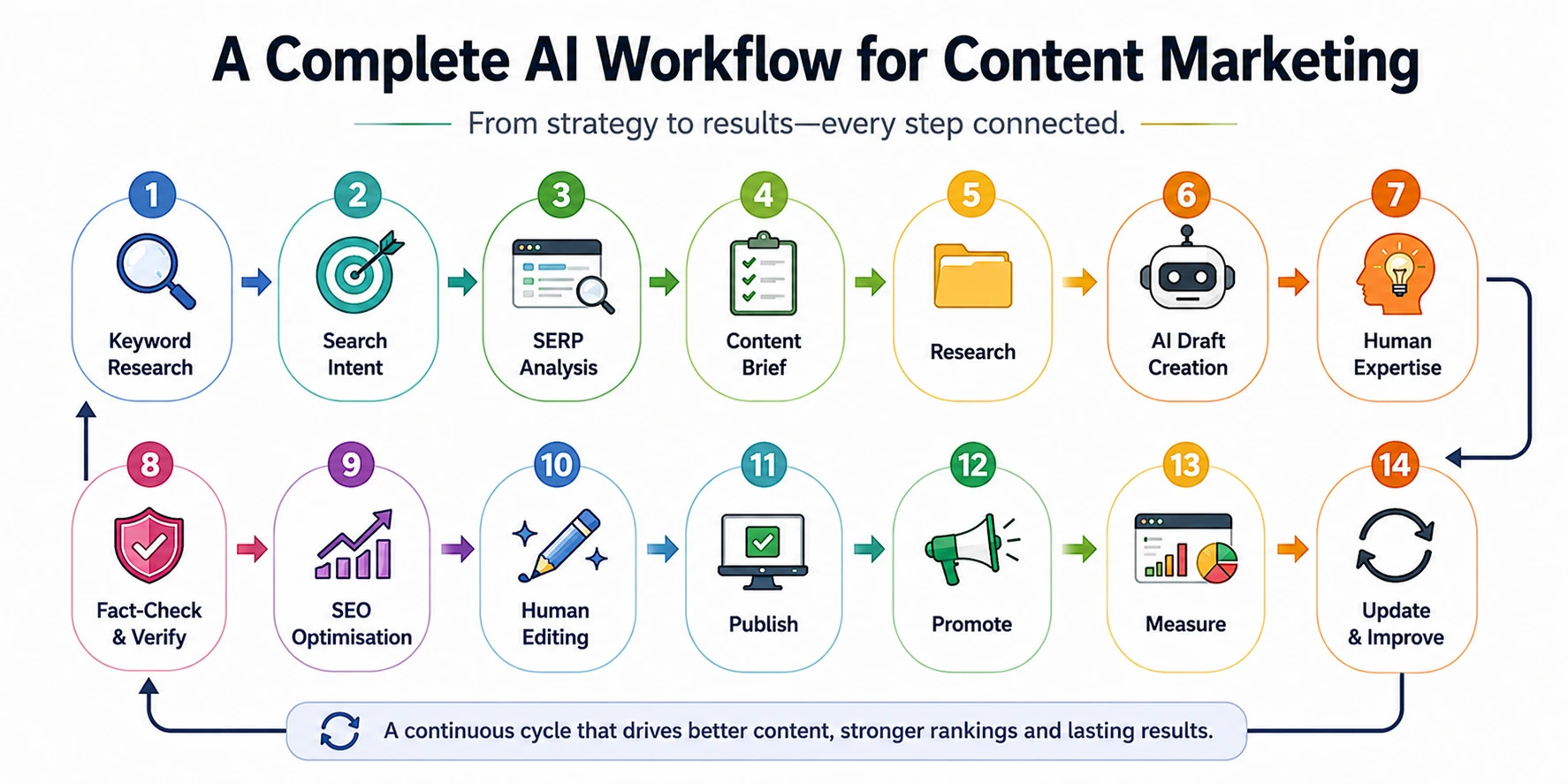
A Complete AI Workflow for Content Marketing
Bringing every stage together: keyword research, search intent, SERP analysis, content brief, research, AI draft, human expertise, fact-check, SEO optimisation, human editing, publish, promote, measure and update. Each stage feeds the next, and skipping one usually shows up later as inaccurate content, poor rankings or writing that reads as generic. This sequence, not any single AI tool, is what makes AI-assisted content marketing repeatable over time.Common AI Content Marketing Mistakes
-
Asking AI to write everything without a strategy behind it
-
Publishing AI output without fact-checking it first
-
Choosing keywords based only on search volume, ignoring intent
-
Copying competitor structure too closely instead of finding real gaps
-
Removing human expertise to save time
-
Overusing AI-generated examples that read as generic or invented
-
Ignoring internal linking, which weakens site structure and discovery
-
Focusing only on rankings while ignoring whether content actually converts
How to Make AI-Assisted Content More Human
Add real examples drawn from actual experience. Include original observations the AI could not have generated on its own. Vary sentence length instead of letting every paragraph follow the same rhythm. Remove generic openings and stock phrases. Include a genuine opinion where it helps the reader. Edit out repetitive AI phrasing, and simplify explanations that are more complex than they need to be. None of this is guaranteed by running a draft through an AI "humanizer" tool; it comes from actual editing.AI Tools for Different Content Marketing Tasks
Rather than a long tool list, think in terms of workflow stage. Keyword research needs a dedicated SEO tool with real search data. Research benefits from AI assistants that summarise sources, alongside primary sources. Writing benefits from AI models capable of following detailed, staged prompts. SEO optimisation benefits from on page analysis tools. Design work benefits from AI image tools. Analytics relies on your website's analytics and Search Console data. Repurposing benefits from AI tools that reformat content for different platforms. No single tool is objectively best for every team; the right choice depends on budget and existing systems.AI Content Marketing E-E-A-T Checklist
Experience: include real, clearly labelled hypothetical examples or genuine first-hand observations, not invented case studies presented as fact.Expertise: explain why each recommendation works, not only what to do.
Authority: reference credible, verifiable sources for factual or platform-specific claims.
Trust: be transparent about what AI can and cannot do, and avoid exaggerated or guaranteed outcomes.
E-E-A-T is not demonstrated by a single paragraph claiming trustworthiness. It comes from the accuracy, depth and honesty of the entire page.
If you want to develop the broader SEO, content marketing, social media and paid advertising skills needed to use AI effectively in marketing, you can learn more about the Digital Marketing Course in Chandigarh at Digital Study School.
FAQs
What is an AI workflow for content marketing?
It is a structured process where AI tools assist with research, drafting, SEO and repurposing, while a human marketer handles strategy, fact-checking, and original expertise. It typically covers keyword research, intent analysis, briefs, drafting, editing, publishing, promotion, measurement and updates rather than a single AI-generated draft.How can AI help with content marketing?
AI can speed up keyword brainstorming, generate first draft outlines and content, assist with editing, help repurpose content across formats and support basic SEO analysis. It works best as an assistant inside a defined workflow, not as a replacement for strategy, subject knowledge or verification.Can AI automate content marketing?
AI can automate specific tasks such as drafting, formatting and repurposing, but full automation without human review is risky. Factual errors, generic writing and outdated information are common issues, so human oversight for accuracy, strategy and expertise remains necessary at multiple stages.Can AI do keyword research?
AI can generate seed keywords, related terms and topic clusters quickly, which is useful for early ideation. However, it does not have access to live search volume or difficulty data, so keyword opportunities should always be validated with an actual SEO or keyword research tool.Should AI write an entire blog post?
Letting AI write an entire post unsupervised usually produces generic, unverified content. A more reliable approach is to give AI a detailed brief, verified facts and an outline, then add human expertise, fact-check the result and edit it before publishing.How do you fact-check AI-generated content?
Check statistics, dates, product and pricing details, platform features, algorithm claims, quotes and regulatory information against current, credible sources. Confident-sounding language from an AI tool does not confirm accuracy, so every specific factual claim needs independent verification before publishing.Can AI-generated content rank on Google?
Content that started as an AI draft can rank if it is accurate, genuinely useful, well optimised and includes real expertise, similar to any other content. There is no guarantee tied to how content was drafted; quality, accuracy and relevance to search intent matter more than the writing method.How do you make AI content more useful?
Add specific, experience-based examples, verify every fact, answer the exact questions the searcher has, remove generic phrasing and structure the page clearly with headings and direct answers. Usefulness comes from depth and accuracy, not from the length of the article.What is the best AI workflow for SEO content?
There is no single best workflow, but an effective one includes keyword and intent research, SERP analysis, a detailed brief, AI-assisted drafting, human expertise, fact-checking, SEO optimisation, editing, publishing and ongoing measurement and updates, rather than a single prompt-and-publish step.How often should AI-assisted content be updated?
This depends on the topic. Fast-changing subjects may need review every few months, while more stable topics can be reviewed less often. A practical approach is to monitor performance and revisit content whenever rankings drop, information becomes outdated or new questions emerge.