How to Build a Digital Marketing Funnel That Converts
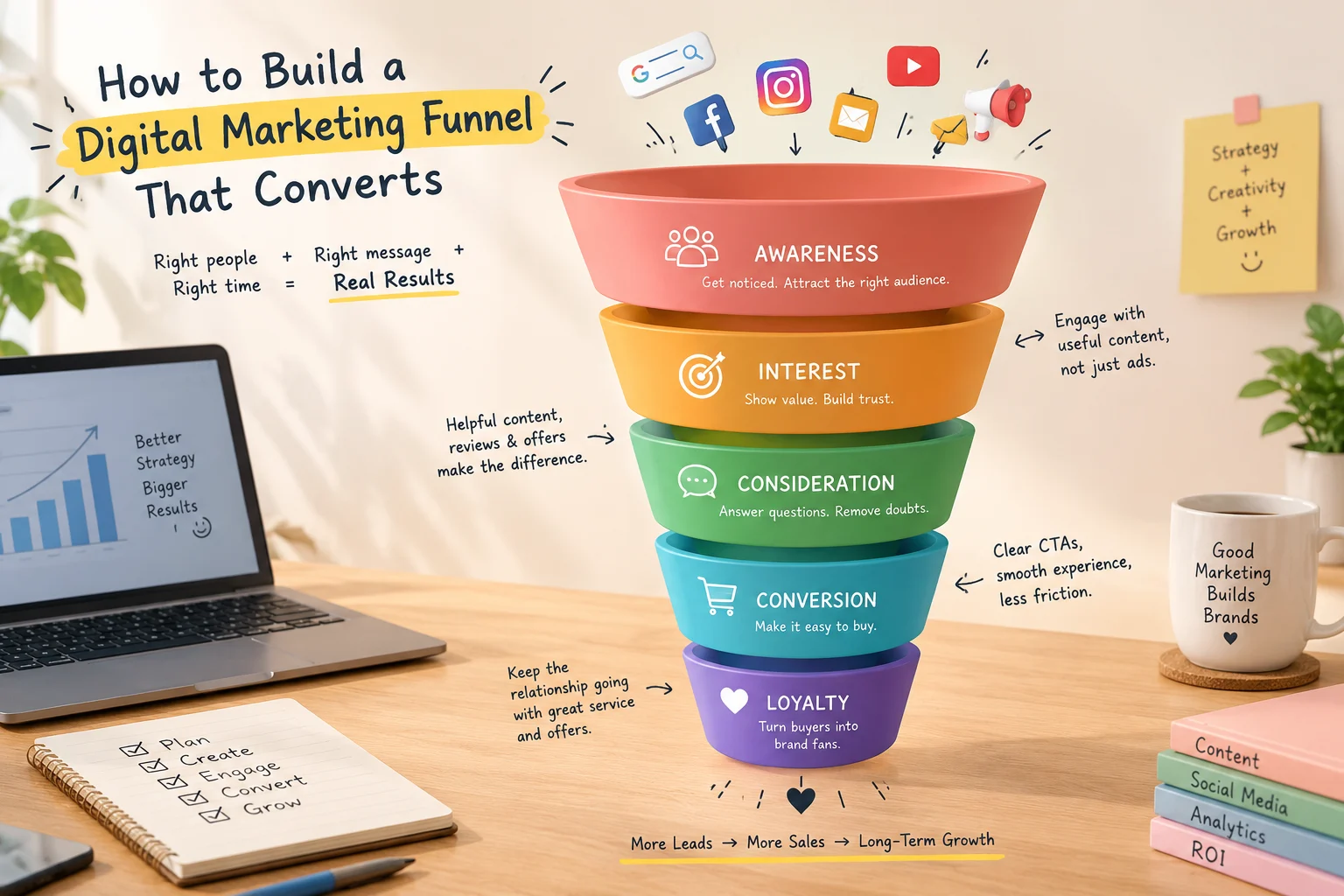
You can have steady traffic, a growing Instagram page and a busy inbox of form fills, and still struggle to sell. Attention is not intent, and a click is not a customer. A digital marketing funnel connects the two. It is a structured path of stages, channels, content and follow-up that guides people from first discovery to purchase and beyond.
This guide shows you how to build one from scratch, using a single working sequence: Goal → Audience → Journey → Funnel → Channels → Content → Conversion → Nurturing → Measurement → Optimisation. You'll also learn how to find out where a funnel is leaking. It works for small business owners and for learners studying digital marketing strategy.
What Is a Digital Marketing Funnel?
A digital marketing funnel is a model of the path people take from first noticing a business to becoming customers, together with the marketing that supports each step. It is called a funnel because many people enter at the top and fewer move forward at every stage.People rarely buy at first contact. Someone watches a video, ignores it, searches for the problem weeks later, reads reviews, and only then enquires. The funnel gives each of those moments a purpose.
A marketing funnel covers the whole journey, from attention through retention. A sales funnel is narrower. It begins when a person becomes a lead and follows the sales process to a closed deal. Marketing feeds the sales funnel.
Real journeys are not perfectly linear. People skip stages, loop back to compare options, or arrive ready to buy because a friend referred them. Treat the funnel as a planning tool, not a law.
Take a dental clinic. A patient searches "teeth whitening cost," reads a service page, checks reviews, then books through WhatsApp. That is a funnel, whether or not the clinic designed it.
What Are the Stages of a Digital Marketing Funnel?
Funnel models vary. Some use three stages; others use AIDA (Awareness, Interest, Desire, Action). This guide uses six, because retention and advocacy often decide whether a business is profitable. Six is a practical model, not the only correct one.At each stage, ask the same chain of questions: customer need → marketing action → channel → content → CTA → metric.
1. Awareness
The person has a problem but may not know you exist. Your aim is relevant attention. Search, short video and organic social work well here, with how-to guides and explainers as content. Keep the CTA soft: read the next guide, watch a video. Track reach, new visitors and the share of visitors who fit your audience.2. Interest
They now want to understand the problem. Answer their questions with tutorials, checklists and templates. A lead magnet, such as a free checklist, can earn an email address. The CTA is a next step, like subscribing. Watch engaged sessions, video completion and signup rate.3. Consideration
They are comparing options. Trust matters most here, so use case studies, testimonials, comparisons, demos, reviews and FAQs. Address doubts directly. Measure return visits, demo requests and engagement with proof content.4. Conversion
They are ready to act: buy, book, enrol, request a demo or submit a form. Use focused landing pages, clear CTAs, visible trust signals and low-friction checkout. The metric is conversion rate at the action you defined.5. Retention
The sale is not the finish line. Onboarding, support, useful emails, education, cross-selling and upselling turn a first purchase into a lasting relationship. Track repeat purchases, churn and product usage.6. Advocacy
Happy customers recommend you through reviews, referrals, testimonials, user-generated content and word of mouth. Ask at the right moment, then measure referral volume and review count.How to Build a Digital Marketing Funnel Step by Step
Each step below builds on the one before it. Skipping ahead to ads or landing pages is the most common reason funnels fail.Step 1: Define Your Business Goal
A funnel begins with one measurable outcome, not a collection of activities. The goal changes the whole design:-
Lead generation: qualified enquiries
-
Ecommerce: completed orders
-
Course enrollment: paid enrolments
-
Consultation bookings: appointments held
-
Software trials: trials that become paid plans
-
B2B demos: demos completed
-
Repeat purchases: customers who buy a second time
Step 2: Define Your Ideal Customer
Go beyond age and location. Work out what triggered their search, what problem they want solved, what they are afraid of, and what would stop them buying. Note who else influences the decision, what they can spend, where they look for answers, and how much information they need first.Each answer shapes something. Objections become middle-funnel content. Budget shapes the offer. Preferred channels shape distribution.
Step 3: Map the Customer Journey
Sketch the path as Problem → Discovery → Research → Evaluation → Decision → Purchase → Retention. Under each point, write what the customer needs. In research, they need explanations. In evaluation, they need proof. At decision, they need clarity on price, process and risk. Remember that people can enter anywhere, so a referred customer may begin at evaluation.Step 4: Choose the Right Funnel Stages
Match funnel complexity to the buying decision. A low-priced product may need three steps. A high-priced course or B2B software needs more. Complexity rises with price, sales cycle length, customer risk, product complexity, trust required and the number of decision-makers.Step 5: Select the Right Marketing Channels
Search captures existing demand. Social and video create awareness. Paid advertising adds speed. Email builds a relationship you control. Content marketing earns trust over time. Creators borrow credibility, referrals multiply it, and WhatsApp suits customers who prefer conversation. You do not need all of them. Choose by audience behaviour, intent, business model, resources and funnel stage.Step 6: Create Content for Each Stage
Use one chain: customer question → content → CTA → next stage. A learner asking "Is this course worth it?" needs a syllabus walkthrough or student project review, followed by a CTA to book counselling. Every piece of content should point somewhere.Step 7: Build the Conversion Path
Decide where people will act: landing page, service page, lead form, booking page, checkout, consultation, demo, free trial, or a call or WhatsApp button. Match each ad or post to a page that continues the same promise, and remove steps that add friction.Step 8: Create a Lead-Nurturing Process
Most leads are not sales-ready. Follow up with a welcome email, educational content, case studies, testimonials and answers to common objections. Retargeting can gently remind visitors who left.Step 9: Set Up Tracking
Track traffic, engagement, leads, qualified leads, conversions, revenue, acquisition cost and retention. Agree in advance what "qualified" means. Tag campaigns consistently and record outcomes in a CRM or even a simple spreadsheet.Step 10: Test and Improve
Follow a loop: Measure → Diagnose → Test → Compare → Improve. Optimisation never ends, because audiences, competitors and channels keep changing.What Content Should You Create at Each Funnel Stage?
| Funnel Stage | Customer Need | Content Examples | CTA | Main Metric |
| Awareness | Understand the problem | Explainer videos, how-to guides, search-focused articles | Read next, watch, follow | Qualified traffic |
| Interest | Learn how to solve it | Tutorials, checklists, webinars, newsletters | Download, subscribe | Signup rate |
| Consideration | Compare and trust | Case studies, comparisons, demos, FAQs, reviews | Book a demo, request details | Demo or enquiry rate |
| Conversion | Feel safe deciding | Landing pages, pricing, guarantees, checkout | Buy, book, enrol | Conversion rate |
| Retention | Get value after buying | Onboarding, tips, support content, loyalty emails | Use, renew, buy again | Repeat rate |
| Advocacy | Share a good experience | Review requests, referral offers, community features | Review, refer | Referrals, reviews |
Which Digital Marketing Channels Work at Each Funnel Stage?
No channel is universally best. Effectiveness depends on your audience, buyer intent, product or service, sales cycle, budget and business model. The channels below simply tend to play different roles.-
Search (SEO): captures people actively looking for answers, mostly awareness through consideration.
-
Google Ads: reaches people with clear search intent, often near conversion.
-
Meta and social advertising: creates demand and reaches defined audiences, from awareness to lead capture.
-
Organic social media: builds familiarity and shows personality. It supports awareness and advocacy.
-
Email: nurtures leads and retains customers.
-
Content marketing: educates, builds trust and feeds every stage.
-
Video: explains and demonstrates, useful from awareness to consideration.
-
Influencer marketing: borrows an existing audience's trust.
-
Remarketing: brings back people who showed interest.
-
Referral marketing: turns satisfied customers into new leads.
How to Build a Funnel for Different Business Models
The right funnel depends on how people buy.-
Ecommerce: Social/search → Product page → Cart → Checkout → Purchase → Retention. Decisions are quick, so friction and trust at the product page and checkout matter most.
-
Local service business: Search/ads → Service page → Call/form/WhatsApp → Qualification → Appointment → Service → Review. Customers want speed and local proof, so the funnel ends in a conversation and a review.
-
Online education: Social/search → Educational content → Lead magnet/webinar → Course page → Counselling → Enrollment → Onboarding. The purchase is a big commitment, so guidance is part of the funnel.
-
B2B: Content/search → Landing page → Lead → Nurturing → Demo → Proposal → Sale. Several people decide over weeks or months, so nurturing and sales alignment carry the weight.
-
Agency or freelancer: Content → Portfolio/case study → Consultation → Proposal → Client. Buyers are hiring judgement, so proof of work matters more than volume.
How to Build a Conversion Path That Turns Interest Into Action
Traffic does not equal conversion. A business can have plenty of visitors and still lose most of them on a weak page. A strong conversion path removes doubt when someone is considering acting.-
State the value clearly. Say what you offer, for whom, and why it matters, above the fold.
-
Match the message. The headline should continue whatever the ad, email or post promised.
-
Keep one main CTA. Give the visitor one obvious next step.
-
Show trust. Add reviews, testimonials, credentials you can verify and answers in an FAQ.
-
Reduce form friction. Ask only for what you need to follow up.
-
Design for mobile. Many visitors will arrive on a phone, so buttons and forms must be easy to use.
-
Be clear about pricing. Where appropriate, explain the price or what happens after an enquiry.
-
Use the thank-you page. Confirm the action and say what happens next.
How Lead Nurturing Moves Prospects Toward Conversion
Leads often don't buy immediately because they are still comparing, waiting on budget, or unsure whether you fit. Lead nurturing keeps you useful until they are ready.Start with a welcome message that delivers what you promised. Then send an educational sequence that answers the next likely question. Bring in case studies and social proof as they consider options, and address objections openly. Follow up when someone takes a meaningful action, such as visiting a pricing page. Retargeting can reinforce the same messages elsewhere.
Timing and relevance matter more than frequency. Nurturing should feel like help, not pressure, so avoid flooding people with repeated sales messages.
How to Measure Digital Marketing Funnel Performance
Measure the funnel as a progression: Traffic → Engagement → Leads → Qualified Leads → Customers → Revenue → Repeat Customers.-
Traffic: visitors and their sources.
-
Engagement: time spent, pages viewed, video views, clicks.
-
Conversion rate: the share of people who take a defined action.
-
Leads and qualified leads: total enquiries, and those that fit your criteria.
-
Cost per lead: spend divided by leads.
-
Customer acquisition cost: spend divided by new customers.
-
Revenue and return on ad spend: where you run paid campaigns.
-
Retention and repeat purchase: how many customers come back.
-
Customer lifetime value: what a customer is worth over time, where you have enough data.
How to Find Where Your Marketing Funnel Is Losing Customers
Compare each stage with the one before it, then use the symptoms below as a starting point. These are possible causes to investigate, not guaranteed diagnoses.Traffic problem: too few people arrive. This may indicate weak audience targeting, poor channel selection, limited reach or inadequate distribution. Check where your audience actually spends time.
Engagement problem: people arrive but leave. Possible causes include the wrong audience, weak messaging, poor relevance or a disappointing landing experience. Compare the promise in the ad with what the page delivers.
Lead problem: people engage but don't enquire. Investigate the offer, an unclear CTA, form friction and the conversion page itself.
Sales problem: leads exist but don't become customers. Possible causes include low lead quality, thin nurturing, missing trust signals, pricing concerns, a slow sales process or late follow-up. Talk to lost leads if you can.
Retention problem: customers don't return. Look at onboarding, customer experience, the value of the product or service, and how you communicate after purchase.
Fix the first leak you find. Improving later stages rarely helps if the earlier ones are broken.
Common Digital Marketing Funnel Mistakes
-
Sending all traffic to the homepage. Send each source to a page built for its intent.
-
Using one CTA everywhere. Match the CTA to the stage.
-
Selling too early. Offer education first, then the pitch.
-
Creating content with no next step. End each piece with a relevant action.
-
Ignoring lead nurturing. Build a simple follow-up sequence.
-
Using too many channels. Master one or two before adding more.
-
Tracking clicks but not outcomes. Measure leads, sales and revenue.
-
Ignoring existing customers. Add onboarding and repeat-purchase communication.
-
Misaligned landing pages. Match headline and offer to the traffic source.
-
Failing to test. Change one thing at a time and compare results.
-
Treating every lead identically. Separate leads by readiness and fit.
How to Optimize a Digital Marketing Funnel Over Time
Follow this cycle: Measure → Identify the bottleneck → Form a hypothesis → Test → Analyze → Improve.Start with the biggest meaningful bottleneck, the stage where the most valuable people drop out. Write a hypothesis, such as "A shorter form will increase enquiries," and test that single change. Then compare results over a long enough period to trust them.
You can test CTAs, landing pages, offers, ad creatives, audiences, email subject lines and follow-up timing. Changing everything at once makes it impossible to know what worked.
Complete Digital Marketing Funnel Example
Consider an online digital marketing course. This is an illustration, not a formula that guarantees enrollments.-
Social/video content: short lessons and tips attract beginners.
-
Educational resource: a free guide or checklist deepens interest.
-
Lead capture: a simple form exchanges the resource for contact details.
-
Email/WhatsApp nurturing: follow-ups share tips, student work and answers to common questions.
-
Course information: a page covers syllabus, outcomes, fees and FAQs.
-
Demo/counselling: a conversation helps learners judge fit.
-
Enrollment: a clear, simple path completes registration.
-
Student onboarding: early guidance helps students get started.
-
Review/referral: satisfied students are invited to share feedback or recommend friends.
Digital Marketing Funnel Checklist
-
Business goal defined
-
Target audience defined
-
Customer journey mapped
-
Funnel stages selected
-
Channels selected
-
Content mapped
-
Conversion point created
-
Lead capture created
-
Nurturing process created
-
Tracking implemented
-
KPIs defined
-
Drop-off points monitored
-
Testing process established
-
Retention strategy established
FAQs
What is a digital marketing funnel?
A digital marketing funnel is a model showing how people move from first discovering a business to becoming customers, along with the marketing used at each stage.How do you build a digital marketing funnel?
Define your goal, understand your customer, map the journey, choose stages and channels, create content, build a conversion path, nurture leads, track results, and keep testing.What are the stages of a digital marketing funnel?
Common stages are awareness, interest, consideration, conversion, retention and advocacy. Some businesses use fewer stages, others more.What is the difference between a marketing funnel and a sales funnel?
A marketing funnel covers the whole customer journey, from attention to retention. A sales funnel focuses on turning leads into paying customers.Which channels can be used in a digital marketing funnel?
Search, paid ads, social media, email, content marketing, video, influencer marketing, remarketing, referrals and messaging apps such as WhatsApp. Choose based on audience and goal.How do you generate leads through a marketing funnel?
Offer something useful, such as a guide, demo or consultation, on a focused page with a simple form, then follow up with relevant communication.How do you measure funnel performance?
Track each stage: traffic, engagement, leads, qualified leads, customers, revenue and repeat purchases, then compare conversion between stages.How long does it take to build a digital marketing funnel?
A simple funnel can be set up in a few weeks. Refining it takes longer, because you need enough data to learn what works.A digital marketing funnel is not just a diagram. It is a connected system of customer needs, channels, content, conversion, follow-up and measurement. Build yours around your actual business goal and customer journey rather than copying a generic template, then improve it one bottleneck at a time. For a deeper look at combining automation with funnel thinking, read our guide to the AI-powered marketing funnel, and to sharpen your channel skills, see our resources on performance marketing.
If you are interested and want to learn in depth, our Digital Marketing Course in Mohali offer practical training in social media marketing, SEO, paid ads, automation, and email marketing, all with 30+ AI tools.