
How to Create a Social Media Marketing Strategy for a Small Business: A Step-by-Step Guide
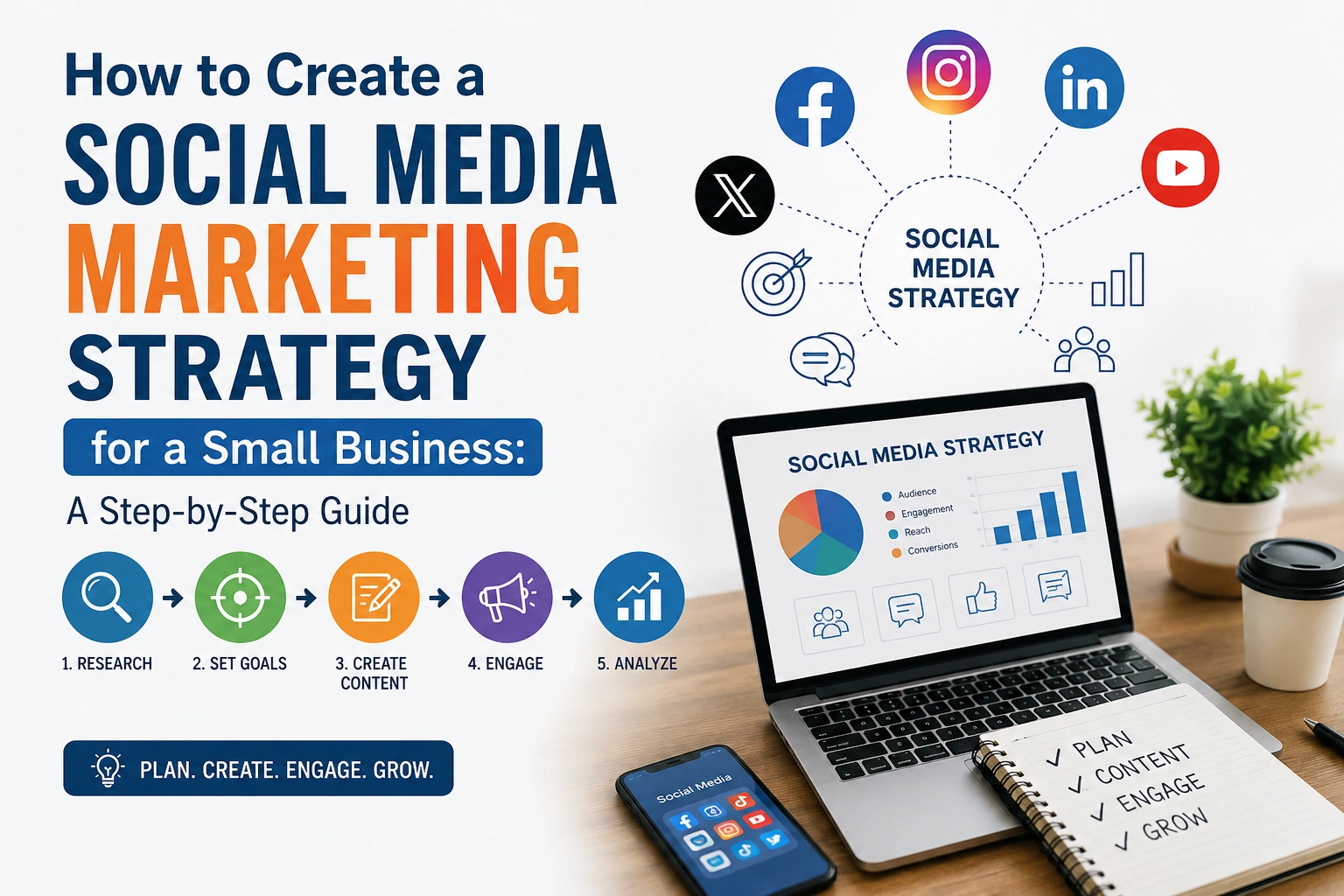
Most small businesses don't have a social media problem. They have a strategy problem.
They post regularly. They spend time on captions and photos. Some even run the occasional promotion. Yet enquiries stay flat, and it's hard to tell whether any of it is actually working. This usually isn't a content quality issue; it's a missing connection between what gets posted and what the business is actually trying to achieve.
A social media marketing strategy fixes that gap. It's the difference between posting because "we should be active on Instagram" and posting because each piece of content moves a specific type of customer one step closer to buying, booking, or enquiring.
This guide walks through a complete, practical framework for building that strategy one step at a time, using real small-business scenarios rather than abstract theory.
What Is a Social Media Marketing Strategy?
A social media marketing strategy is a documented plan that connects a business goal to the right audience, the right platform, the right content, and a way to measure whether it's working. It is not the same as a content calendar, and it's not the same as "posting consistently." A calendar tells you what to publish and when. A strategy tells you why you're publishing it and what it's supposed to achieve.A useful way to think about this is as a chain, where each link depends on the one before it:
Business Goal → Ideal Customer → Platform → Content Pillars → Content Format → Distribution → Engagement → Conversion → Measurement → Optimization
If any link in this chain is missing or disconnected, the whole system tends to underperform. A business might pick a platform without knowing its audience, or create content without a clear goal, and then wonder why followers don't turn into customers. A strong social media strategy also works alongside a broader content marketing strategy, where different content formats support awareness, trust, and conversions. The rest of this guide works through each link in that chain.
Why Small Businesses Need a Social Media Strategy
Small businesses often assume they're at a disadvantage against bigger brands with larger budgets. In practice, budget isn't usually the deciding factor on social media; clarity is. A large brand with an unfocused strategy will still underperform a small business that knows exactly who it's talking to and what it wants that person to do next.There's also a behavioural shift worth acknowledging: customers now routinely check a business's social profiles before making a decision. Someone in Chandigarh comparing restaurants for a Saturday dinner will often look at recent photos and reviews before calling. Someone in Mohali choosing a salon will scroll through an Instagram grid before booking. The profile itself has become part of the buying decision, which is exactly why a plan behind it matters more than the volume of posts.
Step 1: Define Your Business Goal
Every strategy should start with a specific, measurable business goal, not "get more followers" or "increase engagement." Followers and likes are indicators, not outcomes. A business needs to be honest about what it actually wants social media to produce.Common goal categories include:
-
Brand awareness — being recognised in a specific market or category
-
Community engagement — building a loyal, interactive audience over time
-
Lead generation — collecting enquiries, calls, or form submissions
-
Direct sales — driving purchases, often through a website or product page
-
Retention — keeping existing customers engaged and coming back
Step 2: Identify and Understand Your Ideal Customer
Once the goal is clear, the next question is: who exactly needs to see this content for the goal to happen? This goes beyond basic demographics like age and location. It means understanding what problem the customer has, what hesitations they have before buying, and where they actually spend time online.A small B2B software company in Bengaluru, for instance, is usually trying to reach IT managers or founders people who respond to case studies and product demonstrations, not casual entertainment content. That audience is more reachable on LinkedIn than on Instagram Reels, because the platform matches how that audience makes decisions.
Compare that to a salon audience, which is often local, visually driven, and influenced by transformation photos, reviews, and quick responses to direct messages. Same exercise in understanding the customer, but a completely different outcome.
Step 3: Choose the Right Social Media Platforms
Platform choice should follow the audience, not the other way around. A common mistake is choosing a platform because it's popular or because a competitor uses it, rather than because the target customer is actually active there and behaves in a way that matches the business model.| Platform | Best suited for | Example business | Typical content |
| Visual, local, and lifestyle-driven businesses | Salon in Mohali, restaurant in Chandigarh | Photos, Reels, Stories, before/after content | |
| Local community reach and older demographics | Neighbourhood restaurant, family-run store | Event posts, offers, customer photos | |
| B2B, professional services, education | Software company, digital marketing institute | Case studies, thought leadership, course updates | |
| YouTube | In-depth or evergreen educational content | Digital marketing institute, consultants | Tutorials, explainer videos, testimonials |
| WhatsApp Business | Direct enquiry handling and conversion | Salon, e-commerce store, institute | Quick replies, booking confirmations, catalogues |
Step 4: Research Your Competitors Without Copying Them
Competitor research is useful for finding gaps, not for finding a template to copy. The goal is to understand what similar businesses are already doing well, where their content falls short, and what questions their audience is asking that aren't being answered.A practical way to do this: read the comments and DMs (where visible) on 3–5 similar businesses' posts. Look for recurring questions, complaints, or requests. If several people are asking a restaurant "do you have outdoor seating?" in the comments and the business never addresses it directly in a post, that's a content gap worth filling.
Step 5: Build Your Social Media Content Pillars
Content pillars are the 3–5 recurring themes that all of a business's content falls under. They exist so that content creation doesn't rely on guesswork or random inspiration each week; every post can be mapped back to a pillar that supports the overall goal.Take an Indian e-commerce business selling Phone covers as an example. Its content pillars might look like this:
-
Product education — how different case materials affect protection
-
Style inspiration — matching a case to personal style or occasion
-
Protection — drop tests, durability comparisons
-
Comparisons — clear cases vs. designer cases, silicone vs. leather
-
Customer content — reposts of customers showing off their cases
-
Product demonstrations — short videos showing MagSafe compatibility or grip
Step 6: Choose the Right Content Formats
Format should be chosen based on what the content needs to communicate, not based on which format is currently popular. Short-form video can be useful when a business needs to demonstrate a product, process, or transformation quickly, but the format should match the objective rather than being used simply because it performs well for other accounts.A rough guide:
-
Carousels work well for step-by-step education or comparisons
-
Short-form video works well for demonstrations, transformations, and behind-the-scenes moments
-
Single images work well for simple announcements or aesthetic-led content
-
Live sessions work well for Q&A, launches, or building trust in real time
-
Stories work well for urgency, polls, and quick daily updates
Step 7: Create a Social Media Content Calendar
A content calendar turns pillars and formats into an actual weekly plan. It removes the daily pressure of "what should we post today" and keeps content aligned with the strategy rather than reactive decisions.Here's a simplified 7-day example for the e-commerce business:
| Day | Content pillar | Format |
| Monday | Product education | Carousel |
| Tuesday | Customer content | Story repost |
| Wednesday | Style inspiration | Reel |
| Thursday | Comparisons | Carousel |
| Friday | Product demonstration | Reel |
| Saturday | Customer content | Image post |
| Sunday | Protection | Carousel |
Step 8: Create Content Around Customer Problems
Content that starts with a genuine customer problem tends to build more trust than content that starts with a product pitch. A useful sequence to follow here:Customer Problem → Helpful Content → Trust → Call to Action → Conversation → Lead → Customer → Retention
Consider a local restaurant in Chandigarh trying to increase weekend bookings. Instead of only posting food photos, it could address a real customer problem: "Where can we host a birthday dinner for 15 people without splitting into two tables?" A post answering that directly with seating capacity, a private area, or a group menu solves a real concern before the customer even has to ask, which naturally leads into a booking enquiry.
Step 9: Turn Social Media Attention Into Leads and Sales
This is where many small businesses lose momentum. They generate likes and comments but don't have a clear path from attention to action. A social media funnel is simply the sequence a potential customer moves through from noticing a business, to engaging with it, to eventually converting into a paying customer.For the Indian e-commerce business, that path might look like:
Content → Profile → Website → Product Page → Purchase → Review → Repeat Customer
Every piece of content should make the next step obvious. A post about choosing a MagSafe-compatible case should link to a bio link or product page, not leave the viewer to search for it themselves.
For service businesses without a website checkout, the equivalent path often runs through WhatsApp. A digital marketing institute generating course enquiries, for example, typically moves people from an Instagram post to a DM or WhatsApp conversation, then to a call, then to enrollment. Retargeting, showing ads to people who already visited a website or engaged with a profile, can support this journey later, but it works best as a follow-up to genuine organic interest, not a replacement for it.
Want to build practical digital marketing skills like these? Explore Digital Study School's hands-on courses in digital marketing.
Step 10: Create Better Hooks and Calls to Action
A hook is the first line or first two seconds of a post that decides whether someone keeps watching or scrolls past. Vague hooks ("Check this out!") rarely perform as well as specific ones that name the problem or benefit directly ("Struggling to pick between two iPhone cases? Here's how to decide in 10 seconds.")The same principle applies to calls to action. "DM us" is vague. "DM us 'BOOK' to check Saturday slots" gives the customer a specific, low-effort next step, which tends to produce more actual conversations than an open-ended prompt.
Step 11: Measure Social Media Performance
Measurement is where strategy and guesswork separate. A few terms are worth clarifying here, since they're often used loosely:-
Engagement rate — the percentage of people who interact (like, comment, share) relative to how many saw the post
-
Conversion — when someone takes the intended action, such as booking, enquiring, or purchasing
-
Social media ROI — the value generated (leads, sales, bookings) relative to the time or money invested
| Metric | What it tells you | Useful for |
| Reach | How many people saw the content | Awareness goals |
| Engagement rate | How compelling the content was | Content quality |
| Click-through rate | How many people took the next step | Funnel effectiveness |
| Conversion rate | How many completed the goal action | Business impact |
| Cost per lead/sale | Efficiency of paid spend | Budget decisions |
Step 12: Review and Improve Your Strategy
Strategy isn't a one-time document it needs a regular review cycle, ideally monthly. A simple framework for this review:Keep → Stop → Improve → Test
-
Keep what's clearly working, based on the metrics tied to the actual goal
-
Stop content types or platforms that consistently underperform despite effort
-
Improve content that's close to working but needs a stronger hook, CTA, or format
-
Test one new idea at a time, so it's clear what caused a change in results
30-Day Social Media Strategy Example for a Small Business
Using the salon in Mohali as a working example, here's how the first month might be structured:-
Week 1: Finalise the goal (appointment enquiries), define the ideal customer, and set up Instagram and WhatsApp Business properly, including quick-reply templates.
-
Week 2: Launch content pillars: before/after transformations, service education, pricing transparency, and customer reviews following a basic weekly calendar.
-
Week 3: Introduce clearer CTAs on every post and track how many DMs or WhatsApp messages mention a specific keyword or offer.
-
Week 4: Review reach, engagement, and most importantly actual enquiries generated. Apply the Keep/Stop/Improve/Test framework and adjust the following month's calendar accordingly.
Organic Social Media vs Paid Social Media
Organic content builds trust and long-term audience relationships without direct media spend, but it depends on consistency and can take time to show results. Paid social media advertising can accelerate reach and put content in front of people who don't already follow the business, but it works best when it amplifies content that has already shown organic promise rather than replacing a strategy that doesn't exist yet.A practical approach for most small businesses: build and test organic content pillars first, identify what genuinely resonates with the audience, and then use paid promotion selectively, for example, to retarget website visitors or promote a proven post to a wider local audience. Running ads behind content with no organic validation is a common way budgets get spent without a clear return.
Common Social Media Strategy Mistakes Small Businesses Make
-
Posting consistently without a defined business goal behind it
-
Choosing a platform because it's trendy rather than because the audience is there
-
Copying competitor content instead of identifying genuine gaps
-
Treating comments and DMs as an afterthought rather than part of the funnel
-
Measuring vanity metrics (likes, followers) instead of goal-relevant ones (leads, conversions)
-
Running paid ads before testing what organic content actually works
-
Abandoning a content pillar after one or two low-performing posts, rather than reviewing over a longer period
Social Media Marketing Strategy Checklist
-
Defined a specific, measurable business goal
-
Documented the ideal customer's problems and platform habits
-
Selected one primary and one supporting platform
-
Reviewed competitors for content gaps, not templates
-
Built 3–5 clear content pillars
-
Matched content formats to objectives
-
Created a repeatable content calendar
-
Mapped the path from content to conversion
-
Set up tracking for goal-relevant metrics
-
Scheduled a monthly Keep/Stop/Improve/Test review
Frequently Asked Questions
How do I create a social media marketing strategy for a small business?
Start by defining a specific business goal, then identify your ideal customer, choose one or two platforms that match their behaviour, build content pillars around their problems, and set up a way to measure whether the content leads to real enquiries or sales.Which social media platform is best for a small business?
There isn't a single best platform; it depends on the audience and business model. Visual, local businesses often do well on Instagram; B2B and professional services often perform better on LinkedIn; and community-driven local businesses frequently benefit from Facebook alongside a strong Google Business Profile presence.How often should a small business post on social media?
Consistency matters more than frequency. Three to five well-planned posts a week, tied to clear content pillars, generally outperform daily posting with no underlying plan.What should a small business post on social media?
Content built around real customer problems, product or service education, behind-the-scenes moments, and genuine customer stories tends to perform better than purely promotional posts.How can social media generate leads?
By guiding attention through a clear path from a helpful post to a profile, to a website or WhatsApp conversation, to an actual enquiry rather than hoping followers convert on their own.Is organic social media marketing still effective?
Yes, particularly for building trust and long-term audience relationships. It generally takes more time and consistency than paid advertising, but it doesn't rely on ongoing ad spend to sustain visibility.Should a small business use paid social media advertising?
Paid advertising can be effective, especially for extending the reach of content that has already performed well organically or for retargeting people who've visited a website. It works best as a complement to a working organic strategy, not a substitute for one.How long does it take for social media marketing to produce results?
This varies by industry and goal, but most small businesses need at least 8–12 weeks of consistent, strategy-led posting before concluding what's working, since audience trust and content patterns take time to develop.Conclusion
A social media marketing strategy isn't about posting more; it's about making sure every post has a reason to exist and a role to play in getting a customer closer to a decision. The businesses that see consistent results aren't necessarily the ones with the biggest budgets or the most followers; they're the ones who've connected their goal, audience, content, and measurement into a single working system.Start with one clear goal, one well-understood customer, and one platform done properly. The rest of the framework builds naturally from there.
If you'd like to go deeper into building these skills professionally, Digital Study School offers practical, project-based digital marketing courses covering social media, performance marketing, and content strategy.