
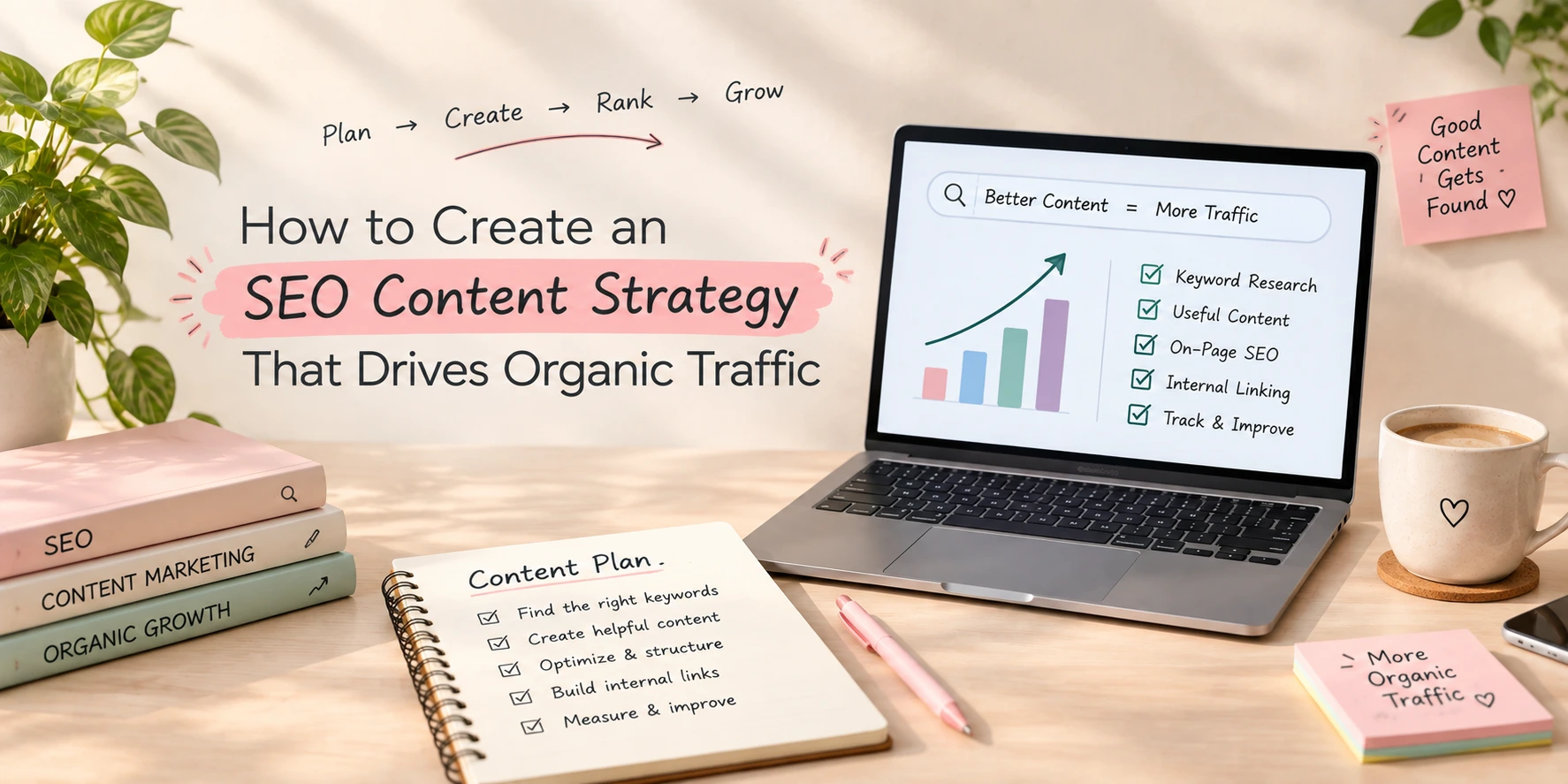
How to Create an SEO Content Strategy That Drives Organic Traffic
How to Create an SEO Content Strategy That Drives Organic Traffic
Most websites that struggle with organic traffic aren't short on content. They publish regularly, cover popular topics, and still watch traffic stay flat. The usual reason isn't lack of effort; it's that the content isn't connected to anything. Each article gets chosen because it "sounded good," not because it fits into a system built around what people search for, what the business needs, and how pages support one another.An SEO content strategy fixes that. It decides which topics deserve a page, which search intent each page should satisfy, how pages link to each other, and how you'll know whether any of it is working. It's narrower than a general marketing plan and more structural than a content calendar; it connects audience needs, keyword research, intent, page architecture, internal linking, and measurement into one system.
This guide walks through a complete framework for building one:
RESEARCH → CLUSTER → MAP → PRIORITIZE → CREATE → OPTIMIZE → LINK → MEASURE → REFRESH
What Is an SEO Content Strategy?
An SEO content strategy is the plan that decides what a website publishes, why, and in what order based on audience needs and real search demand rather than guesswork.It's easy to confuse with related terms. Content creation is the act of writing or producing a piece. Content marketing is the broader discipline of using content to build awareness and trust across channels, not just search. A content calendar is a scheduling tool; it tells you when something publishes, not why it should exist.
An SEO content strategy sits above all three. It decides which topics matter, which pages target which intent, what gets built first, how those pages connect internally, and how performance gets measured. If you're still building foundational SEO knowledge, it's worth having that grounding first; without it, teams end up with a content calendar full of topics never checked against real demand or intent.
Why an SEO Content Strategy Matters for Organic Traffic
Publishing more content doesn't reliably produce more organic traffic. A strategy exists to prevent the failure patterns that quietly waste content budget:-
Random publishing with no connection between articles
-
Keyword cannibalisation, where two pages compete for the same query
-
Duplicate topics covering the same intent from slightly different angles
-
Content that ranks for the wrong intent and earns clicks that never convert
-
Thin pages built to hit a keyword instead of answer a question
-
Weak internal linking that leaves strong pages isolated
-
Chasing high-volume keywords with no realistic path to ranking
-
New content that ignores what's already published and performing
The 9-Step SEO Content Strategy Framework
Everything below runs on one operating sequence: RESEARCH → CLUSTER → MAP → PRIORITIZE → CREATE → OPTIMIZE → LINK → MEASURE → REFRESH. Each stage answers a specific question and produces something concrete.1. RESEARCH: Understand Your Audience, Business, and Search Demand
Don't open a keyword tool first. Start with the business: what it sells, who buys it, what problems those buyers have, and their path from "I have a problem" to "I chose a solution." Then review what's already on the site, what competitors cover, and the intent surrounding the topic.Keyword research fits inside this stage it doesn't replace it. Tools tell you what people type; they don't tell you what matters to your business. DSS's guide on how to do keyword research for SEO covers that process in depth; this framework picks up where that leaves off and turns those opportunities into an actual content system.
2. CLUSTER: Group Keywords Into Topics and Search Intent
Individual keywords rarely deserve individual pages. Related searches, different phrasings, questions, and modifiers around the same need usually belong to one topic, grouped by shared intent rather than shared words.A cluster typically has one primary topic, several supporting keywords, and a set of related questions. "Email marketing tools," "best email marketing software," and "email marketing platforms compared" likely belong to one commercial page, not three competing articles. A separate page for every keyword variation is one of the fastest routes to cannibalisation, with pages splitting the same relevance and ranking against each other instead of the competition.
3. MAP: Assign Keywords and Topics to the Right Pages
Search intent should decide page type before anything else does:-
Informational intent → guide or blog article
-
Commercial investigation intent → comparison page or buyer's guide
-
Transactional intent → product or service page
-
Local intent → location or service-area page
4. PRIORITIZE: Decide What Content to Publish First
A keyword list with a hundred ideas doesn't mean a hundred articles deserve to be written this quarter. This is where strategy actually happens; everything before it was research. Weigh each topic against:-
Relevance to the business and audience
-
How realistic the intent is to satisfy well
-
Business value leads, revenue, or a meaningful next action
-
Ranking opportunity given competition and current site authority
-
Search demand (worth considering, but never the only factor)
-
Content effort required to do it properly
-
Existing topical authority on adjacent subjects
-
Potential to support other pages in the same cluster
-
Conversion potential
5. CREATE: Build Content That Satisfies Search Intent
Start writing only once topic, intent, page type, and priority are decided. Before drafting, check what currently ranks for the target query: what angle those pages take, what they cover well, and what they skip or explain poorly.That gap is where information gain lives: the part your page adds that existing results don't already cover: a clearer explanation, a more complete example, a missing step, a more honest answer. Depth matters less than usefulness; a shorter page that actually resolves the problem beats a long one that restates common knowledge. Support the core answer with real examples, FAQs where they genuinely help, and visuals that clarify rather than decorate.
6. OPTIMIZE: Improve Every Page for Search and Users
On-page optimisation should make a page clearer, not manipulate rankings. That means a descriptive title and H1, a logical H2/H3 structure that mirrors how someone would actually read the answer, an accurate meta description, clean URLs, alt text that describes images instead of stuffing keywords, and internal links with descriptive anchor text instead of "click here."Keyword usage should read naturally, using the terms real searchers and related entities actually use not a fixed density target. Google's Search Central guidance is consistent here: content built mainly to please an algorithm rather than a reader tends to underperform over time.
7. LINK: Build a Strategic Internal Linking System
Internal linking is often treated as an afterthought. Treat it as infrastructure instead. Internal links tell search engines which pages matter most, help users find related content, and pass relevance between pages in the same cluster.A simple structure: one pillar page covering a broad topic, several supporting pages covering subtopics, and contextual links running both ways between them. When you publish something new, link it from older related pages and back to the pages it depends on. Use descriptive anchor text, and skip links that aren't genuinely relevant.
8. MEASURE: Track Whether the Strategy Is Working
Rankings alone don't tell you if a strategy is working. Search Console is the primary tool: track impressions, clicks, CTR, and average position by query and landing page, alongside organic traffic and, where relevant, conversions.The useful signals come from patterns, not single numbers:
-
High impressions, low clicks — the page ranks, but the title or description isn't earning the click
-
Clicks with no conversions — traffic is landing against the wrong intent, or the page lacks a next step
-
Rising impressions, flat clicks — visibility is building ahead of rankings; worth watching, not panicking over
-
Falling impressions on a strong page — check for content decay before traffic drops further
9. REFRESH: Improve, Update, Consolidate, or Remove Content
Publishing isn't the finish line. Content decays: competitors publish stronger resources, information ages, and intent shifts. Revisit pages based on evidence, not a calendar reminder.Update a page when it's losing impressions or clicks it used to earn, missing something competitors now cover, or its intent no longer matches what's ranking nearby and strengthen its internal links as related content gets published. When pages overlap and compete for the same intent, consolidate them into one stronger page and redirect the weaker one. Remove content only when there's a clear reason: no demand, no business purpose, not worth fixing. Refreshing purely because content is old wastes time; a targeted update would be better.
How to Build an SEO Content Strategy for a New Website
The framework doesn't change; for a new site, expectations should. New domains rarely win visibility for competitive terms quickly, so foundational structure matters more than volume early on.-
Define audience and business goals
-
Build a seed list of core topics
-
Research keywords within those topics
-
Identify realistic opportunities given current site authority
-
Group topics into clusters
-
Map keywords to page types
-
Prioritise foundational, business-critical content first
-
Publish supporting content around it
-
Build internal links between them
-
Measure early signals in Search Console
-
Improve based on what the data shows
SEO Content Strategy for Different Types of Websites
Local business — Structure around service + problem + location + audience: "AC repair for apartments in [city]" beats a generic "AC repair" page competing nationally.Service business — Combine the problem, the service, commercial intent, and demonstrated expertise; comparison and process pages tend to outperform generic "about our service" pages.
E-commerce — Structure around category, product, attribute, and use case; "waterproof phone case for hiking" targets a sharper intent than "phone cases" alone.
Educational website — Centre content on the course or subject, the questions learners actually ask, and the outcome they're working toward.
Blog or publisher — Build around the problems, comparisons, and questions the audience searches for, connected into clusters rather than published as isolated posts.
How to Create an SEO Content Calendar
A content calendar should record decisions already made in the strategy above, not set an arbitrary publishing frequency. Useful fields: topic, primary keyword, search intent, page type, cluster, priority, audience, internal links planned, status, and publish or update date. Keep it simple enough that one row tells someone exactly what to write and why.Common SEO Content Strategy Mistakes
Most of these come from skipping a stage in the framework above:-
Publishing without keyword research
-
Choosing topics by search volume alone
-
Ignoring search intent
-
Targeting highly competitive keywords too early
-
Creating multiple pages for the same intent
-
Publishing unrelated topics with no cluster logic
-
Writing only blog content while ignoring commercial and service pages
-
Ignoring what's already published and performing
-
Weak or missing internal links
-
No prioritisation, treating every topic as equally urgent
-
No measurement process
-
Never refreshing older content
-
Writing for algorithms instead of the person searching
-
Producing high volumes of shallow content with no real information gain
-
Losing sight of business value in favour of traffic for its own sake
How AI Search Changes SEO Content Strategy
Search increasingly includes conversational and AI-generated answers alongside traditional results. That shifts some tactics, not the underlying goal: content still has to be genuinely useful to the person asking.What tends to help across both traditional and AI-assisted search: clear, accurate, well-structured content; direct answers positioned near the top of a section; comprehensive coverage of a topic and its related questions; original information rather than a rewritten summary of existing pages; and content that's easy to extract and verify.
No one can guarantee inclusion in a specific AI tool's answers, and those systems change often DSS's guide on AI search vs. Google search covers how that landscape has shifted. The durable approach is building content clear and complete enough to be understood and connected to related concepts, regardless of which system reads it.
A Practical 90-Day SEO Content Strategy
Phase 1 (Weeks 1–3): Research and planning audience, business goals, keyword research, SERP analysis, clustering, and keyword-to-page mapping.Phase 2 (Weeks 4–7): Build core content the highest-priority pages carrying the most business and topical weight.
Phase 3 (Weeks 8–11): Build supporting content for long-tail questions and related topics, linked back to the core pages.
Phase 4 (Weeks 12–13): Measure and improve review Search Console data, update underperforming pages, consolidate overlap, and identify the next round of opportunities.
Ninety days is enough time to build a working system and see early signals, but not enough for guaranteed rankings or a fixed traffic number. Treat it as one full cycle of the framework, then repeat it.
SEO Content Strategy Checklist
-
Business goals and audience defined
-
Keyword research completed
-
Search intent identified for each target topic
-
SERPs analysed for existing competition and gaps
-
Keywords grouped into topic clusters
-
Keywords mapped to the right page type
-
Topics prioritised by relevance, opportunity, and business value
-
Content created around genuine information gain
-
Pages optimised for clarity and search
-
Internal links planned within and across clusters
-
Measurement process in place, Search Console at minimum
-
Refresh schedule based on performance evidence, not age alone
Frequently Asked Questions
What is an SEO content strategy?
The plan that decides which topics a website should cover, which page each belongs on, and how those pages connect and get measured based on audience needs and search demand, not guesswork.How do I create an SEO content strategy?
Research your audience and search demand, cluster keywords into topics, map them to the right page types, prioritise what to build first, create content with real information gain, optimise, link, measure, and refresh based on evidence.What should an SEO content plan include?
At minimum: target topics, primary keywords, the intent behind each, the page type it maps to, priority order, planned internal links, and a way to measure results.How does keyword research fit into content strategy?
Keyword research supplies the raw opportunities what people search for and how often. Content strategy decides how those become a coherent set of pages, in what order, and how they connect.How many SEO articles should I publish per month?
There's no fixed number that works for every site. Frequency should follow the priority order from the strategy, not a schedule one well-targeted page usually outperforms several unfocused ones.Should I update old content or create new content?
Both. Update pages losing visibility or missing coverage; create new pages for topics and intents that nothing on the site currently addresses well.How do I measure SEO content performance?
Track impressions, clicks, click-through rate, and average position in Search Console by query and page, alongside organic traffic and conversions where relevant; use the patterns to decide what to fix, not just report numbers.