
How to Rank an E-commerce Website on Google: A Complete SEO Guide

A store owner selling iPhone covers types "cute iPhone 15 case" into Google and lands behind a competitor even though their case is better made and better priced. That gap between a good product and a visible product is what e-commerce SEO closes.
Ranking a store differs from ranking a blog: it needs a homepage, category pages, subcategory pages, product pages, and blog content to each target a different kind of search, all connected in a structure Google can crawl, understand, and trust. Get the structure wrong, and good product descriptions still won't rank; keep the content shallow and a technically clean site won't rank either.
This guide covers how Google evaluates e-commerce sites and what to actually do about it: search intent, keyword mapping, site architecture, category and product pages, internal linking, technical SEO, structured data, authority, and measurement, using a fictional iPhone-covers store as a running example throughout. The same principles apply whether the store sells clothing, electronics, beauty products, or anything else. No tactic here guarantees a first-page ranking; this is which levers actually matter, and why.
How Does Google Rank E-commerce Websites?
There's no single "e-commerce ranking factor." Google weighs relevance and intent, helpful, people-first content (per its helpful content guidance), page quality and trust, site architecture, crawlability and indexability, authority, and user experience together. A well-written page Google can't crawl won't rank; a crawlable page with thin content won't either. Each lever below only works once the others are in place.1. Start With Search Intent, Not Just Keywords
Search volume shows how often a phrase is typed, not what the searcher wants. Match the page type Google expects for a query:| Intent | Wants | Page type |
| Informational | To learn | Blog post, guide |
| Commercial investigation | To compare | Comparison article |
| Transactional | To buy now | Product/category page |
| Navigational | A specific page | Homepage |
2. Perform E-commerce Keyword Research and Keyword Mapping
Discover terms via autocomplete, "People also ask," and the category/filter names shoppers already use. Group them by intent, not shared words, then map each group to exactly one URL; merging or differentiating overlapping pages avoids keyword cannibalisation, where competing pages both rank worse than one strong page would. Prioritise by business value, not just volume. Keyword stuffing doesn't work; aim for coverage of intent, not density of a phrase.Example map: "iPhone cases" → category page. "iPhone 16 case" → subcategory. "clear MagSafe case iPhone 16" → product page. "best iPhone cases for students" → buying guide, linking into the relevant category.
3. Build an E-commerce Website Architecture Google Can Understand
Homepage → Category → Subcategory → Product is the structure Google expects, because it relies on links between pages, not URL structure, to understand what matters, per its ecommerce site structure guidance. A product reachable only via on-site search generally won't be found. Keep click depth low, use descriptive URLs (/product/clear-magsafe-case, not /product/8213), add breadcrumbs, and eliminate orphan pages ones with no internal links pointing to them.iPhone covers example: homepage → iPhone Cases → iPhone 16/15/14 Cases → individual products: H, with a Blog section linking into categories within two or three logical clicks, shopper and crawler both.
4. Create SEO-Friendly Category and Subcategory Pages
Category pages often rank for the highest-volume searches on the site. Each needs unique intro copy (not filler above the grid), a clear title and H1, internal links to subcategories, breadcrumbs, and FAQs only where they answer real questions. A "thin" category page just a grid with the same structure as every other category gives Google no reason to prefer it over a near-identical competitor page.Example: An "iPhone 16 Cases" page opens with a line on MagSafe alignment for that model, not generic filler; that's what differentiates it from the iPhone 15 page.
5. Optimise Product Pages for Google
| Element | Purpose |
| Title/H1, URL | Specific identification |
| Meta title & description | Earns the SERP click |
| Description & specs | Real benefits, not just keywords |
| Images + alt text | Reduce uncertainty; help image search |
| Reviews & FAQs | Social proof, answers real objections |
| Availability & pricing | Required for Product structured data |
| Internal & related-product links | Connects the page into site structure |
6. Create Unique Product Content and Avoid Duplicate Pages
Copy-pasted manufacturer descriptions and near-identical SKU pages compete against each other rather than getting penalised outright; usually, none of them wins. Google's URL structure guidance recommends a separate crawlable URL per variant (colour, size), with the base URL as canonical if using query parameters. A MagSafe case in five colours deserves five linkable URLs, not five full separate product pages for identical products with different packaging.7. Build a Strong Internal Linking Strategy
Internal links tell Google which pages matter: homepage → categories → subcategories → every indexed product, plus blog → relevant categories/products, breadcrumbs everywhere, and contextual links in body copy using descriptive anchor text ("clear MagSafe cases for iPhone 16," not "click here"). Pages with more internal links pointing to them read as more important, so bestsellers should be linked from the homepage or blog content, not buried three clicks deep. Linking helps Google find pages; it won't make a thin one rank.8. Build Topical Authority With Helpful Content
A store with only product and category pages has a ceiling; it can't compete for informational searches or attract links. Buying guides, comparisons, and how-tos fill that gap: informational article → category page → product page. "Best iPhone Cases for Students in India" links into "budget" and "durable" subcategories, which link to bestsellers.9. Optimise E-commerce Images for Search and UX
Product images decide purchases and act as a discovery channel through Google Images and Shopping. Use descriptive filenames (clear-magsafe-case-iphone-16.jpg, not IMG_4821.jpg), accurate (not keyword-stuffed) alt text, compression, modern formats (WebP/AVIF), responsive sizing, and lazy loading below the fold. Real product photography outperforms shared manufacturer stock for both trust and differentiation, and keyword-stuffed alt text reads as spam to screen readers without helping rankings.10. Fix Technical SEO Before Expecting Strong Rankings
Search happens in three stages: crawling, indexing, and serving results per Google's explanation of how Search works. A page stuck at crawling never reaches ranking, regardless of content quality. Checkpoints: current XML sitemap, robots.txt that doesn't accidentally block category/product pages, self-referencing canonical URLs, HTTPS, minimal duplicate URLs, controlled faceted navigation (next section), clean redirects, no orphan pages, mobile usability, and reasonable Core Web Vitals.11. Manage E-commerce Filters, Faceted Navigation, and Duplicate URLs
Filters (colour, size, price) are useful for shoppers but can generate thousands of near-duplicate URLs from one product set, wasting crawl budget and bloating the index. Rule of thumb: a filter combination deserves an indexable URL only if people actually search for it and it shows meaningfully different products ("Nike shoes," not "sorted by price"). Google's faceted navigation guidance recommends the standard & separator and a real 404 for combinations with no matches. For an iPhone covers store, model + colour combinations likely deserve indexable URLs; deep multi-filter stacks generally should canonicalise back to the parent category.12. Use Structured Data Correctly
Schema.org markup (Product, Breadcrumb, Organisation, and genuine review data) helps Google understand a page but doesn't guarantee a rich result or higher ranking; it makes a page eligible, subject to Google's own checks. Never add rating markup that doesn't reflect real reviews on the page; that violates Google's guidelines and risks a manual action.13. Build Trust and E-E-A-T Signals
Because e-commerce ends in a payment and an expectation the product arrives as described, trust matters more here than for most sites. Baseline signals: a real About page, visible contact information, clear business identity, transparent shipping and returns policies, standard privacy/terms pages, secure checkout, authentic (never fabricated or incentivised) reviews, and real product photography. None is individually dramatic, but together they signal a legitimate business worth transacting with and worth linking to.14. Build Relevant Authority and Backlinks
Backlinks remain a signal Google's link analysis systems weigh, but value depends on the linking site's own relevance and credibility. Sustainable paths: digital PR, original resources (a sizing or compatibility guide), niche reviewer coverage, and partnerships. Avoid bought links, link farms, and automated schemes; these violate Google's spam policies and risk a manual action rather than helping.15. Improve User Experience and Conversion Potential
SEO earns qualified visits; conversion optimisation turns them into revenue. Conversion rate itself isn't a confirmed direct ranking factor, but the elements behind it mobile usability, clear navigation, fast pages, frictionless checkout overlap with signals Google does weigh through page experience.16. Keep Product and Category Pages Fresh
For temporary stock shortages, keep the page live and marked out of stock, with a restock notification if possible, rather than removing it and losing accumulated ranking signal. For discontinued products, use a genuine 301 redirect to the closest equivalent, or a helpful page pointing to alternatives, not a dead-ending 404. Review old buying guides periodically for stale model references. Deleting indexed URLs with no plan wastes ranking signal and breaks existing links.17. Measure E-commerce SEO Performance
Search Console shows impressions, clicks, CTR, queries, and indexing status by page; analytics shows organic traffic, product views, add-to-carts, and organic revenue by landing page. Ranking position alone is a vanity metric if it doesn't convert into qualified traffic and revenue reviewed together; a drop with stable impressions but falling CTR points to a title or snippet problem, while falling impressions point to something more structural worth investigating before blaming content.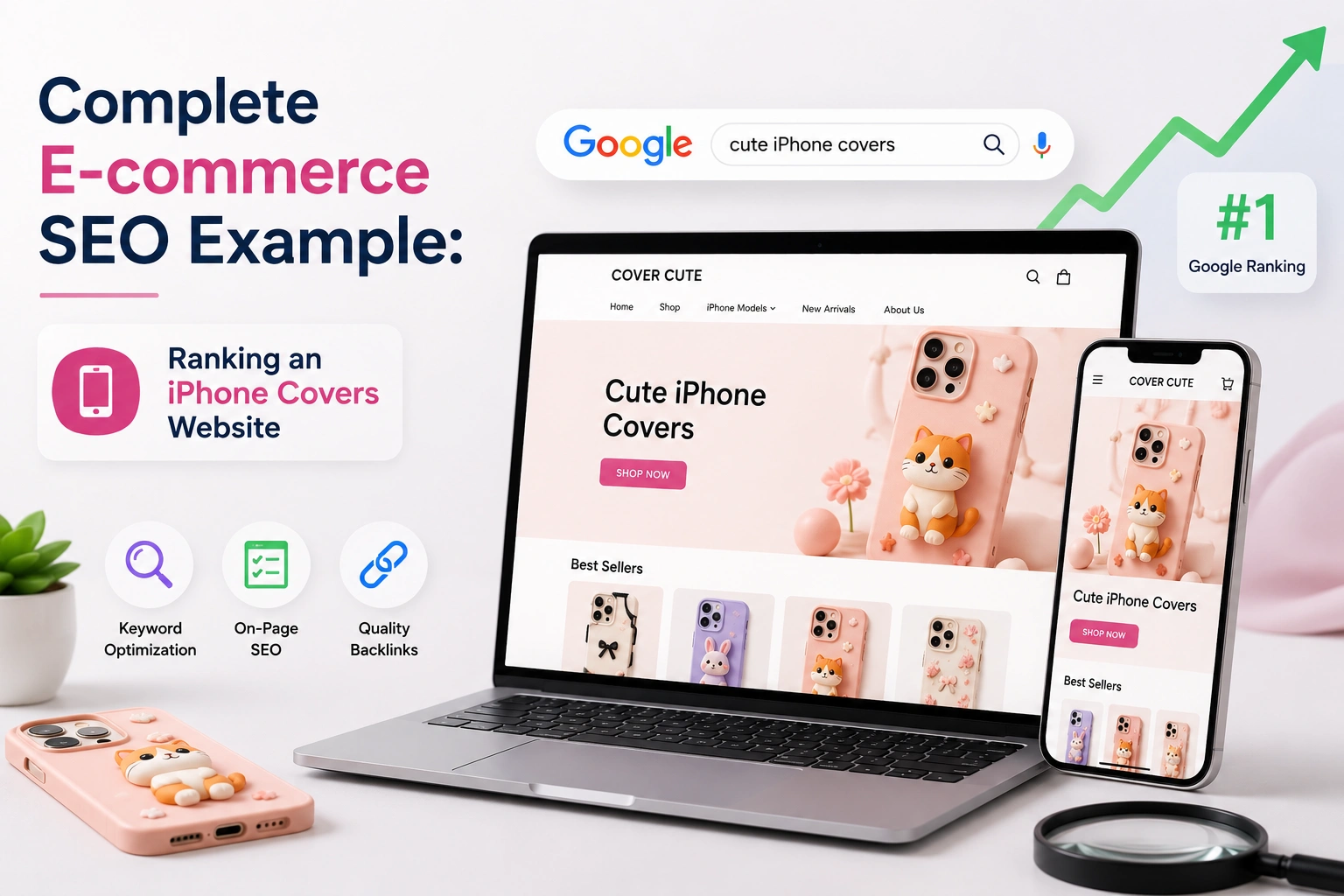
18. Complete E-commerce SEO Example: Ranking an iPhone Covers Website
Putting it together: homepage links to top-level categories, which link to model-specific subcategories (16, 15, 14), each linking to every product; broad terms map to categories, model terms to subcategories, exact searches to product pages, and informational searches to blog content linking downward. Each subcategory gets a differentiated intro; each product page follows the full framework from section 5.A content cluster of buying guides links contextually into categories and bestsellers. A clean sitemap, correct canonicals, and Product/Breadcrumb structured data handle the technical side. Outreach targets relevant tech and lifestyle publications. Search Console and analytics, reviewed together, decide where further investment goes. This shows how the pieces connect, not a guarantee of a #1 ranking; competition and execution still decide the outcome.
19. Common E-commerce SEO Mistakes That Prevent Websites From Ranking
| Mistake | Better approach |
| Targeting one intent with multiple pages | Map each intent to one URL (§2) |
| Thin category pages | Add genuine, category-specific context (§4) |
| Duplicate product descriptions | Write unique descriptions per product |
| Keyword stuffing | Write for the shopper first |
| Poor internal linking/orphan pages | Link deliberately, top to bottom (§7) |
| Indexing unnecessary filter URLs | Canonicalise low-value combinations (§11) |
| Ignoring technical SEO or mobile usability | Fix crawlability first (§10) |
| Low-value AI-generated content | Use AI as a drafting aid, not a replacement |
| Buying low-quality backlinks | Build links through genuine relevance (§14) |
| Ignoring search intent | Match page type to intent first (§1) |
| Deleting URLs with no plan | Redirect or replace thoughtfully (§16) |
| Chasing rankings, not conversions | Track ranking and revenue together (§17) |
20. E-commerce SEO Checklist
-
Research: intent identified and keywords mapped to single URLs
-
Architecture: homepage → category → subcategory → product; no orphan pages
-
Category pages: unique intro copy, clear H1, breadcrumbs, real FAQs
-
Product pages: unique content, real images with alt text, availability/shipping visible
-
Internal linking: blog → categories/products; bestsellers linked prominently
-
Content: buying guides and comparisons feed commercial pages
-
Technical: current sitemap, clean robots.txt, canonicals, mobile-tested
-
Structured data: Product and Breadcrumb markup; genuine reviews only
-
Images: descriptive filenames, compressed, modern formats
-
Authority & trust: relevant backlinks; About/contact/returns pages complete
-
Measurement: Search Console + analytics reviewed together; revenue tracked
Frequently Asked Questions
How long does it take to rank?
There's no fixed timeline, and anyone promising a specific number of weeks is guessing. Meaningful movement for a new or newly optimised store commonly takes several months, depending on domain history, competition, and content quality. Technical fixes tend to show results faster than content or authority gains, which compound gradually.Can a new store rank?
Yes, though newer sites compete more easily for narrow, long-tail searches than broad, high-competition terms a reason to build full architecture and content from the start rather than launching with just a handful of product pages.How do I get products indexed?
Link every product from a category or subcategory page, not just on-site search, which crawlers generally don't use. Submit a current sitemap, use self-referencing canonicals, and check Search Console's coverage report for pages stuck at "crawled, not indexed."Category or product pages which matters more?
They serve different intents and aren't really competing. Category pages capture broader, higher-volume searches, while product pages capture lower-volume but higher-intent ones. A healthy site invests in both.How many products are needed to rank?
No minimum; a small, well-optimised catalogue can outrank a larger one full of thin listings.Does blogging help?
Yes, when built as a content cluster linked into commercial pages, not published in isolation.How important are backlinks?
A meaningful signal, but value depends on the linking site's relevance; a few genuine links beat many purchased ones.Should every product page be indexed?
Not automatically; thin or duplicate variants without independent demand often shouldn't be, to avoid index bloat.How do I prevent duplicate content?
Write original descriptions, canonicalise variants and filtered URLs (§6, §11), and keep URL parameters consistent.What matters most?
Nothing works in isolation, but technical crawlability and architecture come first; every other improvement depends on Google being able to find the page.Putting It All Together
Ranking an e-commerce site is rarely one fix; it's search intent mapped correctly, a structure Google can actually crawl, category and product pages with real substance behind them, deliberate internal linking, technical fundamentals that don't quietly get in the way, and enough trust and authority that Google and shoppers both prefer this store over the next one. Helpful content and structured data support that foundation; they don't replace it.None of this happens in an afternoon, and no single tactic internal linking, structured data, backlinks moves a badly structured site to the first page alone. The practical starting point is the least glamorous one: confirm Google can crawl and index the site, fix the architecture so every product is reachable, then build outward into content, authority, and measurement. Digital Study School's SEO course and e-commerce marketing and dropshipping course cover both in more hands-on depth.