Marketing Automation: What It Is, How It Works, and Where to Start
Most businesses reach the same wall eventually. Leads start coming in from a website form, a WhatsApp inquiry, or a landing page, and for a while someone replies to each one personally. Then the volume grows. Follow-ups get delayed. Some leads never hear back at all. Existing customers get the same generic newsletter as brand-new prospects, because there isn't time to separate them.
Marketing automation exists to solve this. It lets a business build a workflow once triggered by a specific customer action and have it run consistently, whether five people take that action in a month or five hundred. Done well, it doesn't remove people from marketing. It removes repetition from their day, so they can spend more time on strategy, content, and the conversations that genuinely need a human.
This guide covers what marketing automation actually is, how a workflow gets built, what to automate first, what to leave alone, and how to know whether it's working.
What Is Marketing Automation?
Marketing automation is the use of software to carry out repeatable marketing tasks automatically, based on a trigger (an event, such as a form submission) and a set of conditions (rules deciding who receives what). Instead of a person deciding, case by case, who gets an email, the system applies the same logic every time.A single automated email an instant "thank you for signing up" message is a small, useful piece of automation. A marketing automation workflow is larger: a connected sequence of triggers, segments, actions, and conditions that guides a contact through several steps over days or weeks, adjusting based on what they do along the way.
The core building blocks are consistent across almost every use case:
-
Triggers – the event that starts the process
-
Segmentation – grouping contacts so the right message reaches the right person
-
Actions – what the system does (send an email, update a record, notify a team member)
-
Personalisation – tailoring the message using what's known about the contact
-
Lead nurturing – the ongoing process of building trust with a prospect who isn't ready to buy yet
How Does Marketing Automation Work?
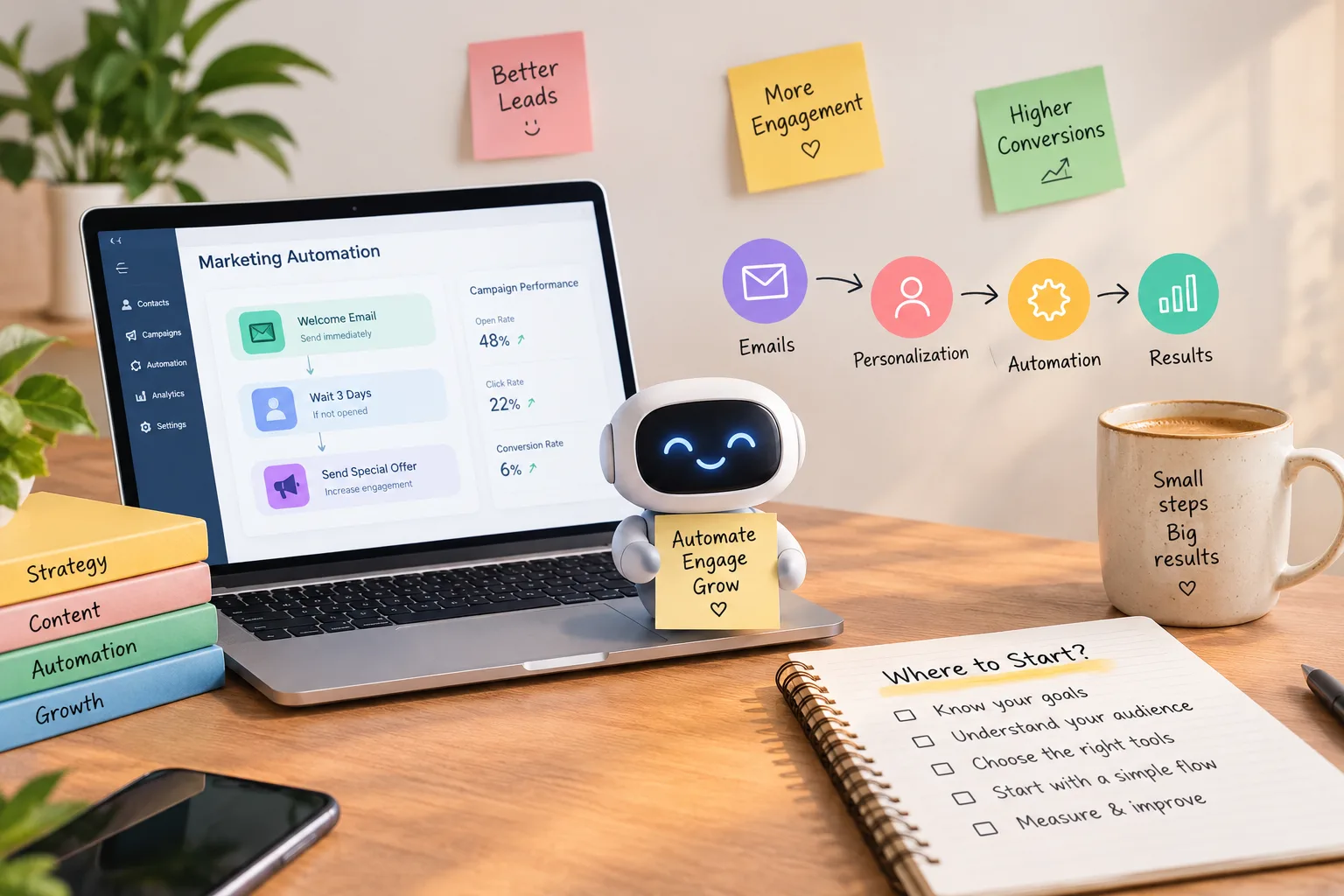
Every automation, from a single welcome email to a multi-week nurturing sequence, follows the same underlying process: Trigger → Segment → Action → Personalise → Conversion → Measurement → Optimisation.Here's what that looks like in practice. A visitor downloads a free guide. That action is the trigger; it tells the system a new lead exists. The lead is placed into a segment based on what they downloaded, so the follow-up actually matches their interest. The system takes an action: it sends a short, useful email on that topic, rather than an immediate sales pitch. The message is personalised with their name and the resource they requested. If they engage, a later email introduces a relevant course or service, with the step aimed at conversion. Throughout, the system tracks opens, clicks, and replies for measurement, and the workflow gets optimised over time based on what the data shows.
Workflows can include conditions ("if the lead opens the email, send X; if not, send Y"), delays, branching paths, and lead scoring. None of this needs to be complicated to be effective. A three-step sequence with a clear trigger will usually outperform an elaborate ten-step workflow nobody has time to maintain.
What Can You Automate in Marketing?
Lead Capture and Follow-Up
When someone fills out a form, downloads a resource, or registers for a webinar, an automated response can confirm receipt and set the next step in motion immediately, instead of waiting for someone to notice the submission.Email Nurturing
Sequences based on a contact's interests or stage in the buying process keep prospects engaged with relevant content, rather than one identical newsletter sent to everyone.Lead Scoring
Assigning points to behaviours like opening emails, visiting a pricing page, or downloading resources helps sales prioritise who to call first. Scoring is a useful signal, not a guarantee; a high score suggests interest, not confirmed intent.Customer Onboarding
Welcome messages, setup instructions, short educational sequences, and follow-up reminders help new customers get value from a purchase without a salesperson checking in manually on every account.Ecommerce Automation
Abandoned cart reminders, purchase confirmations, post-purchase care, relevant cross-sell suggestions, and re-engagement messages are some of the most measurable automations a store can run for a small ecommerce seller as much as a large one.Re-engagement
Identifying contacts who've gone quiet and sending a relevant, low-pressure message gives a business one more chance to win attention back before removing them from active lists.Internal Notifications
Automation isn't only customer-facing. A system can notify sales or support the moment a lead reaches a defined score or takes a high-intent action, so the handoff happens in minutes, not by the end of the day a coordination gap that matters just as much for performance marketing teams working paid channels as it does for organic lead generation.What Should You NOT Automate?
Not every marketing interaction belongs in a workflow, and this is where many businesses get automation wrong. A sensitive customer complaint needs a person who can actually listen and adapt, not a templated reply. A complex sales conversation, a partnership discussion, or a nuanced customer question all depend on context a rules-based system cannot read. Crisis communication and decisions affecting brand reputation require judgment, not a pre-written sequence.The guiding principle: automate repetitive execution, and keep human judgment where context matters. Automation suits consistency at scale. It's poorly suited to empathy, negotiation, or anything where the right response depends on the specific person and situation in front of you.
What Are the Benefits of Marketing Automation?
The practical benefits are straightforward rather than dramatic. Automation saves time on repetitive tasks, so the same message doesn't have to be written and sent each time manually. It keeps follow-up consistent; no lead falls through simply because someone was busy. It gets messages out closer to the moment a contact actually took an action, when relevance is highest.Segmentation and personalisation become realistic at scale, because the system, not a person, does the sorting. Marketing and sales stay better coordinated when a lead's activity is visible to both. And because every workflow has a trigger and a measurable outcome, automation produces more trackable data than manual outreach. None of this happens just by installing software; it depends on the process being sound to begin with.
When Does a Business Actually Need Marketing Automation?
A few practical signs suggest it's time: leads aren't getting followed up with consistently, the marketing team repeats the same tasks every week, customers receive communication that has nothing to do with them, or sales can't tell which leads are worth calling first. If the customer journey has predictable, repeatable steps sign up, receive information, get a follow-up that predictability is exactly what automation is built for.It's equally worth recognising when a business doesn't need a sophisticated setup. A company with few leads and highly customised sales conversations, where every deal is different, may get more value from a simple CRM and a disciplined founder than from an elaborate platform. The right answer depends on lead volume, how repeatable the journey is, and how much of the process benefits from consistency over customisation.
How to Start Marketing Automation Step by Step
Step 1: Define the business goal. Be specific: generate qualified leads, improve follow-up speed, increase repeat purchases, or reduce manual work in one area. A vague goal produces a vague workflow.Step 2: Map the customer journey. Identify the entry point, the key actions people take, the decision points, the moment of conversion, and what happens after they buy.
Step 3: Find repetitive processes. Look across marketing and sales for tasks that happen the same way, every time, for every contact. These are the strongest candidates.
Step 4: Choose one workflow. Resist automating the entire journey at once. Pick a single high-value workflow, often lead follow-up or cart abandonment, and get it right before expanding.
Step 5: Define the trigger. Be precise about the exact event that starts the workflow. "A form is submitted" is clear. "Someone shows interest" is not.
Step 6: Define conditions and segments. Decide who receives which version of the workflow, based on what's known about them at the trigger point.
Step 7: Create useful messages. Prioritise relevance over volume. One well-targeted email usually outperforms three generic ones.
Step 8: Define the desired action. Every workflow needs a clear purpose: a reply, a click, a booking, a purchase, not just "engagement."
Step 9: Connect tracking. Track clicks, conversions, qualified leads, sales, revenue, unsubscribes, and completion rates. Open rates are useful context, not a business outcome.
Step 10: Test before scaling. Test timing, subject lines, segmentation logic, branching, and calls to action on a small group before rolling out fully.
Step 11: Review and optimise. Use the performance data to adjust the workflow; this step never really ends.
Marketing Automation Workflow Examples
Welcome Workflow
Signup → welcome message → a genuinely useful resource → a relevant offer → follow-up.Goal: build early trust. Main metric: engagement with the first resource.
Lead Nurturing Workflow
Lead magnet → educational content → problem-focused content → an offer → sales follow-up.Goal: move a prospect from curious to ready. Main metric: lead-to-qualified-lead rate.
Abandoned Cart Workflow
Cart abandonment → a reminder → helpful information (sizing, shipping, guarantees) → a final reminder.Goal: recover purchases without pressure tactics. Main metric: cart recovery rate.
Customer Onboarding Workflow
Purchase → welcome → setup help → educational content → check-in → feedback request.Goal: reduce early churn. Main metric: activation rate.
Re-engagement Workflow
Inactive contact → a helpful reminder → relevant content → an option to re-engage → suppression if there's still no response.Goal: win back attention or clean the list. Main metric: reactivation rate.
How to Choose Marketing Automation Software
Rather than chasing a "best tool" list, evaluate software against your actual situation. Consider your number of contacts, how complex your workflows need to be, and whether the platform integrates cleanly with your CRM. Look at its segmentation and lead-scoring capabilities, its analytics, and whether it supports e-commerce integration if that's relevant.Ease of use matters more than it seems: a powerful platform your team won't use is worse than a simple one they will. Budget and scalability should be weighed together: a tool that's cheap now but can't grow with your contact list will need replacing later, which has its own cost. Whatever platform you choose, pairing it with the right analytics tools makes the measurement step in the next section far easier. Data handling and privacy requirements are worth checking early, not after a workflow is already built.
A small business with a few hundred contacts typically needs a straightforward platform with solid email and basic segmentation. A larger organisation coordinating marketing, sales, and multiple product lines usually needs something more integrated with its CRM and reporting stack. There isn't one universal right answer; there's a right answer for your current volume and complexity, which will likely change as you grow.
How to Measure Marketing Automation Success
Measurement works best across three levels.Workflow-level metrics show how the mechanics perform: delivery rate, click-through rate, conversion rate, completion rate, and unsubscribe rate.
Lead-level metrics show whether the workflow produces real prospects: qualified leads generated, lead-to-customer rate, and average time to convert.
Business-level metrics connect automation back to outcomes that matter: new customers, revenue attributable to the workflow, customer acquisition cost, and lifetime value.
A workflow with strong open and click rates but no qualified leads or sales is worth investigating rather than celebrating. High engagement and a good business outcome aren't automatically the same thing. Track all three levels together, and be cautious about treating any single metric, especially opens, as proof a workflow is working.
Common Marketing Automation Mistakes
Automating before understanding the customer journey. A workflow built on assumptions rather than an actual map of how customers move tends to solve the wrong problem.Automating too many processes at once. Launching five workflows simultaneously makes it hard to tell which one is working, or fix the one that isn't.
Sending too many messages. Frequency without relevance is one of the fastest ways to raise unsubscribe rates.
Poor segmentation. A single generic message sent to everyone defeats the purpose of automation.
Weak personalisation. Inserting a first name into a template isn't the same as sending something relevant to that person's situation.
No clear goal. A workflow without a defined action it should produce is hard to evaluate.
Ignoring human handoff. When a lead is ready for a real conversation, automation should step back, not keep sending scripted messages.
Failing to test. Launching a workflow at full scale without testing timing or messaging first multiplies any mistake.
Measuring clicks instead of business outcomes. Engagement metrics are a means, not the goal.
Forgetting to update workflows. A sequence built two years ago, referencing an offer that no longer exists, quietly damages trust every time it fires.
How AI Fits Into Marketing Automation
AI works best here as a supporting layer, not a replacement for strategy or judgment. It can help draft content faster, assist with segmentation, surface predictive insights about which leads are likely to convert, prioritise leads for a sales team, and suggest personalisation based on behaviour patterns. Many platforms now use AI to recommend workflow adjustments from performance data, which can speed up the optimisation step described earlier.None of this removes the need for human review. AI-generated content still needs a check against brand voice and accuracy before it goes out. AI-driven lead scoring still benefits from a person sanity-checking results against what sales actually hears in conversations; this matters even more for anything involving sensitive communication or customer data, which are exactly the areas where automated judgment shouldn't run unsupervised. Businesses exploring this further can look at how AI is being applied across digital marketing more broadly and how an AI-supported funnel connects these pieces end to end.
A Simple Marketing Automation Strategy for a Small Business
Consider a hypothetical online education business generating leads through content and social media. Its workflow: lead capture → welcome email → educational resource → segmented follow-up → course information → human counseling → enrollment → onboarding.Each step has a reason to exist. The welcome email and educational resource are automated because every new lead needs the same starting information, regardless of volume. The segmented follow-up runs on which topic the lead engaged with, a pattern the system tracks more reliably than a person juggling dozens of leads. Course information can be automated up to a point but the counselling conversation, where a prospect asks real questions about fit and outcomes, stays human, because that's where judgment and trust matter most.
The metrics worth tracking here are resource engagement, follow-up click rate, and most importantly the rate at which leads reach a human counselling conversation and enrol. This is a fictional illustration, not a claim about any specific business's results, but the structure reflects how email marketing automation is typically layered with human follow-up in practice. For businesses using WhatsApp as a primary channel in markets like India, the same trigger-and-handoff logic applies: automation handles the initial response, and a person takes over once the conversation gets specific.
Frequently Asked Questions About Marketing Automation
What is marketing automation?
Using software to carry out repeatable marketing tasks automatically, based on triggers and conditions, rather than a person handling each one manually.How does marketing automation work?
A trigger starts a workflow. The contact is segmented, an action is taken, the message is personalised, and results are measured and used to improve the workflow over time.What can be automated in marketing?
Lead follow-up, email nurturing, lead scoring, onboarding, e-commerce sequences like abandoned cart recovery, re-engagement campaigns, and internal notifications to sales teams.Is marketing automation only for large businesses?
No. A small business with a repeatable journey and even modest lead volume can benefit from a simple workflow. Platform complexity should match business complexity, not the reverse.What is the difference between email marketing and marketing automation?
Email marketing usually means sending campaigns to a list on a schedule. Marketing automation is broader, triggered, behaviour-based workflows across channels, often connected to a CRM.How do I start marketing automation?
Define one business goal, map the customer journey, identify a repetitive process, and build a single workflow around a specific trigger before expanding.How much does marketing automation cost?
It varies with contact volume, features, and integration needs. Simple tools for small lists cost far less than enterprise platforms built for large, multi-team organisations.How do you measure marketing automation success?
By tracking workflow metrics like conversion and completion rates, lead metrics like qualified leads and time to conversion, and business metrics like acquisition cost and revenue.If you are interested and want to learn in depth, our Digital Marketing Course in Mohali offer practical training in social media marketing, SEO, paid ads, automation, and email marketing, all with 30+ AI tools.