Skill Courses vs College Degrees After 12th: What Should You Choose in 2026?
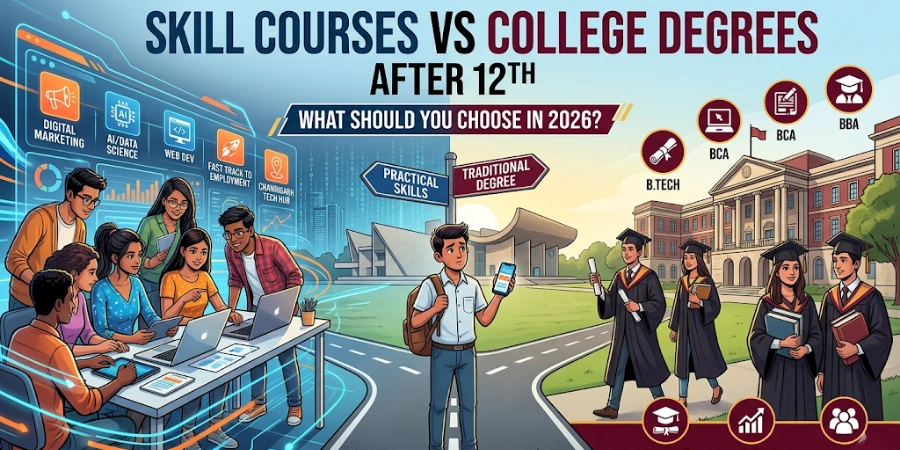
You just finished your 12th exams. Big moment. But now a new tension has started at home, in your head, maybe in your WhatsApp chats too.
"Should I do a degree or a skill course?"
Your parents want you in college. Your friends are talking about the skill course. And you don't know who to listen to.
Don't worry. By the end of this post, you'll have a clear answer that actually fits your life.
First, Let's Be Honest About One Thing
There is no single right answer for everyone.A student who wants to become a doctor needs a degree. A student who wants to edit videos for brands does not.
The mistake most people make is following the crowd instead of thinking about what they actually want. So let's look at both options clearly.
What Is a Traditional College Degree?
A degree is what most people think of when they hear "higher education." You join a college, study for 3 to 5 years, take exams, and get a certificate at the end.Common degree options after 12th:
-
BA (Bachelor of Arts) – 3 years
-
BCom (Bachelor of Commerce) – 3 years
-
BSc (Bachelor of Science) – 3 years
-
BTech / Engineering – 4 years
-
BBA / BCA / Law – 3 to 4 years
-
MBBS – 5+ years
When a Degree Still Makes Sense
Degrees are not useless. They still matter in some situations.-
You want a government job. Bank officer, teacher, civil servant, most of these jobs require a degree. No degree, no application. Simple.
-
You want to study further. Thinking about an MBA or PhD later? You'll need a bachelor's degree first. That's just how it works.
-
Your family situation needs it. For some families, a degree is not just about jobs. It's about respect, marriage prospects, and community standing. That's real, and it matters.
-
You want medicine, law, or academics. These careers have no shortcut. You must go through the formal route.
The Real Problems with Degrees Nobody Talks About
Here's the part colleges don't put in their brochures:Too much theory, not enough practice. You can study marketing for three years and still not know how to run a single Facebook ad.
You can't earn for years. Most students finish a degree at 21 or 22. That's four years of waiting to start earning.
The syllabus is often outdated. Many colleges are still teaching things that companies stopped caring about five years ago.
Too many graduates, not enough jobs. Lakhs of students graduate every year. The job market simply can't absorb everyone.
This is not said to scare you. It's just the truth on the ground.
What Are Skill-Based Courses?
Skill courses teach you how to do something not just read about it.Instead of sitting in classrooms for years, you learn tools, work on real projects, and build a portfolio that you can actually show to employers or clients.
Most skill courses take 3 to 12 months to complete.
Top Skill Courses After 12th in 2026
1. Digital Marketing
Every business today needs customers online, and digital marketing is the most powerful way to reach them.Digital marketing is the process of promoting products and services through online platforms like Google, Instagram, Facebook, YouTube, and websites. It helps businesses connect with the right audience, generate leads, and increase sales using data-driven strategies.
In this field, you learn how to run Google Ads, manage social media pages, create engaging content, write emails that convert, and analyse website data to improve performance. You also understand how search engines work and how brands grow online.
What you'll work on:
-
Real Google Ads campaigns
-
Social media marketing strategies
-
SEO (Search Engine Optimisation) projects
-
Content creation for brands
-
Email marketing campaigns
-
Website traffic and analytics reports
Skills you will develop:
-
Online advertising & targeting
-
Branding & content strategy
-
Marketing analytics
-
Client handling & freelancing skills
-
AI tools for marketing automation
Jobs you can get:
-
Digital Marketing Executive
-
Social Media Manager
-
Performance Marketer
-
SEO Specialist
-
Content Marketer
-
Freelance Digital Marketer
Why it's popular:
Digital marketing is one of the fastest-growing careers because every business is going online. This is one of the best career options after 12th for students from any stream (Arts, Commerce, or Science). You don’t need coding or a technical background. After completing a digital marketing course after 12th, students can start working in companies, start freelancing, or even build their own online business.2. Graphic Design
If you have an eye for visuals, this one is for you.You'll learn to create logos, posters, brand kits, social media creatives, and more.
Tools: Canva, Photoshop, Illustrator
Jobs: Brand Designer, Freelance Designer, In-house Creative
3. Video Editing
Reels, YouTube, ads, and corporate videos, the demand for good video editors has exploded.What you'll learn: Cutting clips, colour correction, adding music, transitions, and effects
Software: Premiere Pro, After Effects, CapCut
The opportunity: Every content creator, brand, and business needs a video editor right now.
4. Web Design and Development
Businesses need websites. Someone has to build them. That someone can be you.You'll learn: HTML, CSS, JavaScript basics, WordPress, and how to design layouts that look good.
Career paths: Web Developer, WordPress Freelancer, Frontend Developer
5. Data Analytics
Companies collect a lot of data. Most of them have no idea what to do with it.Data analysts help businesses understand their numbers and make smarter decisions.
Skills you'll pick up: Excel, SQL, Power BI, dashboards, and reporting
Jobs: Data Analyst, Business Analyst
Why it pays well: Good analysts are rare. Companies pay well to find them.
6. Content Creation
If you're already spending hours on Instagram or YouTube, why not build a career out of it?Content creation is now a real profession. Brands hire content creators. Agencies hire them. You can also build your own following.
What it involves: Writing, filming, editing, storytelling, and consistency
Who it's for: People who love creating and communicating online
7. SEO (Search Engine Optimisation)
SEO is about helping websites appear on the first page of Google.Sounds small. But almost every business in the world wants this. That means steady demand for people who can do it.
What you'll learn: Keyword research, on-page optimisation, link building, Google tools
Best part: It's one of the most freelancer-friendly skills out there.
Degree vs Skill Course: Side-by-Side Comparison
| Factor | Traditional Degree | Skill Course |
| Duration | 3 to 5 years | 3 to 12 months |
| Type of Learning | Theory and exams | Practical and projects |
| Cost | ₹2 to 10 lakhs or more | ₹20,000 to 2 lakhs |
| Job Ready? | Not immediately | Usually yes |
| When You Start Earning | After graduation | During or just after the course |
| Flexibility | Fixed career path | Multiple options |
So Which One Should You Choose?
Here's the honest guide:Choose a Skill Course If:
-
You want to start earning before you're 21
-
You learn better by doing things, not reading about them
-
You're interested in digital, creative, or tech work
-
You want the freedom to freelance or work remotely
-
You don't want to spend years studying before you can start
Choose a Degree If:
-
You want a government job
-
You're planning a postgraduate degree like an MBA
-
You want medicine, law, or a teaching career
-
Your family situation genuinely requires it
The Smart Choice Many Students Are Making: Both
Here's what a growing number of students in India are doing now.They are doing their degree and learning a skill at the same time.
For example:
-
BCom + Digital Marketing: great for business and marketing careers
-
BA + Graphic Design: creative work with a degree as backup
-
BTech + Data Analytics: engineering background with data skills on top
Many students start a skill course in their first year of college. By the time they graduate, they already have work experience, a portfolio, and sometimes even regular clients.
A Note for Parents Reading This
It makes complete sense to worry. This is your child's future.But here's what's changed: skill-based careers in India are not risky experiments anymore. They are real, growing, and well-paying.
Digital marketing managers, video editors, data analysts, and web developers are all in high demand. These jobs exist in every city and for remote work, too.
The job market your child will enter in 2026 is very different from the one you entered. That doesn't mean degrees are useless, but it does mean they are no longer the only option.
Before You Decide, Ask Yourself These Questions
Sit quietly and answer these honestly:-
What kind of work actually excites me?
-
Do I enjoy reading and exams or building and creating?
-
How important is it for me to earn money early?
-
Do I want a job in a company or the freedom to work independently?
-
What kind of life do I want in five years?
Final Thoughts
The world has changed. The path after 12th is no longer one straight road.Traditional degrees still have real value, especially for government jobs, higher studies, and certain professional careers.
But skill courses have opened a completely new route. One that is faster, more practical, and more flexible.
The best students today are not picking one over the other. They're being smart about combining both.
Whatever you choose, make sure it's a decision you've thought through. Not one you made because everyone else was doing it.
You have options. Use them wisely.
Final Advice
The old choice was simple: get a degree or fail in life.The new reality is different: you have options.
Traditional degrees still have value. But they're not the ONLY path anymore.
Skill courses offer:
-
Faster learning
-
Real-world practice
-
Earlier career start
-
More flexibility
The key isn't following what everyone else does. The key is choosing what makes sense for YOUR life, YOUR goals, and YOUR dreams.
Whatever you choose, make sure it's YOUR decision, but not just what others expect.