Top Skill-Based Courses After 10th That Lead to Jobs
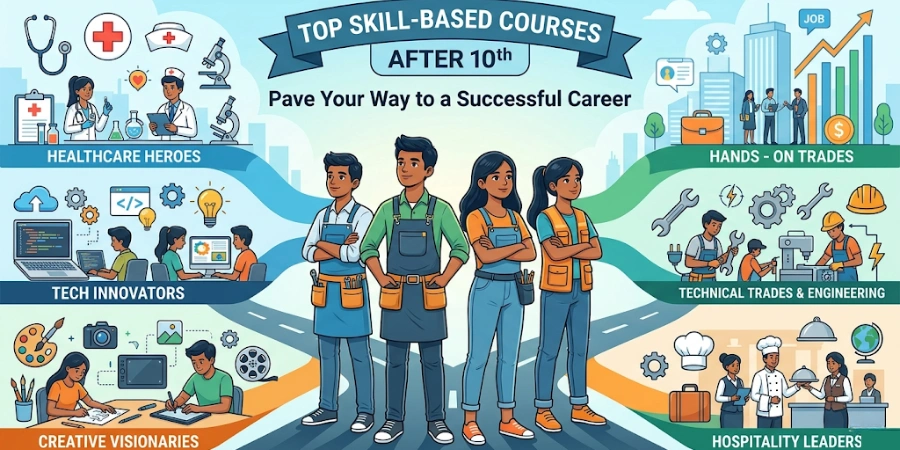
Right after Class 10 results come out, most conversations at home turn to Science, Commerce, Arts or a diploma. Almost nobody asks the other question many students are quietly thinking about: what can I actually learn to do? Marks decide which stream you enter, but they don't tell you what skill you can build with your hands, your thinking or your creativity.
Here's the part that often gets missed: picking a stream and building a practical skill aren't competing decisions. A student can continue Class 11 and 12 normally and, alongside that, start learning something practical, such as a digital skill with real, visible use in businesses today. This article explains which skill-based courses after 10th actually make sense and how to start without unrealistic promises.
What Are Skill-Based Courses After 10th?
A skill-based course differs from a degree or diploma in one key way: it's built around doing, not just studying. A degree gives broad theoretical knowledge over several years, while a skill-based course focuses on one practical area, taught through hands-on work. A diploma sits somewhere in between.
The value of a skill-based course doesn't come from the certificate. It comes from what you can actually show once it's done. A good course should combine:
- Clear conceptual knowledge
- Practical exercises, not just video lectures
- Real or simulated projects
- A portfolio you can show employers or clients
- Feedback from someone who has actually done the work
Before enrolling anywhere, ask what you'll be able to do afterward, not just what you'll be able to say you completed.
Should You Learn a Skill After 10th or Continue With 11th and 12th?
For most students, continuing formal schooling matters, since it keeps options open for college, competitive exams and further specialisation. A skill-based course isn't meant to replace that; it's meant to run alongside it.
Continue school and add a skill if: you want to explore a career direction, you learn better by doing than reading, or you want a portfolio ready before Class 12 ends.
Consider a more focused vocational pathway when: you already have a clear direction, the pathway fits your long-term plans, and the programme is well-structured and properly recognised.
There's no single right path for every student. What matters is that the choice is deliberate, not just something a friend is doing.
Best Skill-Based Courses After 10th
"Best" doesn't mean the same course for every student. It depends on your interests, strengths, learning style, available time, and how willing you are to practise rather than watch tutorials. The courses below focus on digital skills, among the most accessible and job-relevant skill-based courses after 10th right now.
| Course | Main Skills | Entry-Level Roles | Best For |
|---|---|---|---|
| Digital Marketing | SEO, ads, content, analytics | Marketing Executive, Intern | Business-minded learners |
| Website Development | HTML, CSS, JavaScript, WordPress | Junior Developer | Logical, tech-focused learners |
| SEO | Keyword research, on-page SEO | SEO Executive | Research and writing-focused learners |
| Social Media Marketing | Content planning, engagement | Social Media Executive | Communication-focused learners |
| Performance Marketing | Google Ads, Meta Ads, metrics | PPC Executive | Data and testing-focused learners |
| Graphic Design | Layout, colour, branding | Junior Designer | Visually creative learners |
| Video Editing | Cutting, pacing, storytelling | Video Editor | Storytelling-focused learners |
| Affiliate Marketing | Content, SEO, niche audience | Independent/freelance | Patient, content-driven learners |
Each is explained below: what it is, what you'll learn, realistic career paths, and how freelancing works.
Digital Marketing Course After 10th
Digital marketing is the umbrella most other skills here sit under. It means promoting a product, service or brand through online channels, and includes SEO, social media, Google Ads, Meta Ads, content marketing, email marketing, analytics and increasingly AI-assisted tools.
A beginner course typically builds skills in keyword research, content planning, social media management, foundational SEO, setting up simple ad campaigns and reading analytics.
Entry points include Digital Marketing Executive, SEO Executive, Social Media Executive or PPC Executive roles, along with agency internships. Freelancing is realistic for local businesses: managing a shop's Instagram page, writing basic SEO content, or helping an owner post consistently. Results depend on skill level and real work done, not modules watched. This suits students who enjoy business, creativity and online trends.
Website Development: Learn to Make Websites After 10th
Website development means building the websites and applications people use every day. It differs from design, which is about how a site looks, while development is about how it actually works.
A beginner course usually starts with HTML and CSS, introduces JavaScript for interactivity, and covers responsive design so sites work on mobile and desktop, along with WordPress, which lets you publish a site without coding everything from scratch.
Possible paths include Web Developer, Junior Web Developer or WordPress Developer, usually starting as an intern. A short course won't make you a professional overnight, but it gives you real fundamentals and a working website, which matters more in an interview than a certificate alone. This suits students who enjoy computers and step-by-step problem-solving.
SEO Course After 10th
SEO course, or search engine optimisation, means helping a website appear higher and more often in search results. It's why certain pages show up first for a local search or a "how to" query.
A beginner course covers keyword research, on-page SEO, basic technical SEO, content optimisation, internal linking, local SEO and basic analytics. Career paths include SEO Executive, SEO Intern or Content SEO Assistant, often within an agency. Freelancing often starts with keyword research or on-page work for small businesses. SEO is a patient skill: rankings build over weeks and months, and results depend on consistency.
Social Media Marketing Course (SMM) After 10th
SMM course involves managing a brand's presence on platforms like Instagram, Facebook and YouTube: planning content, writing captions, engaging with the community, reading basic analytics and, at a more advanced level, running paid social campaigns.
A common misunderstanding is that SMM is just "posting pictures." In reality, it needs an understanding of audience, platform, content and business goals. Career paths include Social Media Executive, Social Media Manager or Community Manager, alongside brand and agency internships. This suits students who enjoy content, trends and communicating with an audience.
Performance Marketing Course After 10th
Performance marketing Course is advertising measured against specific actions, such as a purchase or a lead, rather than just views. It involves running campaigns on Google Ads and Meta Ads, setting up conversion tracking, and understanding metrics like CPC, CTR, CPL, CPA and ROAS. Much of the skill is testing and optimising based on data rather than guesswork.
Career paths include Performance Marketing Executive, PPC Executive or Paid Media Executive, usually starting under an experienced marketer. This suits students comfortable with numbers who enjoy testing ideas.
Graphic Design Course After 10th
Graphic design Course is visual communication: branding, social media graphics, posters, thumbnails and ads that catch attention and communicate clearly. Common tools include Canva for beginners, and Photoshop or Illustrator for advanced work.
Knowing a tool isn't the same as being a good designer. The real skill lies in principles like layout, colour and typography, built through practice. Career paths include Graphic Designer, Junior Designer or Social Media Designer, and freelancing is realistic once you have a small portfolio of posts, logos or posters for local businesses.
Video Editing Course After 10th
Video content drives a large share of online attention, from YouTube and Reels to short-form ads. Video editing turns raw footage into something watchable: cutting, transitions, subtitles, audio, basic colour correction and, most importantly, pacing that holds attention.
Common tools include Premiere Pro, CapCut for mobile edits, and DaVinci Resolve for colour work. Software is only part of the skill; the real value is storytelling judgement. Career paths include Video Editor, Short-Form Video Editor or Social Media Video Editor, and freelancing is accessible once you have a few strong sample edits.
Affiliate Marketing After 10th
Affiliate marketing works on a simple structure: you promote someone else's product using a unique link, and when someone takes an action through it, such as a purchase, you earn a commission.
It involves content creation, choosing a niche, applying basic SEO or social media skills to attract an audience, and building enough trust that people act on your recommendations, usually through a blog, YouTube channel or social page.
Set realistic expectations: it takes real time to build an audience, affiliate programmes have their own eligibility rules, and early results are usually small. Students who treat it as a long-term skill do better than those expecting fast returns.
Which Skill-Based Course Is Best for You?
- Digital Marketing if you enjoy business, social media and online growth
- Website Development if you enjoy coding and technology
- SEO if you enjoy research, writing and problem-solving
- SMM if you enjoy content, platforms and communication
- Performance Marketing if you enjoy numbers and testing
- Graphic Design if you enjoy visual creativity
- Video Editing if you enjoy storytelling through video
- Affiliate Marketing if you enjoy content and audience building
You don't have to commit to just one forever. Many students explore a related second skill once the first one feels solid.
Best Skill Combination for Students After 10th
You don't need to master eight skills. One or two complementary ones are far more useful:
- Digital Marketing + SEO: strong for organic growth and content strategy
- Digital Marketing + SMM: strong for social media and brand building
- Digital Marketing + Performance Marketing: strong for paid customer acquisition
- SEO + Content Writing: strong for search-focused content work
- Graphic Design + SMM: strong for social media content creation
- Video Editing + SMM: strong for Reels, Shorts and social video
- Website Development + SEO: strong for building and optimising sites together
What Jobs Can You Get After Learning These Skills?
Don't expect guaranteed employment from any course. What's realistic is a mix of internships, junior roles, freelance projects and agency or in-house work as you build experience.
| Skill | Example Entry-Level Role | Freelance Opportunity |
|---|---|---|
| Digital Marketing | Marketing Executive | Managing marketing for local businesses |
| SEO | SEO Executive | Keyword research, on-page optimisation |
| SMM | Social Media Executive | Managing pages for small brands |
| Performance Marketing | PPC Executive | Assisting with ad campaign setup |
| Graphic Design | Junior Designer | Social posts, posters, logos |
| Video Editing | Video Editor | Short-form edits for creators |
| Website Development | Junior Web Developer | Simple sites for small businesses |
| Affiliate Marketing | Usually independent | Niche content with affiliate links |
How to Choose a Good Skill-Based Course
Check the syllabus, whether there are practical assignments and real projects, whether it helps build an actual portfolio, the trainer's real experience, student support, duration and format, internship opportunities, and any placement claims. Read genuine student reviews and check the refund policy too.
A certificate alone rarely convinces an employer or client. What matters is being able to show, "here is what I can actually do."
How to Build a Portfolio Before Your First Job
- Digital Marketing: a mock marketing strategy for a local business
- SEO: optimise a small website or build a keyword and content plan
- SMM: a 30-day content calendar
- Performance Marketing: a hypothetical campaign with the metrics you'd track
- Graphic Design: five to ten sample designs
- Video Editing: a few short-form edits
- Website Development: two or three simple websites
- Affiliate Marketing: a small niche content project, documented
A 30-Day Plan to Start Building a Digital Skill
Week 1: Learn the fundamentals of your chosen skill.
Week 2: Practise the core tools and small tasks.
Week 3: Build one small project from scratch.
Week 4: Turn it into portfolio material and start exploring internships or small freelance opportunities.
This won't guarantee a job in 30 days. The goal is to be more prepared to apply, with something real to show for it.
How Much Can You Earn From These Skills?
Income depends on your skill level, portfolio, practical experience, location, communication ability, the employer or client, freelancing ability and demand at the time. It isn't responsible to promise a fixed number, and any course claiming guaranteed income should be treated with caution. Skill and portfolio come first; income tends to follow demonstrated ability.
Can Students Learn These Skills While Studying Class 11 and 12?
Yes, and for most students this is the sensible approach. School remains important, so the goal is to add a skill alongside it, not replace it. A realistic structure is three to five hours a week. Avoid signing up for multiple courses at once; focus on one skill and let a portfolio build gradually rather than rushing it before exams.
Common Mistakes Students Make When Choosing a Course After 10th
- Choosing a course based only on salary claims, not what's taught
- Picking a course because friends are doing it, not because it fits you
- Collecting certificates without doing any real project work
- Trying to learn too many skills at once instead of going deep in one
- Ignoring communication skills, which matter as much as technical skills
- Expecting freelancing income immediately, before building a portfolio or trust
- Enrolling without checking the actual syllabus or practical component
- Believing placement guarantees without verifying them independently
Frequently Asked Questions
Which skill-based course is best after 10th?
There's no single best course for everyone. It depends on whether you enjoy writing and research (SEO), visuals (design), numbers (performance marketing) or communication (SMM).
Which course after 10th can help me become job-ready?
Digital marketing, SEO, website development, graphic design and video editing all offer realistic entry-level and internship paths once you've built a small portfolio.
Can I learn digital marketing after 10th?
Yes, many beginner-friendly courses need no prior experience, covering SEO, social media, ads and analytics step by step.
Can I learn SEO after 10th?
Yes. It doesn't need advanced technical knowledge, though it needs patience, since rankings improve gradually.
Can I learn website development after 10th?
Yes, starting with HTML, CSS and basic JavaScript. A short course won't make you an expert, but it gives you fundamentals and a first working website.
Can I learn graphic design or video editing after 10th?
Yes, both are beginner-friendly, tool-based skills that improve mainly through practice and honest feedback.
Can I learn these skills while studying Class 11 and 12?
Yes, most students manage this with a few focused hours a week, without treating it as a replacement for school.
Which digital skill is best for freelancing?
Graphic design, video editing, SEO and social media marketing tend to have the most accessible freelance entry points once you have sample work to show.
Want to Learn Digital Marketing Practically?
If the digital marketing path interests you, it helps to learn through structured, practical training rather than scattered videos. Digital Study School's approach covers SEO, social media marketing, Google Ads, Meta Ads, content, analytics, AI tools and basic website understanding, built around real project work. It's meant to give students a working foundation and a portfolio to build on, not a promise of a guaranteed job.
Conclusion
There's no single "best" skill-based course after 10th for every student. The right choice depends on your interest, aptitude, career goals and how willing you are to practise rather than just watch tutorials. Digital marketing, SEO, website development, social media marketing, performance marketing, graphic design, video editing and affiliate marketing are all realistic starting points, but none work without consistent effort behind them.
The most useful thing you can do after Class 10 is pick one skill that genuinely interests you, start building small, real projects, and let your portfolio grow from there. Add a second, related skill once the first feels solid. Formal education and practical skill-building aren't in competition. Done together, they give you more options, not fewer, by the time you finish Class 12.