
WhatsApp vs Instagram for Small Businesses: Which Platform Converts Better in 2026?
Introduction
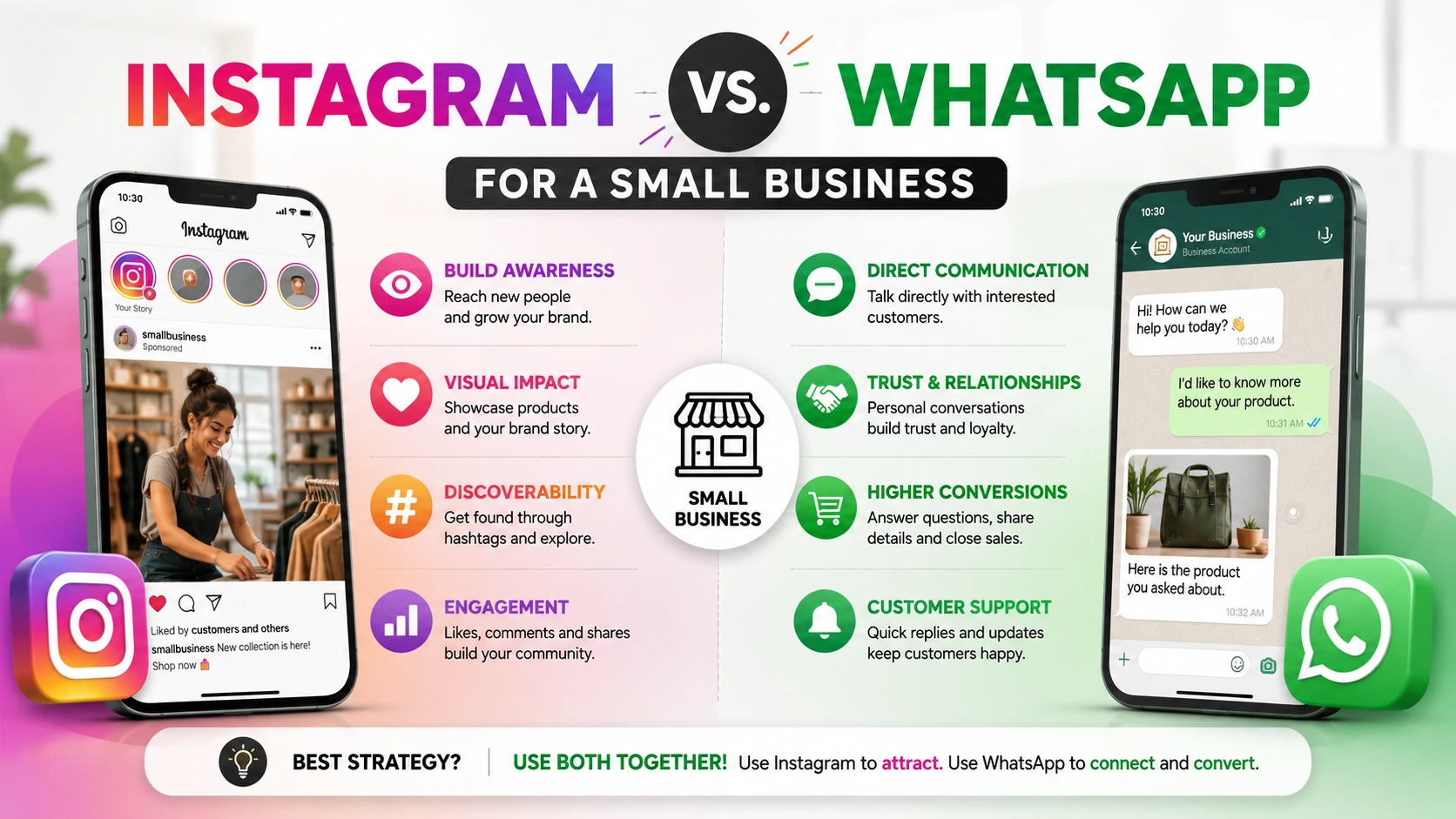
Most small business owners hit the same wall eventually: "Should I focus on Instagram or WhatsApp?" It feels like a decision you make once and live with. Pick wrong, and you assume you've wasted months of effort.Here's the problem with that thinking. Instagram and WhatsApp aren't competing for the same job. Instagram gets people to notice you. WhatsApp gets people to buy from you. Treating them as rivals is like asking whether a shop window or a salesperson matters more; you need the window to pull people in, and the salesperson to close the sale.
Working with small and local businesses across different industries, we've consistently noticed the same pattern: the businesses that struggle aren't choosing the "wrong" platform; they're using the right platform at the wrong stage of the customer journey. This guide fixes that. You'll learn what each platform does well, where it falls short, which one fits your business, and how to connect both into one system that turns strangers into repeat customers.
Quick Answer
WhatsApp converts better than Instagram for most small businesses, but only after Instagram has done its job first. Instagram is built for discovery it helps strangers find you and builds enough trust for them to consider buying. WhatsApp is built for conversion it turns interest into a real conversation, and conversations close far more sales than posts and comments ever will. Businesses relying on Instagram alone often get likes without enquiries. Businesses relying on WhatsApp alone struggle to find new people to message. The businesses that grow fastest use Instagram to create demand and WhatsApp to convert it, treating the two as one connected system rather than separate channels.Why This Comparison Matters
Small businesses don't have unlimited time, staff, or ad budget. Every hour spent on content or replies is an hour taken from running the business, which is exactly why picking the wrong platform, or splitting effort evenly across the wrong ones, is expensive in attention rather than money.Customer behaviour has shifted too. People increasingly prefer messaging a business directly over calling or filling out a form; a private conversation feels faster and less risky than a public enquiry. Meta's own WhatsApp Business data shows more than 175 million people message a WhatsApp Business account every single day, a scale of direct customer conversation that older channels like email and phone simply can't match. That single number explains why "conversations convert" has become the defining idea in small business marketing.
Understanding Instagram for Business
Instagram is a visual discovery platform. People don't go there looking for your business specifically; they go there to be entertained or inspired, and businesses that understand this earn attention instead of demanding it.A Business Profile unlocks Insights, contact buttons, and category labels that build credibility.
Reels are your discovery engine, shown to people who don't follow you yet, making them the best tool for reaching new customers.
Stories build familiarity through daily, low-pressure updates.
Posts and Carousels suit education and storytelling people save and revisit.
Highlights turn your best Stories into a permanent menu, portfolio, or FAQ.
Location tags and hashtags help nearby or interested people find you organically, while
Direct Messages and Broadcast Channels start conversations with people who already know your content.
According to DataReportal's Digital 2026 report, 62.8% of Instagram users say they use the platform specifically to research and follow brands or products a larger share than on any other social network. That matters because it confirms Instagram isn't just for entertainment; people are actively sizing up businesses there before they ever reach out.
Instagram's biggest strength is discoverability. Its biggest weakness is that attention doesn't automatically become income; a Reel can get thousands of views and zero enquiries without a clear next step. Visual businesses (cafés, salons, fashion, interiors, fitness) benefit most; businesses with little visual to show, such as some B2B services, often struggle here.
Understanding WhatsApp Business
WhatsApp Business is a conversation platform, not a broadcasting one. Its purpose isn't to be seen by strangers; it's to have direct, personal conversations with people already interested.A Business Profile displays hours, address, and website in one trustworthy place. The Catalogue lets people browse products inside the chat.
Quick Replies and Greeting Messages save time on repeated questions;
Away Messages manage expectations after hours.
Labels organise enquiries by status: new, quoted, paid, follow-up so nothing slips through.
Broadcast Lists message multiple customers individually without a group chat.
Status works like Stories for existing contacts.
And Click-to-WhatsApp ads, order updates, appointment reminders, and lead follow-up together make WhatsApp the strongest tool for closing a sale and keeping a customer coming back. Meta reported that revenue from Click-to-WhatsApp ads grew 60% year over year in Q3 2025, a clear sign that more businesses are choosing to convert leads inside a chat rather than on a landing page.
WhatsApp's biggest strength is conversion; a real conversation builds trust faster than any amount of content. Its biggest weakness is that it has almost no discovery mechanism; nobody stumbles onto your number by accident. Businesses built on bookings, consultations, or repeat orders (salons, clinics, coaching institutes, real estate agents) get the most value from it.
Instagram vs WhatsApp: Understanding the Customer Journey
Comparing features misses the real point. The better question is where each platform fits in the journey a stranger takes before becoming a loyal customer:Discovery → Interest → Trust → Enquiry → Conversation → Purchase → Follow-up → Loyal Customer → Referral
Instagram owns the first three stages. It's where a stranger discovers you exist, usually through a Reel or hashtag, develops interest by watching more content, and starts building trust through consistency and social proof. Very few people buy from a single post; they quietly evaluate you over several visits.
WhatsApp owns everything from Enquiry onward. Once someone is genuinely interested, they want a direct answer and to feel like they're talking to a real person. This is where price objections get resolved, and trust becomes a decision. After purchase, WhatsApp is also where you send updates, ask for reviews, and remind people about their next visit, quietly turning a one-time buyer into a repeat customer.
The mistake most businesses make is expecting one platform to do the whole job. Instagram was never built to close a sale, and WhatsApp was never built to reach people who don't know you yet. Seen this way, "which platform is better" mostly answers itself.
Instagram vs WhatsApp: Biggest Differences
Reach and Discoverability
Instagram is built for reach; the algorithm actively pushes content to people who've never followed you, especially through Reels. WhatsApp has no organic reach; a customer needs your number or a link first. This is the biggest structural difference between the two.Customer Intent
People on Instagram are often casually browsing until something stops their scroll. People who message you on WhatsApp have already decided to reach out. That's why WhatsApp conversations convert at a noticeably higher rate, even though far fewer people reach that stage.Trust and Relationship Building
Instagram builds trust in public, slowly, through consistency. WhatsApp builds trust in private, quickly, through one honest conversation. Both matter, but they work at different speeds.Support, Automation and Retention
WhatsApp suits support, reminders, and repeat business better because messages land somewhere people check constantly, and Quick Replies and Labels make it manageable for a small team. Instagram DMs can do some of this, but they get buried under everything else in someone's inbox.Local and Community Marketing
Instagram helps local businesses get discovered through location tags and Reels that circulate within a neighbourhood. WhatsApp helps them stay connected to people who already know them; a broadcast list of regulars is often worth more than thousands of followers who never buy.Which Platform Converts Better?
-
Brand Awareness — Instagram wins clearly; Reels and hashtags reach people who've never heard of you.
-
Lead Generation — Instagram generates the lead through content; WhatsApp turns it into a real enquiry you can act on.
-
Sales — WhatsApp converts better; a direct conversation resolves doubts faster than a comment thread.
-
Appointments — WhatsApp wins decisively; reminders sent here get seen and acted on.
-
Customer Support — WhatsApp is built for this: private, direct, and low-friction.
-
Repeat Customers — WhatsApp wins; a quick "your usual?" message outperforms hoping someone sees your next post.
-
Retention — WhatsApp again, because retention depends on personal touch, not content.
-
Word of Mouth — Instagram helps customers show off your business through tags; WhatsApp helps them refer friends directly.
-
High-Ticket Services — WhatsApp wins; big decisions need a conversation, not a caption.
-
Local Businesses — Both matter equally: Instagram brings nearby customers in, WhatsApp keeps them coming back.
Which Platform Works Best for Different Businesses?
Food & Drink: Restaurants and Cafés
Instagram wins new customers here food is visual, and Reels of dishes or a full Saturday morning do the selling for you. A café attracting nearby customers with Reels while managing bookings and large orders on WhatsApp is a strong combination. Common mistake: posting food photos with no way to order; always add a WhatsApp link in the bio and captions.Beauty & Fitness: Salons and Gyms
A salon showcasing before-and-after transformations on Instagram builds proof, while WhatsApp confirms appointments and cuts no-shows. Gyms follow the same pattern: transformation stories on Instagram, membership follow-ups on WhatsApp. Mistake to avoid: posting results with no clear "message us to start yours" prompt.Visual Retail: Boutiques, Jewellery Stores and Retail Shops
These businesses sell desire before product. A jewellery business using Instagram to build demand, then converting serious enquiries on WhatsApp where price and customisation can be discussed privately, consistently outperforms selling through captions. Boutiques and retail shops work the same way. Avoid pricing items only in public comments move that conversation to WhatsApp.High-Value Advice: Real Estate and Interior Design
A real estate agent educating buyers through short videos builds authority before they've even met; WhatsApp is where the serious, personal follow-up sharing listings and negotiating happens. Interior designers follow an identical path: Instagram showcases finished projects, WhatsApp handles consultations. Avoid trying to close a high-value decision inside a DM thread.Healthcare: Doctors and Clinics
Instagram works for health education and building local familiarity; WhatsApp suits appointment booking and reminders, since patients expect privacy and convenience. Common mistake: listing only a phone number, which requires calling during hours, when WhatsApp lets patients book whenever suits them.Knowledge & Services: Coaching Institutes, Consultants and Freelancers
A coaching institute generating enquiries through Instagram videos, then moving serious conversations to WhatsApp for counselling and enrolment, builds more trust than an application form. Consultants and freelancers work the same way: Instagram shows expertise, WhatsApp handles scoping and proposals. Avoid treating Instagram as the place to close deals; its job is convincing someone you're worth talking to.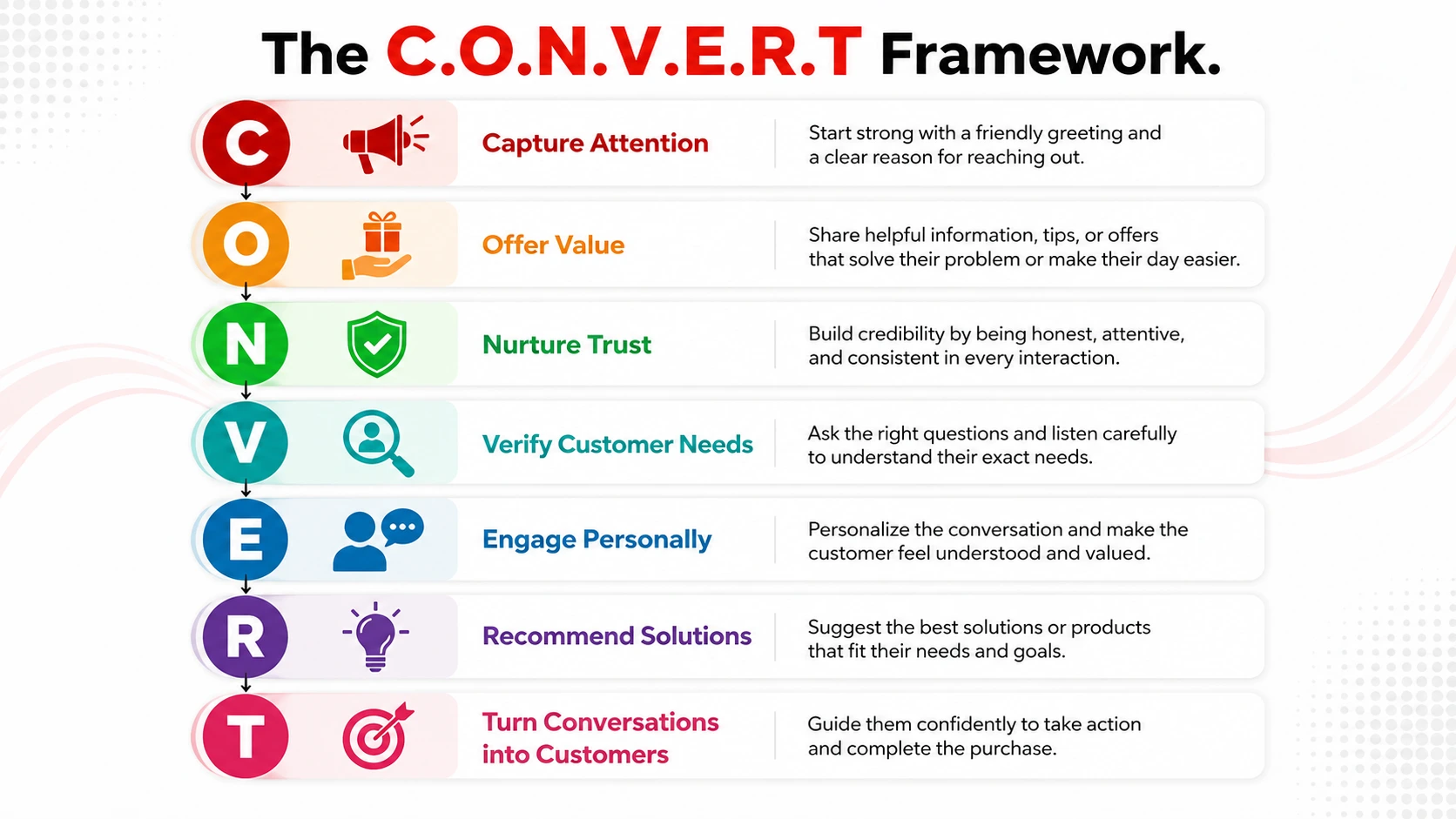
The C.O.N.V.E.R.T Framework
Most advice tells you what to post. This framework explains how attention actually becomes a paying customer.C — Capture Attention. Interrupt the scroll with something specific: a real result, a real process. Vague content gets scrolled past.
O — Offer Value. Give people a reason to keep watching before you ask for a sale: a tip, an honest answer to a question they actually have.
N — Nurture Trust. Trust builds through consistency, not intensity. Showing up reliably over weeks beats one viral post.
V — Verify Customer Needs. Once someone reaches out, ask what they actually need before pitching anything. This habit alone separates businesses that convert from ones that just quote a price.
E — Engage Personally. This is where WhatsApp takes over. A real, unhurried conversation turns interest into confidence.
R — Recommend Solutions. Only after understanding the need should you recommend a specific product or package it converts far better than a generic offer.
T — Turn Conversations into Customers. Make the next step effortless a clear price, a simple booking link so the customer never has to chase you.
When Instagram Is the Better Choice
Reach for Instagram first when building brand awareness, launching a product, growing a following from scratch, developing brand personality, telling your story creatively, or trying to be discovered by people who don't know you yet.When WhatsApp Is the Better Choice
Move to WhatsApp when the conversation involves bookings, consultations, high-ticket decisions, customer support, order follow-up, repeat purchases, appointment reminders, or anything depending on an ongoing relationship rather than a one-off post.Why Smart Businesses Use Both Together
Instagram creates attention. WhatsApp creates conversations. Conversations create customers, who become repeat buyers and eventually refer friends, restarting the cycle with almost no extra effort. Businesses that focus only on followers often struggle to generate enquiries, because followers alone don't pay bills. Businesses that focus only on WhatsApp often run out of new people to talk to, because nothing is bringing strangers in. A common mistake is treating this as an either-or decision when it was always meant to be a handoff: Instagram opens the door, WhatsApp walks the customer through it.Instagram + WhatsApp Sales Funnel
Instagram Reel introduces your business to someone new. Profile Visit happens if it earns enough interest. Call-to-Action tells them exactly what to do next, usually "message us on WhatsApp." WhatsApp Click moves them into a private space with much higher intent. Conversation is where real questions get real answers. Trust builds as you help rather than just sell. Quotation gives a clear price once you understand their needs. Purchase happens once trust and clarity align. Follow-up shows you care beyond the sale. Review comes naturally when a customer feels looked after. Referral happens when they forward your number to a friend. Repeat Customer is the outcome of doing this consistently and usually where the real profit lives.Common Mistakes Businesses Make
-
Posting without a next step — views without enquiries. Add a clear call-to-action in every caption.
-
Only listing a phone number — calling feels intrusive. Use a Click-to-WhatsApp link instead.
-
Replying too slowly — interest fades fast. Set up Quick Replies and Away Messages.
-
Selling in the comments — public replies feel awkward and get missed. Move pricing to WhatsApp.
-
Posting inconsistently — audiences forget businesses that vanish for weeks. Aim for a sustainable rhythm.
-
Chasing followers as the finish line — followers who never enquire don't grow a business. Measure conversations started instead.
-
Never organising WhatsApp leads — enquiries get lost. Use Labels for new, quoted, and repeat customers.
-
Sounding scripted — customers notice a copy-paste template. Personalise replies with their name and question.
-
No follow-up after a "no" — timing was often the real issue. Follow up politely a few days later.
-
Ignoring Stories and Status — these build familiarity but get skipped. Use both for quick daily visibility.
-
Never asking for reviews or referrals — happy customers rarely offer these unprompted. Ask right after a good experience.
-
Running both platforms as disconnected efforts — every piece of content should lead somewhere, usually to WhatsApp.
Best Practices for Higher Conversions
Do a small number of things consistently rather than everything at once. Keep your Instagram bio link pointed straight at WhatsApp so interested visitors never search for how to contact you. Reply to enquiries within a few hours; where possible, response speed affects conversion more than almost anything else. Use Labels or a simple spreadsheet to track where each lead is, because forgotten follow-ups are lost sales. Record short, honest videos rather than polished but generic ones; specificity converts better than perfection. And occasionally review your last twenty WhatsApp conversations to see exactly where customers hesitate; that's usually the fastest thing you can fix. Our WhatsApp Marketing Guide and Instagram Marketing Guide go deeper into building each of these habits step by step.30-Day Marketing Plan
Week 1 — Foundation. Clean up your Instagram Business Profile and WhatsApp Business Profile. Add Quick Replies, a Greeting Message, and a Click-to-WhatsApp link in your bio.Week 2 — Content Rhythm. Post consistently, focusing on Reels that show real work or results. Reply to every DM and comment personally.
Week 3 — Conversation Quality. Audit how you're responding on WhatsApp. Introduce Labels and follow up with anyone who went quiet.
Week 4 — Retention. Message past customers with a simple check-in or offer. Ask recent happy customers for a review or referral, and note which content generated the most genuine conversations.
Future of Instagram and WhatsApp Marketing
Both platforms are moving toward AI-assisted, automated, and more personalised communication. Instagram is investing in AI content tools and smarter DM automation for lead capture, while WhatsApp continues expanding catalogue and automation features that let small teams handle more conversations without losing the personal feel. Customers expect faster, more relevant responses, and businesses that combine helpful automation with genuine human follow-up will have the advantage. Automation without a human touch, however, tends to erode the trust that made messaging effective in the first place. A broader Social Media Marketing Guide or AI Marketing Guide is worth exploring if you want to prepare for this shift properly.Key Takeaways
-
Instagram builds awareness and trust; WhatsApp builds conversations and conversions.
-
Comparing features matters less than understanding the customer journey.
-
Reels are Instagram's strongest tool for reaching new customers.
-
WhatsApp has almost no organic reach, but the highest conversion intent of any channel.
-
High-ticket and appointment-based businesses depend heavily on WhatsApp.
-
Visual, discovery-driven businesses depend heavily on Instagram.
-
The C.O.N.V.E.R.T framework works because it mirrors how trust actually forms.
-
Every piece of Instagram content should lead somewhere, usually WhatsApp.
-
Response speed and follow-up consistency affect conversions more than content volume.
-
Businesses using both platforms together consistently outperform those using either alone.
Frequently Asked Questions
Is WhatsApp better than Instagram for small businesses?
Neither is universally better; WhatsApp converts enquiries into sales more effectively, while Instagram is better at generating those enquiries in the first place.Can I run a small business using only WhatsApp?
Yes, if you have a steady source of new contacts, such as local referrals. Without that, you'll eventually run out of new people to message.Can I run a small business using only Instagram?
Yes, but expect lower conversion rates, since many customers hesitate to finalise purchases through comments or slow DMs.How do I add a WhatsApp button to my Instagram profile?
Add your number as your contact option in Instagram Business Profile settings, and include a Click-to-WhatsApp link in your bio.Do I need the WhatsApp Business app or the API?
Most small businesses only need the free app; the API is built for larger volumes and advanced automation.How often should a small business post on Instagram?
Consistency matters more than frequency a realistic, sustainable schedule outperforms sporadic bursts.Is Instagram or WhatsApp better for appointment bookings?
WhatsApp, because reminders are seen quickly in a space customers already check constantly.How do I get more enquiries on Instagram?
Focus on Reels showing real work or results, and always end with a specific call-to-action.Why aren't my Instagram followers turning into customers?
Followers indicate interest, not intent. Without a clear next step, most simply keep scrolling.Should I reply to comments or move the conversation to WhatsApp?
Acknowledge the comment briefly, then invite the person to WhatsApp for anything involving price or personal details.Is Click-to-WhatsApp advertising worth it for small businesses?
Often yes it sends interested people straight into a conversation instead of a landing page, shortening the path to a sale.How do I know whether to prioritise Instagram or WhatsApp?
If your biggest challenge is being found, prioritise Instagram. If it's closing enquiries you already have, prioritise WhatsApp.Conclusion
If people don't yet know your business exists, prioritise Instagram, the stronger tool for discovery and building an audience from nothing. If you already get enquiries but struggle to convert them, prioritise WhatsApp, the stronger tool for trust, follow-up, and closing sales. If you're serious about sustainable growth, use both, deliberately connected, rather than treating them as competitors.If you are interested and want to learn in depth, our Digital Marketing Course in Mohali offer practical training in social media marketing, SEO, paid ads, automation, and email marketing, all with 30+ AI tools.
The businesses that win in 2026 won't be the ones with the most followers or the most messages sent. They'll be the ones who understood that Instagram opens a door and WhatsApp walks the customer through it. Start this week: check whether your Instagram bio actually leads somewhere useful, and check whether your last ten WhatsApp enquiries got the follow-up they deserved. Small fixes like these, applied consistently, are what separate businesses that grow from businesses that just stay busy.