Why Is My Social Media Not Getting Engagement
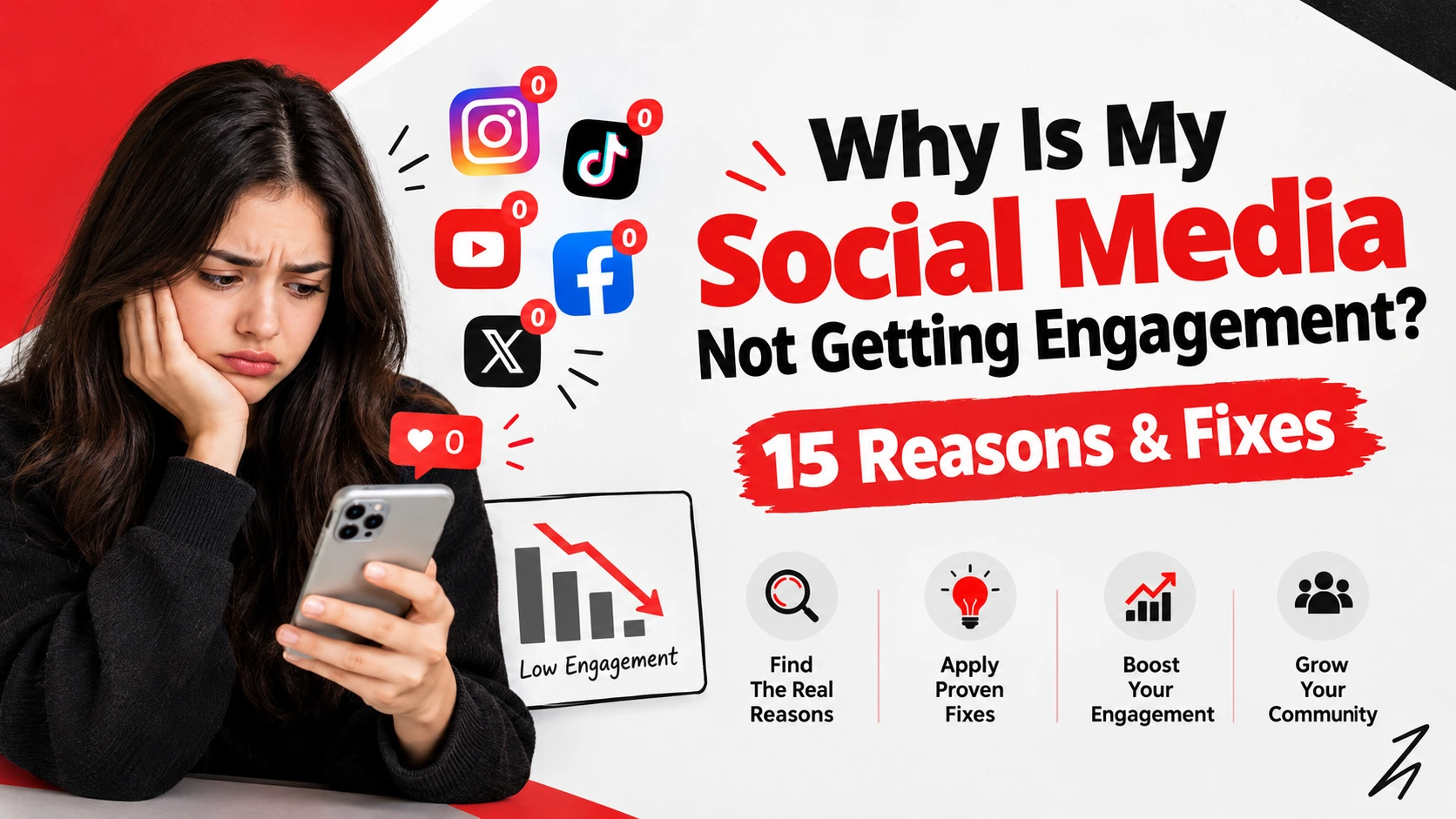
If your posts go out but nothing comes back barely any comments, few saves, likes that feel like an afterthought the honest answer is rarely "the algorithm hates you." Low engagement is almost never one universal mistake. It's usually a breakdown at one specific stage of a process: people don't see the content, don't stop for it, don't feel anything toward it, or have no reason to act on it. Why Is My Social Media Not Getting Engagement? 15 Reasons & Fixes
Direct answer: Your social media isn't getting engagement because something is breaking down at one of five stages: reach, attention, interaction, relationship, or action. Reach problems are about distribution. Attention problems are about hooks. Interaction problems are about relevance. Relationship and action problems are about trust and follow-through. Fixing engagement starts with identifying which stage is actually broken, not changing everything at once.
This matters because reach and engagement measure different things. A post can reach thousands and still get almost no engagement, while another reaches far fewer people but earns a disproportionate number of comments and saves. Treating both problems the same way "just post more" is why many accounts stay stuck. Below is a way to diagnose exactly where content is breaking down, fifteen specific reasons engagement stalls, and what to do about each one.
What Does Low Social Media Engagement Actually Mean?
Engagement is usually measured through likes, comments, shares, saves, replies, profile visits, link clicks, video completion, and new follows.Reach is how many people were shown your content.
Engagement is what a portion of those people chose to do about it, a different number entirely.
A post with 10,000 views and 40 interactions has a low engagement rate. A post with 400 views and 60 interactions has a high one, and arguably represents a healthier relationship with the audience despite the smaller numbers. That's why comparing follower counts across accounts is often misleading: a local business with 300 engaged followers who ask questions and book consultations is stronger than a page with 20,000 disengaged followers from a giveaway. What matters is the ratio of meaningful action to people actually reached.
The Social Media Engagement Funnel
Reach → Attention → Interaction → Relationship → Action-
Reach — Is content being distributed at all?
-
Attention — Does it make someone stop scrolling?
-
Interaction — Does it give a reason to comment, save, or share?
-
Relationship — Does it build enough trust that people return?
-
Action — Does that relationship lead to a click, follow, message, or sale?
| What you're seeing | Possible problem | What to investigate |
| Few people see posts at all | Reach/distribution issue | Posting consistency, format choice, platform fit |
| Good reach, few likes or comments | Attention/relevance issue | Hook strength, topic relevance |
| Interaction exists, but no repeat engagement | Relationship issue | Content variety, personality, responsiveness |
| Engagement exists, but no clicks or replies | Action/conversion issue | Bio clarity, CTA relevance |
15 Reasons Your Social Media Isn't Getting Engagement
1. You're Creating Content for Yourself, Not Your Audience
Feeds full of announcements and "we're excited to share" posts matter to the business, not the follower.Spot it: count how many recent captions start with "we" versus addressing a reader problem.
Fix: reframe around audience questions; a gym posting "why your shoulder hurts after bench press" outperforms "new equipment arrived."
Track: comment sentiment and save rate.
2. Your Hook Doesn't Give People a Reason to Stop
The first line, frame, or carousel cover doesn't create curiosity fast enough, often because it was written last, as an afterthought. Weak: "Here are 5 tips for social media." Stronger: "The reason your reach dropped isn't the algorithm."Fix: write the hook first.
Track: first-three-second retention on video, scroll-stop rate on static posts.
3. Your Content Is Useful but Too Generic
Advice that's technically correct but broad enough to apply to everyone helps no one specifically. Instead of "engage with your audience more," try "reply to every comment within the first hour; early activity signals relevance and invites more comments."Track: save rate, since people save content they intend to act on.
4. You're Targeting the Wrong Audience
Followers gained through giveaways or broad hashtags often don't match who your current offer serves.Diagnostic: look at who comments most; are they potential customers, or unrelated accounts?
Fix: audit your last 20 followers and adjust topics and language toward the audience you actually want, even if growth slows temporarily.
Track: profile visits and follow-through from people matching your customer profile.
5. Your Content Format Doesn't Match the Message
A dense explanation crammed into one image, or a simple tip stretched into a long video, both fight the format. A step-by-step process usually suits a carousel; a quick opinion suits short video; a detailed case study suits longer written content. No format is universally superior. Track: completion rate for video, swipe-through for carousels.6. Your Posts Are Too Promotional
A feed dominated by offers and "book now" messaging, with little standalone value, causes disengagement. A consultant explaining a genuinely useful framework for free builds more trust and eventually more inquiries than repeated "book a call" posts.Track: compare engagement rate on value-first versus promotional posts.
7. Your Content Looks and Sounds Like Everyone Else's
Templated designs, recycled trends, and repeated industry advice make an account forgettable. Apply Experience + Opinion + Evidence + Specificity: add what you've actually observed, a real opinion, a concrete example, or specific numbers, instead of restating common advice. This isn't a formal ranking formula; it's a practical filter for whether content is worth attention.Track: comment quality; original content invites opinions and questions, not just generic reactions.
8. People Have No Natural Reason to Respond
Comments usually come from an opinion or question, saves from something worth referencing later, shares from something relatable or useful to pass along. Adding "comment below!" to a post with no reason to comment doesn't fix that.Fix: match content to the action you want; state an opinion for comments, give a checklist for saves.
Track: which engagement type is unusually low relative to others; that shows which trigger is missing.
9. You're Publishing but Not Building a Community
Content goes out consistently, but comments go unanswered, and DMs sit unread. Publishing feels like the finish line, but platforms and audiences reward accounts that behave like active participants.Fix: reply to comments within the first hour when possible, and respond to DMs and mentions.
Track: response rate and response time.
10. Your Posting System Is Inconsistent or Unsustainable
Bursts of frequent posting followed by long gaps usually mean the schedule wasn't realistic to begin with. Consistency doesn't mean maximum frequency it means a rhythm you can sustain.Fix: pick a frequency you can maintain for three months, batch content in advance, and build a simple content calendar.
Track: gaps between posts over 90 days, not just posts per week.
11. You're Repeating the Same Content Too Often
The same subjects, formats, or promotional asks on repeat cause audiences to tune out. Build variety on purpose using Educate → Entertain → Prove → Connect → Convert; not every post needs to sell. Track: engagement trend across consecutive posts using the same format; a decline signals fatigue.12. Your Platform Doesn't Match Your Audience
Effort spent on a platform where your audience doesn't spend meaningful time, or doesn't behave the way your content assumes, limits engagement regardless of content quality. Choose platforms based on audience behaviour and buying journey, not habit. A B2B consultancy often does better on LinkedIn, while a restaurant or salon often benefits more from Instagram and Facebook's visual, local discovery behaviour (see how social media marketing helps local businesses).Track: engagement rate and lead quality per platform, not follower count.
13. You're Not Using Analytics to Improve Your Content
Publishing without reviewing what performed, and why, means every post is a guess. Use a simple model for standout posts: Topic → Hook → Format → Message → CTA → Distribution → Result.Fix: review your top three and bottom three posts monthly against this model.
14. You're Measuring Likes Instead of Meaningful Outcomes
Likes are the most visible number, so they get treated as the most important one by default. For a lead-generation business, qualified inquiries matter more than likes. For educational content, saves and shares often reflect real value better than a quick like. For video, watch time usually says more than raw views. No metric is universally most important it depends on the goal.Fix: define the primary metric before publishing, not after.
15. You're Changing Your Strategy Before You Have Enough Evidence
One underperforming post triggers a full overhaul new format, tone, and posting time all at once, which destroys the ability to learn what actually went wrong. Apply an optimisation loop: Test → Measure → Learn → Adjust. Change one meaningful variable at a time and give it enough posts before changing another. Track: keep a simple log of what was tested and the result.How to Diagnose Your Engagement Problem in 15 Minutes
Work through your last 8–10 posts:-
Check reach — flat or falling reach points to a distribution problem, not the individual posts.
-
Check attention — a low reached-to-engaged ratio points to hook or relevance problems.
-
Check interaction type — is one type (comments, saves, shares) unusually low? That shows which trigger is missing.
-
Check profile behavior — are engaged users visiting your profile or following? If not, the relationship stage is weak.
-
Check conversion — are repeat engagers clicking, messaging, or buying? If not, the gap is in your CTA or offer.
Social Media Engagement Audit Checklist
-
Does content address audience problems, not just business updates?
-
Does every post have a genuine hook?
-
Is advice specific rather than generic?
-
Does the audience match your actual customer profile?
-
Does the format suit the complexity of the message?
-
Is the value-to-promotional ratio reasonable?
-
Does content reflect real experience, opinion, or evidence?
-
Does each post give a natural reason to comment, save, or share?
-
Are comments and DMs answered consistently?
-
Is the posting schedule realistic and sustainable?
-
Are topics and formats varied enough to avoid fatigue?
-
Is the platform where your actual audience spends time?
-
Are analytics reviewed on a regular schedule?
-
Is the tracked metric matched to the business goal?
-
Is only one variable being tested at a time?
What to Do If Engagement Suddenly Drops
Before assuming an algorithm shift, check in order of what changed most recently:-
Content change — did format, topic, or posting time shift?
-
Audience change — did a promotion bring in a wave of unrelated followers?
-
Consistency gap — was there an unplanned pause?
-
Seasonal behaviour — does your audience typically engage less at this time of year?
-
Platform shift — has distribution for a specific format changed?
-
Measurement difference — are you comparing like-for-like metrics?
-
Distribution change — was this post shared to fewer channels than usual?
How to Increase Engagement Without Simply Posting More
-
Strengthen hooks before increasing volume.
-
Make advice more specific, with real examples.
-
Re-align content with the audience you actually want.
-
Match format to message complexity.
-
Use a CTA that matches the action the content naturally invites.
-
Spend time actively in comments and DMs.
-
Refresh or repurpose content that already performed well instead of starting from scratch every time.
-
Let analytics guide decisions rather than assumptions.
Instagram vs Facebook vs LinkedIn vs YouTube Engagement
| Platform | Typical audience intent | Content that tends to engage | What to evaluate |
| Discovery, visual inspiration | Carousels, short video, relatable moments | Save and share rate | |
| Local connection, groups | Community posts, discussion-driven content | Comment quality, group shares | |
| Professional insight, credibility | Opinion posts, case studies, commentary | Comments from relevant professionals | |
| YouTube | Intentional, search-driven learning | In-depth tutorials, explainer content | Watch time and retention |
Social Media Engagement for Small Businesses
-
Local service businesses: trust-building content (before/after work, common problem explanations) usually outperforms promotions.
-
Restaurants: in-the-moment visuals and responsiveness to tags beat generic menu posts.
-
Salons: transformation content and public Q&A build more trust than discounts.
-
Real estate: educational content about the buying process often outperforms listing photos alone.
-
E-commerce: user-generated content and real use cases often outperform polished product shots.
-
Professional services: opinion-led, experience-based posts build more credibility than generic tips.
-
Education businesses: specific, teachable breakdowns earn more saves than motivational statements.
-
Coaches/consultants: content built around real client problems resonates more than generic advice.
When Low Engagement Is Not Necessarily a Problem
Low likes don't automatically mean the strategy is failing. For example, a B2B company might publish a technical post that gets only a handful of comments, but two of those commenters turn into real sales conversations. That can matter more than a viral post with thousands of likes and no business relevance.Evaluate engagement against what it's meant to produce: awareness (is the right audience becoming familiar with the brand?), consideration (are the right people visiting the site or asking questions?), leads (are inquiries increasing regardless of like count?), sales (is content contributing to bookings or purchases?), community (is a smaller, loyal audience forming?), and retention (are existing customers staying engaged?). A small number of highly relevant interactions is often worth more than a large number of irrelevant ones.
Frequently Asked Questions
Why is my social media not getting engagement?
Usually because one stage of the reach-attention-interaction-relationship-action funnel is broken, not because of one universal mistake.Why are my posts getting views but no likes?
This typically signals an attention or relevance problem: content is seen but doesn't give a strong enough reason to react.Why do my posts get reach but no comments?
Comments come from opinions or questions. If content invites neither, reach alone won't produce them.Why is my Instagram engagement so low?
Common causes include a weak hook, low content relevance, or a follower base that doesn't reflect your actual audience.How can I increase social media engagement?
Strengthen hooks, be more specific, match format to message, and respond actively in comments and DMs.Why is my social media not growing?
Growth and engagement share many of the same root causes: relevance, hooks, and consistency.Does posting more often increase engagement?
Not by itself. A sustainable, consistent rhythm with strong content usually beats high-frequency posting with weak content.What type of content gets the most engagement?
It depends on platform and audience intent; there's no universally best format, only one that matches your message.Should I focus on likes, comments, saves or shares?
Focus on whichever metric aligns with your goal: saves for reference content, comments for discussion, shares for relatable information.How long does it take to improve engagement?
It varies, but testing one variable at a time over several weeks is more reliable than expecting results from a single change.Final Takeaway
Low engagement is a symptom, not a diagnosis. The path forward is the same regardless of platform or business type: Diagnose → Fix → Measure → Improve. Find the stage where content is breaking down, make one deliberate change, track the right metric, and let evidence guide what comes next. For a structured way to build this into a repeatable system, DSS's social media marketing course and social media strategy guide for small businesses walk through it in more depth.